New planet discoveries suggest low-mass planets are common around nearby stars (w/ Video)
December 14, 2009 By Tim Stephens
New planet discoveries suggest low-mass planets are common around nearby stars

Enlarge

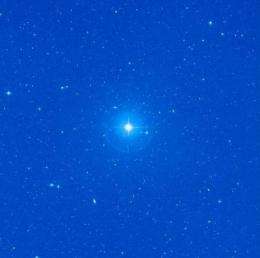
61 Virginis is one of only a handful of truly Sun-like stars that can be seen with the naked eye. Astronomers have discovered three low-mass planets orbiting the star. The image above is from NASA's Sky View.

(PhysOrg.com) -- An international team of planet hunters has discovered as many as six low-mass planets around two nearby Sun-like stars, including two "super-Earths" with masses 5 and 7.5 times the mass of Earth. The researchers, led by Steven Vogt of the University of California, Santa Cruz, and Paul Butler of the Carnegie Institution of Washington, said the two "super-Earths" are the first ones found around Sun-like stars.

"These detections indicate that low-mass planets are quite common around nearby stars. The discovery of potentially habitable nearby worlds may be just a few years away," said Vogt, a professor of astronomy and astrophysics at UCSC.

The team found the new planet systems by combining data gathered at the W. M. Keck Observatory in Hawaii and the Anglo-Australian Telescope (AAT) in New South Wales, Australia. Two papers describing the new planets have been accepted for publication in the .

This video is not supported by your browser at this time.

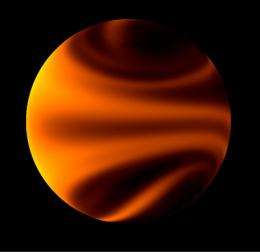
This simulation (above) shows the temperature patterns in the global atmospheric flow on the planet 61Vir b, which is hot enough that it glows. The animation is for one full orbit. The point of view hovers above a single longitude and rotates with the planet. The flow pattern is somewhat reminiscent of the upper atmosphere of Venus. Credit: J. Langton, Principia College.

Three of the new planets orbit the bright star 61 Virginis, which can be seen with the naked eye under dark skies in the Spring constellation Virgo. Astronomers and astrobiologists have long been fascinated with this particular star, which is only 28 light-years away. Among hundreds of our nearest stellar neighbors, 61 Vir stands out as being the most nearly similar to the Sun in terms of age, mass, and other essential properties. Vogt and his collaborators have found that 61 Vir hosts at least three planets, with masses ranging from about 5 to 25 times the mass of Earth.

Recently, a separate team of astronomers used NASA's to discover that 61 Vir also contains a thick ring of dust at a distance roughly twice as far from 61 Vir as Pluto is from our Sun. The dust is apparently created by collisions of comet-like bodies in the cold outer reaches of the system.

"Spitzer's detection of cold dust orbiting 61 Vir indicates that there's a real kinship between the Sun and 61 Vir," said Eugenio Rivera, a postdoctoral researcher at UCSC. Rivera computed an extensive set of numerical simulations to find that a habitable Earth-like world could easily exist in the as-yet unexplored region between the newly discovered planets and the outer dust disk.

According to Vogt, the planetary system around 61 Vir is an excellent candidate for study by the new Automated Planet Finder (APF) Telescope recently constructed at Lick Observatory on Mount Hamilton near San Jose. "Needless to say, we're very excited to continue monitoring this system using APF," said Vogt, who is the principal investigator for the APF and is building a spectrometer for the new telescope that is optimized for finding planets.

The second new system found by the team features a 7.5-Earth-mass planet orbiting HD 1461, another near-perfect twin of the located 76 light-years away. At least one and possibly two additional planets also orbit the star. Lying in the constellation Cetus, HD 1461 can be seen with the naked eye in the early evening under good dark-sky conditions.

The 7.5-Earth-mass planet, assigned the name HD 1461b, has a mass nearly midway between the masses of Earth and Uranus. The researchers said they cannot tell yet if HD 1461b is a scaled-up version of Earth, composed largely of rock and iron, or whether, like Uranus and Neptune, it is composed mostly of water.
New planet discoveries suggest low-mass planets are common around nearby stars
Enlarge

This image from a simulation of atmospheric flow shows temperature patterns on one of the newly discovered planets (61Virb), which is hot enough that it glows with its own thermal emission. A movie of the simulation is posted at the bottom of this story, showing global atmospheric flow for one full orbit of the planet around its star. Credit: J. Langton, Principia College

According to Butler, the new detections required state-of-the-art instruments and detection techniques. "The inner planet of the 61 Vir system is among the two or three lowest-amplitude planetary signals that have been identified with confidence," he said. "We've found there is a tremendous advantage to be gained from combining data from the AAT and Keck telescopes, two world-class observatories, and it's clear that we'll have an excellent shot at identifying potentially habitable planets around the very nearest stars within just a few years."

The 61 Vir and HD 1461 detections add to a slew of recent discoveries that have upended conventional thinking regarding planet detection. In the past year, it has become evident that planets orbiting the Sun's nearest neighbors are extremely common. According to Butler, current indications are that fully one-half of nearby stars have a detectable planet with mass equal to or less than Neptune's.

The Lick-Carnegie Exoplanet Survey Team led by Vogt and Butler uses radial velocity measurements from ground-based telescopes to detect the "wobble" induced in a star by the gravitational tug of an orbiting planet. The radial-velocity observations were complemented with precise brightness measurements acquired with robotic telescopes in Arizona by Gregory Henry of Tennessee State University.

"We don't see any brightness variability in either star," said Henry. "This assures us that the wobbles really are due to planets and not changing patterns of dark spots on the stars."

Due to improvements in equipment and observing techniques, these ground-based methods are now capable of finding Earth-mass objects around nearby stars, according to team member Gregory Laughlin, professor of astronomy and astrophysics at UCSC.

"It's come down to a neck-and-neck race as to whether the first potentially habitable planets will be detected from the ground or from space," Laughlin said. "A few years ago, I'd have put my money on space-based detection methods, but now it really appears to be a toss-up. What is truly exciting about the current ground-based radial velocity detection method is that it is capable of locating the very closest potentially habitable ."

Source: University of California - Santa Cruz (news : web)

4.9 /5 (20 votes)  

Filter


Move the slider to adjust rank threshold, so that you can hide some of the comments.


Display comments: newest first

Mayday
Dec 14, 2009

Rank: 4.8 / 5 (4)
How fascinating. It seems that the discovery of an actual Earth-like planet just might coincide with the complete extinction of our manned space program.

It is truly hard for me to understand how a person can not hunger to begin the work of going out there to visit. Wouldn't today be the best possible day to begin a project that will take hundreds of years and bring an endless flood of technical advancements?
mklnk
Dec 14, 2009

Rank: 5 / 5 (2)
Unfortunately, the only time we come together as nations, let alone as a species, is in response to unprecedented crises. I shudder to think what sort of crisis would lead even a single nation on earth to invest the resources needed to earnestly look for or colonize a nearby habitable world.
ShotmanMaslo
Dec 14, 2009

Rank: 3 / 5 (3)
Great find.
If you think about it, it is not very suprising, considering that our Sun has plenty of planets, with mercury, venus, earth, mars, uranus and neptune falling into this "low-mass" category. I am sure that almost every star has at least one, probably more, planets with similar mass to earth.
pauljpease
Dec 14, 2009

Rank: 4.5 / 5 (2)

Wouldn't today be the best possible day to begin a project that will take hundreds of years and bring an endless flood of technical advancements?


Actually, since it's going to take hundreds of years, shouldn't we spend at least a few decades ensuring that we'll be around when the interplanetary voyage is over? Or else, what's the point? I'm pretty sure the skills of massive international cooperation we'll need to ensure the survival of our civilization will be crucial for any interplanetary mission. Technology is not really the limiting factor for us anymore, it's patience, cooperation, kindness, goodwill, wisdom... basically everything our mothers tried to teach us as children but which we forgot when we became "grown-ups" and thought we were in control.

The "progress NOW" attitude reminds me of my 12 year old student who always wants to fire up the bunsen burner before he remembers to turn on the exhaust fan and put on his safety goggles.
omatumr
Dec 14, 2009

Rank: 3.1 / 5 (8)
If we find that other ordinary stars have Earth-like planets - constructed of elements like Fe, O, Si, Ni and S from the deep interior of a supernova - then the Standard Solar Model of a Hydrogen-filled Sun will be destroyed.

With kind regards,
Oliver K. Manuel
dachpyarvile
Dec 14, 2009

Rank: 5 / 5 (2)
This is very cool information. I am glad that we are finally finding worlds closer in size to earth.

However, we are not even technologically capable of sustained, short-termed interplanetary space flight much less interstellar space flight.

What to do about the radiation, small mass objects slamming into the hulls of one's high velocity ship, and so forth?

We are far from ready for interstellar space. We are not really ready for interplanetary space at this time--but maybe by 2036 we might be ready to go to Mars? Only time will tell.
dachpyarvile
Dec 14, 2009

Rank: 5 / 5 (2)
If we find that other ordinary stars have Earth-like planets - constructed of elements like Fe, O, Si, Ni and S from the deep interior of a supernova - then the Standard Solar Model of a Hydrogen-filled Sun will be destroyed.

With kind regards,
Oliver K. Manuel


Please pardon my apparent ignorance but how does finding that extrasolar planets are composed of similar elements that come from supernovae prove anything of the like?

We already know that supernovae eject this stuff all over the regions of space where they are found. We also know that it is the outer shells that are blown off that contain Si, for example. If it is the outer shells from which the material is derived in solar system formation, how does that relate anything to us of the composition of the cores of supernovae?

By the way, we also know of the existence of Oxygen-Neon stars. These produce O through Si from fusion.
PinkElephant
Dec 14, 2009

Rank: 4.5 / 5 (2)
Wouldn't today be the best possible day to begin a project that will take hundreds of years and bring an endless flood of technical advancements?


I'd say before contemplating any interstellar (or even interplanetary) space travel, we ought to figure out how to reduce the cost of launch to orbit. If we can lower it from $10,000/kg to $100/kg, then we can start making some rapid progress. Until that happens, any and all ambitions of space-faring are nothing but an unsustainable spend-a-thon.

For some time prior to the arrival of Bush' administration, NASA indeed had such a long-term R&D priority set: lowering cost to orbit. They were pursuing it with their X33/Venturestar program, and doing some innovative research. That was promptly scrapped, and replaced by a cockamamie scheme to return to the Moon for permanent settlement, with an eye toward Mars -- using nothing but modernized Apollo-style technology.

I say learn to walk before trying to run!
dachpyarvile
Dec 14, 2009

Rank: 5 / 5 (2)
I'd say, learn a little more about the complex problems involving the X-33 program and find out _why_ the program was doomed to failure. There were many problems, not the least of which was the composition and design of the fuel tank. The program became unworkable, agreement between Lockheed-Martin and NASA broke down and the government vetoed additional funding.

The program was becoming a waste of tax-payer moneys. One of the project personnel testified of the difficulties and it was his testimony that led Congress toward killing the program.

I would have told them to go back to the drawing board and killed the project, too.

One day, I hope that they will return to this program. But, for now, until we develop newer technology to solve problems inherent in the design, the program should remain dead and "tried and true" remains the most feasible to get us into interplanetary space on the "cheap."

Launching from a permanent lunar base would be much cheaper than from earth.
PinkElephant
Dec 14, 2009

Rank: not rated yet
I'd say, learn a little more about the complex problems involving the X-33 program and find out _why_ the program was doomed to failure.


I already know the details. And that was *not* failure. It's normal R&D: when you try to push the envelope, you *will* fail. It's a given, and must be expected. What you gain, though, is the stuff that you learned and built through your failures. And not *everything* about the X33 was a failure, by the way.

The program was becoming a waste of tax-payer moneys.


You mean, a bigger waste than this whole "back to the Moon" nonsense?

But, for now, until we develop newer technology to solve problems inherent in the design...


And how would we do that, without an actual program dedicated to such goals? You can't invent new things when you stick to "tried and true". And oh no, what's currently feasible is not at all "cheap".
PinkElephant
Dec 14, 2009

Rank: not rated yet
When it comes to NASA's job, I view it in the long term as that of being an enabler. NASA (and the government) should invest in projects where the degree of difficulty and uncertainty is too high for the private sector, yet the potential payoffs and enabling technologies are spectacular. NASA should be a catalyst and an incubator, then feed the results to the private sector.

Instead, we have this vision that NASA has to run a grand space colonization program. I'm sorry, but NASA isn't big enough for that. It never will be. The entire U.S. government isn't big enough for that, nor will it ever be. The only way this can be achieved, is through the action of the private sector. But the private sector will never achieve any of it, as long as there is no profit to be had. And at $10,000 per kg to orbit, profit opportunities are slim (to put it mildly.)
Arkaleus
Dec 15, 2009

Rank: 5 / 5 (2)
The space program will languish until there is a reason compelling enough to go anywhere. Exploration is not enough to justify human endeavor, there must be a suitable reward.

When telerobotics becomes cheap enough for private companies to mine the resources available on Mercury, Mars and the asteroids, we'll go there with newer technologies like VASMIR and solar system-wide internet.

The real gold rush will come when the first habitable planet is found. All this nonsense about 10,000 year trips in chemical rockets and the general boo-hoo about how far and hard it is will vaporize into 19th century aether. It will be 1848 all over again and the first nation to get there will dominate the future of mankind.
omatumr
Dec 15, 2009

Rank: 1 / 5 (2)
If we find that other ordinary stars have Earth-like planets - constructed of elements like Fe, O, Si, Ni and S from the deep interior of a supernova - then the Standard Solar Model of a Hydrogen-filled Sun will be destroyed.

With kind regards,
Oliver K. Manuel


Please pardon my apparent ignorance but . . .


In 1991 Qi-Lu reported that isotopes of molybdenum retained nucleogenetic isotopic anomalies from the reactions that made them, even in massive iron meteorites [Qi-Lu, Doctoral Dissertation, The University of Tokyo, 1991].

This finding, later confirmed by others [ Nature 415 (2002) 881], shows that iron meteorites formed directly from the iron-rich region of SN debris, not by geochemical differentiation of an interstellar mix of elements.

The isotope data is posted on my web page under 1991 data.

With kind regards,
Oliver K. Manuel
barakn
Dec 15, 2009

Rank: 4.5 / 5 (2)
I believe that you are referring to this: http://www.nature...81a.html
which specifically states that "[v]ariations in the isotopic composition of some components in primitive meteorites demonstrate that the pre-solar material was not completely homogenized" and "the Mo data require the presence of material produced in at least two different r-processes, and that the contribution from the p-process material is decoupled from the r-process, all occurring in supernova explosions. This is consistent with the emerging picture of diverse sources inferred from short-lived isotopes in the early Solar System and elemental analyses of metal-poor star." Your own source suggests mixing of materials from multiple supernovae. If you're going to pretend there's no interstellar mixing, the first thing you should do is stop citing this source.

Rank 4.9 /5 (20 votes)
Related Stories
Relevant PhysicsForums posts
  • Scale of the Universe
    created9 hours ago
  • Titan's lack of impact craters
    createdFeb 09, 2012
  • Real pictures of black hole eating a star?
    createdFeb 08, 2012
  • Hypothetical way to travel faster than light, but not technically exceed lightspeed
    createdFeb 06, 2012
  • How do scientists monitor the Sun's activity?
    createdFeb 05, 2012
  • Search patterns in observational studies
    createdFeb 05, 2012
  • More from Physics Forums - General Astronomy

More news stories

Humans may have helped the decline of African rainforests 3000 years ago

(PhysOrg.com) -- Large areas of rainforests in Central Africa mysteriously disappeared over three thousand years ago, to be replaced by savannas. The prevailing theory has been that the cause was a change ...

Space & Earth / Environment

created 19 hours ago | popularity 4.3 / 5 (11) | comments 12 | with audio podcast report

Could Venus be shifting gear?

(PhysOrg.com) -- ESA’s Venus Express spacecraft has discovered that our cloud-covered neighbour spins a little slower than previously measured. Peering through the dense atmosphere in the infrared, the ...

Space & Earth / Space Exploration

created 15 hours ago | popularity 5 / 5 (7) | comments 7 | with audio podcast

NASA budget will axe Mars deal with Europe: scientists

US President Barack Obama's budget proposal to be submitted next week for 2013 will cut NASA's budget by 20 percent and eliminate a major partnership with Europe on Mars exploration, scientists said Thursday.

Space & Earth / Space Exploration

created 18 hours ago | popularity 5 / 5 (2) | comments 18

Mars Science Laboratory computer issue resolved

(PhysOrg.com) -- Engineers have found the root cause of a computer reset that occurred two months ago on NASA's Mars Science Laboratory and have determined how to correct it.

Space & Earth / Space Exploration

created 16 hours ago | popularity 4.7 / 5 (6) | comments 3 | with audio podcast

Two new moons for Jupiter

Advances in technology have lead to the discovery of new planets outside of our Solar System, and now even new moons in our own backyard.

Space & Earth / Space Exploration

created 15 hours ago | popularity 4 / 5 (1) | comments 7


Google users warned of threat to smartphone wallets

Users of Google smartphone wallets were being warned on Friday that there is a way to crack pass codes intended to thwart thieves from going on illicit shopping sprees.

Anonymous knocks CIA website offline (Update)

The website of the Central Intelligence Agency was inaccessible on Friday after the hacker group Anonymous claimed to have knocked it offline.

New error-correcting codes guarantee the fastest possible rate of data transmission

Error-correcting codes are one of the triumphs of the digital age. They’re a way of encoding information so that it can be transmitted across a communication channel — such as an optical fiber o ...

New power source discovered

(PhysOrg.com) -- Researchers at the Massachusetts Institute of Technology (MIT) and RMIT University have made a breakthrough in energy storage and power generation.

Complex wiring of the nervous system may rely on a just a handful of genes and proteins

Researchers at the Salk Institute have discovered a startling feature of early brain development that helps to explain how complex neuron wiring patterns are programmed using just a handful of critical genes. ...

The power of estrogen -- male snakes attract other males

A new study has shown that boosting the estrogen levels of male garter snakes causes them to secrete the same pheromones that females use to attract suitors, and turned the males into just about the sexiest ...