Sunshine speeded 1940s Swiss glacier melt: scientists
December 14, 2009
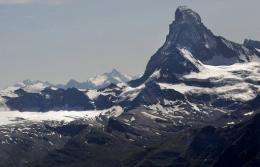
A view of the Swiss Alps at Matterhorn

Enlarge

A view of the Swiss Alps at Matterhorn. A surge in sunshine more than 60 years ago helped Swiss mountain glaciers melt faster than today, even though warmer average temperatures are being recorded now, Swiss researchers said Monday.

A surge in sunshine more than 60 years ago helped Swiss mountain glaciers melt faster than today, even though warmer average temperatures are being recorded now, Swiss researchers said Monday.

Their study into the impact of on made the "surprising discovery" that in the 1940s, and especially summer 1947, the ice floes lost the most ice since measurements begin 95 years ago, according to Zurich's Federal Institute of Technology (ETHZ).

Yet, average temperatures have been rising in the past two decades and scientists have said glacier melt is accelerating at unprecedented levels under the impact of climate change.

"The surprising thing is that this paradox can be explained relatively easily with radiation," said one the ETHZ researchers, Matthias Huss, in the university's online review.

"This should not lead people to conclude that the current period of global warming is not really as big of a problem for the glaciers as previously assumed," he added.

The researchers found from historic data on three Swiss glaciers, as well as radiation recordings from the eastern Alpine town of Davos, that the level of sunshine in the 1940s was eight percent higher than average and significantly higher than now.

As a result, snow and ice melted by about four percent.

A phase of less sunshine -- global dimming -- from the 1950s to 1980s also corresponded with the advance in the snout of .

However, the ETHZ scientists said they also found that "temperature-based opposing mechanisms" came into play about 30 years ago and have been sustained.

The study published in the peer reviewed journal "" is part of broader reseach into the impact of climate change on the Alps and the role of solar radiation in .

Studies have shown that can vary substantially due to cloud cover and aerosols -- particles and gases -- in the atmosphere.

(c) 2009 AFP

Filter


Move the slider to adjust rank threshold, so that you can hide some of the comments.


Display comments: newest first

freethinking
Dec 14, 2009

Rank: 2.7 / 5 (7)
More proof that AGW is a bunch of Garbage. I've been told many time that glaciers are melting due to global warming.... but the sun can melt them too. Who would have thought it....
thermodynamics
Dec 14, 2009

Rank: 4 / 5 (2)
freethinking: The idea that clouds and particulate mater can interfere with sunshine is not a negation of AGW. What it means is that we need to better understand clouds (one of the most severe problems in the global climate models) and particulates better. It may or may not strengthen AGW claims. However, you cannot make the jump to a claim that this is either positive or negative for AGW. Too many people on both sides of this concept are ready to jump when they see anything that hints at support for their "cause." Please be rational and realize that single articles like this do not prove anything about AGW, they just raise more areas that need to be better understood. What could be said is: "The climate change models need to be able to reproduce local variation of this type before they can be relied on to make local or regional claims." However, note I am talking about local and regional claims not global claims from this type of information.
illicit
Dec 14, 2009

Rank: 2 / 5 (4)
"suprising discover" sunlight melts glaciers. ahaha what will they think of next. Silly scientists.
defunctdiety
Dec 14, 2009

Rank: 2 / 5 (4)
they just raise more areas that need to be better understood

Which is another way of saying, the science AGW theory is presently based on is very incomplete and it's results therefore very uncertain. The science is not settled.

Which is another way of saying, AGW theorists are pushing for damaging economic policy without actually caring about the science or carbons true role in global climate.

Which is another way of saying, we should not make any drastic policy decisions based on present AGW theory.
Rank 5 /5 (4 votes)
Related Stories
Relevant PhysicsForums posts
  • Discrepancy between oxygen and carbon-dioxide levels
    created18 hours ago
  • where gems are found in the world
    created21 hours ago
  • Wind Waves in Reservoir ~ Wind run-up and Wind set-up
    createdFeb 08, 2012
  • Balance of oxygen in the atmosphere
    createdFeb 01, 2012
  • The case for a methanol-based economy
    createdJan 30, 2012
  • Weather in a rotating cylinder
    createdJan 25, 2012
  • More from Physics Forums - Earth

More news stories

Humans may have helped the decline of African rainforests 3000 years ago

(PhysOrg.com) -- Large areas of rainforests in Central Africa mysteriously disappeared over three thousand years ago, to be replaced by savannas. The prevailing theory has been that the cause was a change ...

Space & Earth / Environment

created 11 hours ago | popularity 5 / 5 (4) | comments 10 | with audio podcast report

Could Venus be shifting gear?

(PhysOrg.com) -- ESA’s Venus Express spacecraft has discovered that our cloud-covered neighbour spins a little slower than previously measured. Peering through the dense atmosphere in the infrared, the ...

Space & Earth / Space Exploration

created 7 hours ago | popularity 5 / 5 (5) | comments 7 | with audio podcast

Mars Science Laboratory computer issue resolved

(PhysOrg.com) -- Engineers have found the root cause of a computer reset that occurred two months ago on NASA's Mars Science Laboratory and have determined how to correct it.

Space & Earth / Space Exploration

created 8 hours ago | popularity 5 / 5 (5) | comments 3 | with audio podcast

Clam fields found at deep, low-temperature Mariana vents

(PhysOrg.com) -- Scientists have marveled at the unusual life forms thriving at high temperature hydrothermal vents of the deep ocean.

Space & Earth / Earth Sciences

created 7 hours ago | popularity not rated yet | comments 0 | with audio podcast

Two new moons for Jupiter

Advances in technology have lead to the discovery of new planets outside of our Solar System, and now even new moons in our own backyard.

Space & Earth / Space Exploration

created 7 hours ago | popularity not rated yet | comments 5


Complex wiring of the nervous system may rely on a just a handful of genes and proteins

Researchers at the Salk Institute have discovered a startling feature of early brain development that helps to explain how complex neuron wiring patterns are programmed using just a handful of critical genes. ...

CIA website offline, Anonymous takes credit

The website of the Central Intelligence Agency was unresponsive on Friday after the hacker group Anonymous claimed to have knocked it offline.

Q&A: Obama and the birth control controversy

(AP) -- What birth control debate? A half-century after the introduction of the pill, acceptance of birth control by American women is virtually universal.

The power of estrogen -- male snakes attract other males

A new study has shown that boosting the estrogen levels of male garter snakes causes them to secrete the same pheromones that females use to attract suitors, and turned the males into just about the sexiest ...

New error-correcting codes guarantee the fastest possible rate of data transmission

Error-correcting codes are one of the triumphs of the digital age. They’re a way of encoding information so that it can be transmitted across a communication channel — such as an optical fiber o ...

Both maternal and paternal age linked to autism

Older maternal and paternal age are jointly associated with having a child with autism, according to a recently published study led by researchers at The University of Texas Health Science Center at Houston (UTHealth).