Whose Tattoo Is It Anyway?
December 14, 2009
Whose Tattoo Is It Anyway?

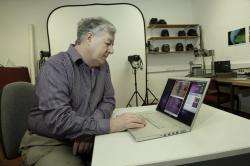
David Bryson pictured with images from the research.

(PhysOrg.com) -- An infra-red digital camera could be a crucial tool in the fight against crime when trying to identify suspects by their tattoos, according to new University of Derby research.

Forensic scientists and detectives traditionally focus on distinguishing features of a suspect when looking to track down offenders - and suspects sporting tattoos can help provide a crucial lead in an investigation.

However, criminals can stay one step ahead of the game by revising or updating their tattoo to escape justice.

Now University of Derby experts are exploring how using an infra-red digital camera can determine if a tattoo is an original, or if it is a second tattoo covering the old one.

A traditional colour camera only picks up what is on the surface of the skin, but using a sensitive to infra-red, researchers can see if there are hidden layers or changes to the original tattoo deeper in the skin.

In a recent experiment, the technique was able to determine that on a student's back, a butterfly image had covered up an image of an imp, in the original tattoo.

David Bryson is a Senior Lecturer at Derby in Applied Photography and Forensic Science and also specializes in the area of Forensic Imaging. He has been working on this project with a number of students studying forensic science at degree level.

He said: "Identifying individuals using tattoos has been an established part of forensic science practice for some time, but there can be cover-ups of tattoos with lasers, more tattoos or surgery.

"It is now possible to take a control photograph and a separate photograph with an infra-red filter to take images of the tattoo, and determine if it is indeed the original or is a cover-up, or altered tattoo on the surface.

"Digital photography means that moments after the images have been taken, they can be viewed on a laptop or computer screen - making this interesting approach now more feasible for use in everyday forensic work, compared to more traditional processes."

Further work is now being undertaken at the University's laboratories at Kedleston Road, Derby, to look at the criteria that leads to the underlying tattoo being visible to infra-red or not visible to infra-red.

This will involve looking at three different aspects of tattoos: the effect of different types of cover-up tattooing or tattoo removal by surgery or , differentiation of ink types and the depth of penetration, which can vary from 0.6mm to 2.2mm into the skin.

Once the research has gone further, David will be looking at trialling digital infra-red photography in police forces as an everyday tool to look at tattoos on suspects.

Other forensic work trialled at the University using photography techniques include analysing lipstick left on coffee cups, ear prints found on glass and fingerprint analysis.

Provided by University of Derby


Rank 4 /5 (1 vote)
Related Stories
Relevant PhysicsForums posts

More news stories

A frank discussion of the power law and linking correlation to causation

(PhysOrg.com) -- Michael Stumpf a mathematics professor at Imperial College in London, and Mason Porter a lecturer at Oxford have teamed together to write and publish a perspective piece in Science regarding the in ...

Other Sciences / Mathematics

created 15 hours ago | popularity 5 / 5 (2) | comments 6 | with audio podcast report

Employers feel no love for unscrupulous practice of 'service sweethearting'

A new study led by two Florida State University marketing professors finds that some frontline service employees who are rewarded for hikes in customer loyalty and satisfaction also may engage in "service ...

Other Sciences / Economics & Business

created 9 hours ago | popularity 4 / 5 (1) | comments 4

The question of life in the ancient world

There’s a general feeling that we don’t get the Greeks – ancient or modern. Many, including heads of state like Angela Merkel, visibly shake their head in exasperation, rightly or wrongly, at ...

Other Sciences / Archaeology & Fossils

created 15 hours ago | popularity 1.3 / 5 (3) | comments 4

Sonic Cradle lands spot in TED exhibition

A Simon Fraser University graduate student project that melds music, meditation and modern technology has landed a rare spot as an exhibit at TEDActive 2012 in Palm Springs, California this month.

Other Sciences / Other

created 11 hours ago | popularity not rated yet | comments 0

Chilean miners' rescue capsule on show in London

The capsule used to rescue Chilean miners trapped underground for two months goes on display Saturday at the Science Museum in London -- the first time it has been seen in Europe.

Other Sciences / Other

created 14 hours ago | popularity not rated yet | comments 0


Anonymous knocks CIA website offline (Update)

The website of the Central Intelligence Agency was inaccessible on Friday after the hacker group Anonymous claimed to have knocked it offline.

Google users warned of threat to smartphone wallets

Users of Google smartphone wallets were being warned on Friday that there is a way to crack pass codes intended to thwart thieves from going on illicit shopping sprees.

New error-correcting codes guarantee the fastest possible rate of data transmission

Error-correcting codes are one of the triumphs of the digital age. They’re a way of encoding information so that it can be transmitted across a communication channel — such as an optical fiber o ...

Complex wiring of the nervous system may rely on a just a handful of genes and proteins

Researchers at the Salk Institute have discovered a startling feature of early brain development that helps to explain how complex neuron wiring patterns are programmed using just a handful of critical genes. ...

Humans may have helped the decline of African rainforests 3000 years ago

(PhysOrg.com) -- Large areas of rainforests in Central Africa mysteriously disappeared over three thousand years ago, to be replaced by savannas. The prevailing theory has been that the cause was a change ...

The power of estrogen -- male snakes attract other males

A new study has shown that boosting the estrogen levels of male garter snakes causes them to secrete the same pheromones that females use to attract suitors, and turned the males into just about the sexiest ...