Scientists discover mechanism behind superinsulation
December 14, 2009
Scientists discover mechanism behind superinsulation

Enlarge

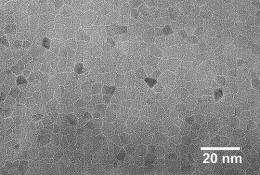
An electron microscopy image of titanium nitride, on which the effect of superinsulation was first observed.

(PhysOrg.com) -- Scientists at the U.S. Department of Energy's Argonne National Laboratory have discovered the microscopic mechanism behind the phenomenon of superinsulation, the ability of certain materials to completely block the flow of electric current at low temperatures. The essence of the mechanism is what the authors termed "multi-stage energy relaxation."

Traditionally, energy dissipation accompanying current flow is viewed as disadvantageous, as it transforms electricity into heat and thus results in power losses. In arrays of tunnel junctions that are the basic building units of modern electronics, this dissipation permits the generation of current.

Argonne scientist Valerii Vinokour, along with Russian scientists Tatyana Baturina and Nikolai Chtchelkatchev, found that at very low temperatures the from electrons to the thermal environment may occur in several stages.

“First, the passing electrons lose their energy not directly to the heat bath; they transfer their energy to electron-hole plasma, which they generate themselves,” Vinokour said. “Then this plasma 'cloud' transforms the acquired energy into the heat. Thus, tunneling current is controlled by the properties of this electron-hole cloud.”

As long as the electrons and holes in the plasma cloud are able to move freely, they can serve as a reservoir for energy—but below certain temperatures, electrons and holes become bound into pairs. This does not allow for the transfer of energy from tunneling electrons and impedes the tunneling current, sending the of the entire system to zero.

“Electron-hole plasma disappears from the game and cannot generate the exchange necessary for tunneling,” Vinokour said.

Because the current transfer in thin films and granular systems that exhibit superinsulating behavior relies on electron tunneling, the multistage relaxation explains the origin of the superinsulators.

Superinsulation is the opposite of superconductivity; instead of a material that has no resistivity, a superinsulator has a near-infinite resistance. Integration of the two materials may allow for the creation of a new class of quantum electronic devices. This discovery may one day allow researchers to create super-sensitive sensors and other electronic devices.

An earlier paper on the discovery of superinsulation was published in Nature on April 3, 2008. A paper on the mechanism behind superinsulation has been published in Physical Review Letters.

Provided by Argonne National Laboratory (news : web)

Filter


Move the slider to adjust rank threshold, so that you can hide some of the comments.


Display comments: newest first

laserdaveb
Dec 14, 2009

Rank: not rated yet
perhaps all the magnets in the vicinity will get sucked right into it!
pseudophonist
Dec 15, 2009

Rank: not rated yet
If electrons and holes form bound pairs at low temperatures then perhaps their energy is quantized and thus can only dissapate particular values of energy. What if you align these values with those of the tunnel junction...
johanfprins
Dec 15, 2009

Rank: not rated yet
This model is absolute nonsense: Just like the BCS model is absolute nonsense. Superconduction occurs when there are enough localised states which can transport charge by borrowing energy as allowed by Heisenberg's uncertainty relationship for energy an time. When cooling a metallic superconductor a gap opens up owing to electron-electron correlations. Localised states form within the gap and when their density reaches a critical amount superconduction becomes possible. Lowering the temperature further causes the Fermi-level to move down to a lower energy within the gap, thus increasing the activation energy: It is this energy which the knuckleheads in charge of the supercondutor-ect believes is "the binding energy" of a Cooper pair.
When increasing the disorder it is easy to show that at some stage the localised states are too disordered to conduct by superconsuction. In addition the localised states above the gap are too few to conduct by nearest neigbour hopping: =superinsulator
joekid
Dec 15, 2009

Rank: not rated yet
Simple question, maybe simpleton, can any of this be used to stop or reduce the discharge rate of electronic appliances such as cell phone batteries and maybe larger things such a car batteries? I live in an area where it is not unusual to get temperatures in the minus 20's Fahrenheit and some day go down to -50 or more. phones die right and left and cars to because increased conductivity.
johanfprins
Dec 15, 2009

Rank: not rated yet
Simple question, maybe simpleton, can any of this be used to stop or reduce the discharge rate of electronic appliances such as cell phone batteries and maybe larger things such a car batteries? I live in an area where it is not unusual to get temperatures in the minus 20's Fahrenheit and some day go down to -50 or more. phones die right and left and cars to because increased conductivity.

No my friend, this material only acts in this way very near absolute zero. You are still living in the tropics!
flaredone
Dec 17, 2009

Rank: not rated yet
This model is absolute nonsense: Just like the BCS model is absolute nonsense.
It's not - it just applies to very low temperatures. In a superconductor, the lack of resistance arises because electrons bind together into pairs called Cooper pairs. When a superconducting material forms flat granular film, pair becomes partitioned. Magnetic field penetrates the superconductor in quantized vortices, which rotate in alternate directions. Strong disorder forces the Cooper pairs into isolated "puddles" separated by insulating regions known as Josephson junctions, and individual Cooper pairs can only pass between puddles via quantum tunnelling. In superinsulators the roles of charge and vortices are swapped. Vortices circulate bound pairs of opposite charge, which prevents a current from flowing - it means, superinsulation cannot appear without the existence of superconductivity in the same film.
johanfprins
Dec 18, 2009

Rank: not rated yet
...a superconductor, the lack of resistance arises because electrons bind together into pairs called Cooper pairs.

Cooper pairs do not exist and even if they do they cannot be responsible for superconduction since they cannot cancel an applied electric-field. The latter characteristic DEFINES superconduction.
Strong disorder forces the Cooper pairs into isolated "puddles" separated by insulating regions known as Josephson junctions, and individual Cooper pairs can only pass between puddles via quantum tunnelling.

Further nonsense. Josephson tunnelling does NOT occur for "Cooper Pairs", since the charge-carriers responsible for tunneling are SINGLY charged: When placing a voltage V over the junction the electron levels shift by eV. When a charge-carrier with charge q tunnels it gains energy qV: Thus the total energy which must be emitted is (q+e)V. Guess what is measured q+e=2e: Thus q=e. No Cooper pairs involved!
flaredone
Dec 18, 2009

Rank: not rated yet
Cooper pairs do not exist and even if they do they cannot be responsible for superconduction since they cannot cancel an applied electric-field
Why they shouldn't, if they can move freely in it?
johanfprins
Dec 19, 2009

Rank: not rated yet
Why they shouldn't, if they can move freely in it?

Any conductor which has "free charges" CAN NEVER cancel an applied electric field while a current is flowing through it. Consider a conductor between two charged capacitor plates which do not make contact with the surfaces of the conductor: Charges then polarise to the surfaces at the capacitor plates and cancel the applied electric field within the conductor: BUT when making contact, the charges CANNOT accumulate at the contacts to cancel the applied electric-field: In fact the current flows in an attempt to cancel the applied electric field BUT CAN NEVER ACCUMULATE BY ENOUGH EVEN IF THEY DO NOT SCATTER WITHIN THE MATERIAL. Cooper pairs can be accelerated and therefore CAN NEVER cancel an applied electric field while a current is flowing. What Onnes measured was that an applied electric field is cancelled as soon as SC sets in. Thus the charge-carriers cannot be Cooper pairs: QED
flaredone
Dec 19, 2009

Rank: not rated yet
...an be accelerated and therefore CAN NEVER cancel an applied electric field while a current is flowing..
I still don't understand. Nobody expects, neither requires some accumulation of charge carriers within superconductor. Things like charge acceleration, induction and skin-effect still apply to superconductors in the same way, like to normal conductors.
johanfprins
Dec 20, 2009

Rank: not rated yet
I still don't understand. Nobody expects, neither requires some accumulation of charge carriers within superconductor. Things like charge acceleration, induction and skin-effect still apply to superconductors in the same way, like to normal conductors.

An applied electric-field around a circuit can ONLY be cancelled within an element within the circuit when a polarisation field within the element cancels the applied electric-field. When a material becomes superconducting the applied electric-field is cancelled within this element: Thus the element becomes a perfect dielectric even though a current is flowing through it.
In all conductors (resistive or not) this is not possible when a current is flowing caused by the acceleration of the charge-carriers. Thus to model SC one has to explain: HOW the applied electric field is cancelled, and HOW the charge carriers can transfer charge without being accelerated. BCS and Cooper pairs cannot explain this.
flaredone
Dec 21, 2009

Rank: not rated yet
..how the charge carriers can transfer charge without being accelerated.
Why they shouldn't, if they're decelerated at the same moment and energy is returned into system? Electric field is indeed cancelled by zero resistance of charge carrier.
johanfprins
Dec 22, 2009

Rank: not rated yet
..if they're decelerated at the same moment and energy is returned into system?

What decelerates them? It is fundamental physics that when decelerating anything, kinetic energy MUST transmute into other types of energy; and according to the second law of thermodynamics this MUST increase entropy: i.e. energy MUST be dissipated, and when energy dissipates within a conductor you have resistance.
Electric field is indeed cancelled by zero resistance of charge carrier.

It is elementary from Newton's second law that zero resistance of charge-carriers is NOT sufficient to cancel the electric-field. From which law do you deduce this fallacy? You violate the most basic postulates on which ALL physics is based.
Please enlighten me!
johanfprins
Dec 25, 2009

Rank: not rated yet
Why do the "superconductor experts" every time disappear when they have to argue simple high school physics? Is this to far above their mental capacity? Or are they unwilling to even consider the possibility that their "saints" could be wrong?
What has happenned to you flaredone? Has your flare fizzled? Really!! Are there no scientists alive anymore who are willing to argue logic?
Rank 5 /5 (12 votes)
Relevant PhysicsForums posts
  • Books To Inspire a Beginnig Physics Student
    created1 hour ago
  • Pith balls problem
    created1 hour ago
  • Electrostatics
    created1 hour ago
  • what is phase constant
    created1 hour ago
  • Basics In electromagnetic wave
    created1 hour ago
  • How to calculate theoretical initial velocity?
    created2 hours ago
  • More from Physics Forums - General Physics

More news stories

Putting the squeeze on planets outside our solar system

(PhysOrg.com) -- Using high-powered lasers, scientists at Lawrence Livermore National Laboratory and collaborators discovered that molten magnesium silicate undergoes a phase change in the liquid state, abruptly ...

Physics / Condensed Matter

created 12 hours ago | popularity 4.3 / 5 (7) | comments 0 | with audio podcast

Hovering not hard if you're top-heavy, researchers find

Top-heavy structures are more likely to maintain their balance while hovering in the air than are those that bear a lower center of gravity, researchers at New York University's Courant Institute of Mathematical Sciences ...

Physics / General Physics

created 13 hours ago | popularity 5 / 5 (1) | comments 1 | with audio podcast

SLAC, Stanford team focuses on high-energy electrons to treat cancer

Accelerator physicists at SLAC and cancer specialists from Stanford are working on a new technology that could dramatically reduce the time needed for cancer radiation treatments. The team ran an initial experiment ...

Physics / General Physics

created 16 hours ago | popularity 5 / 5 (2) | comments 0

Measurements from high-energy collisions lead to better understanding of why meson particles disappear

For several years, physicists at the Relativistic Heavy Ion Collider (RHIC) at Brookhaven National Laboratory (BNL), USA, have studied an unusual state of matter called the quark–gluon plasma, which they ...

Physics / General Physics

created 16 hours ago | popularity 4.5 / 5 (4) | comments 0

Explained: Sigma

It's a question that arises with virtually every major new finding in science or medicine: What makes a result reliable enough to be taken seriously? The answer has to do with statistical significance -- but ...

Physics / General Physics

created Feb 09, 2012 | popularity 5 / 5 (16) | comments 53


Anonymous knocks CIA website offline (Update)

The website of the Central Intelligence Agency was inaccessible on Friday after the hacker group Anonymous claimed to have knocked it offline.

Google users warned of threat to smartphone wallets

Users of Google smartphone wallets were being warned on Friday that there is a way to crack pass codes intended to thwart thieves from going on illicit shopping sprees.

New error-correcting codes guarantee the fastest possible rate of data transmission

Error-correcting codes are one of the triumphs of the digital age. They’re a way of encoding information so that it can be transmitted across a communication channel — such as an optical fiber o ...

Humans may have helped the decline of African rainforests 3000 years ago

(PhysOrg.com) -- Large areas of rainforests in Central Africa mysteriously disappeared over three thousand years ago, to be replaced by savannas. The prevailing theory has been that the cause was a change ...

New power source discovered

(PhysOrg.com) -- Researchers at the Massachusetts Institute of Technology (MIT) and RMIT University have made a breakthrough in energy storage and power generation.

Small modular reactor design could be a 'SUPERSTAR'

(PhysOrg.com) -- Though most of today's nuclear reactors are cooled by water, we've long known that there are alternatives; in fact, the world's first nuclear-powered electricity in 1951 came from a reactor ...