Sign language puzzle solved
December 15, 2009 by Lin Edwards
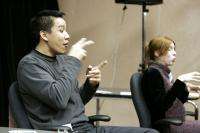
Two sign language interpreters working as a team for a school. Photo: Wikimedia Commons.
(PhysOrg.com) -- Scientists have known for 40 years that even though it takes longer to use sign language to sign individual words, sentences can be signed, on average, in the same time it takes to say them, but until now they have never understood how this could be possible.
Sign languages such as American Sign Language (ASL) use hand gestures to indicate words, and are used by millions of deaf people around the world for communication. In American Sign Language every sign is made up a combination of hand gestures and handshapes. (The sign language for British English is quite different to ASL, and the two sign languages are not mutually intelligible.)
Scientists Andrew Chong and colleagues at Princeton University in New Jersey have been studying the empirical entropy and redundancy in American Sign Language handshapes to find an answer to the puzzle. The term entropy is used in the research as a measure of the average information content of a unit of data.
The fundamental unit of data of ASL is the handshape, while for spoken languages the fundamental units are phonemes. A handshape is a specific movement of the hand and specific location of the hand.
Their results show that the information contained in the 45 handshapes making up the American Sign Language is higher than the amount of information contained in phonemes. This means spoken English has more redundancy than the signed equivalent.
The researchers reached this conclusion by measuring the frequency of handshapes in videos of signing uploaded by deaf people to websites YouTube, DeafRead, and DeafVideo.tv, and videos of conversations in sign language recorded on campus. They discovered that the entropy (information content) of the handshapes averages at 0.5 bits per shape less than the theoretical maximum, while the entropy per phoneme in speech is around three bits below the maximum possible.
This means that even though making the signs for words is slower, signers can keep up with speakers because the low redundancy rate compensates for the slower rate of signing.
Chong believes the signed language has less redundancy than the spoken language because less is needed. The redundancy in spoken language allows speech to be understood in a noisy environment, but Chong explains the "visual channel is less noisy than the auditory channel", so there is less chance of being misunderstood.
The researchers speculated that errors are dealt with differently in signing and speaking. If hand gestures are not understood, difficulties can be overcome by slowing the transition between them, but if speech is not understood speaking phonemes for longer times does not always solve the difficulty.
Understanding sign language and its information content is essential if automated sign recognition technology is to develop, and the language needs to be understood to allow sign language to be encoded and transmitted electronically by means other than video recordings.
More information: Frequency of Occurrence and Information Entropy of American Sign Language, Andrew Chong, Lalitha Sankar, H. Vincent Poor (Princeton University); arXiv:0912.1768; http://arxiv.org/abs/0912.1768
© 2009 PhysOrg.com
-
Deaf children use hands to invent own way of communicating
Feb 15, 2009 |
not rated yet |
0
-
Sign language study reveals key finding about short-term memory
Aug 01, 2006 |
not rated yet |
0
-
Sign language cell phone service created
Mar 06, 2007 |
not rated yet |
0
-
Study: Grammar ability hardwired in humans
Feb 07, 2006 |
not rated yet |
0
-
When using gestures, rules of grammar remain the same
Jun 30, 2008 |
not rated yet |
0
-
Engineers build first sub-10-nm carbon nanotube transistor
Feb 01, 2012 |
4.9 / 5 (31) |
30
-
Something old, something new: Evolution and the structural divergence of duplicate genes
Jan 31, 2012 |
4.6 / 5 (7) |
1
-
The hidden nanoworld of ice crystals: Revealing the dynamic behavior of quasi-liquid layers
Jan 30, 2012 |
5 / 5 (3) |
1
-
Stock market network reveals investor clustering
Jan 27, 2012 |
3.9 / 5 (23) |
8
-
Of microchemistry and molecules: Electronic microfluidic device synthesizes biocompatible probes
Jan 26, 2012 |
5 / 5 (1) |
0
-
Synergistic relations between computer science and technology.
Feb 06, 2012
-
how do iphone gloves work?
Feb 05, 2012
-
iPhone battery over time
Jan 30, 2012
-
Best alternate Tablet to an iPad for writing math or physics equations?
Jan 26, 2012
-
Sending SMS to a website
Jan 20, 2012
-
Need help with my technical fest!
Jan 19, 2012
- More from Physics Forums - Computing & Technology
More news stories
Google users warned of threat to smartphone wallets
Users of Google smartphone wallets were being warned on Friday that there is a way to crack pass codes intended to thwart thieves from going on illicit shopping sprees.
5 hours ago |
5 / 5 (2) |
0
Anonymous knocks CIA website offline (Update)
The website of the Central Intelligence Agency was inaccessible on Friday after the hacker group Anonymous claimed to have knocked it offline.
6 hours ago |
5 / 5 (7) |
11
New error-correcting codes guarantee the fastest possible rate of data transmission
Error-correcting codes are one of the triumphs of the digital age. Theyre a way of encoding information so that it can be transmitted across a communication channel such as an optical fiber o ...
Technology / Computer Sciences
15 hours ago |
4.8 / 5 (6) |
6
|
New power source discovered
(PhysOrg.com) -- Researchers at the Massachusetts Institute of Technology (MIT) and RMIT University have made a breakthrough in energy storage and power generation.
Technology / Energy & Green Tech
14 hours ago |
4.7 / 5 (22) |
8
|
Small modular reactor design could be a 'SUPERSTAR'
(PhysOrg.com) -- Though most of today's nuclear reactors are cooled by water, we've long known that there are alternatives; in fact, the world's first nuclear-powered electricity in 1951 came from a reactor ...
Technology / Energy & Green Tech
14 hours ago |
4.3 / 5 (11) |
21
|
Complex wiring of the nervous system may rely on a just a handful of genes and proteins
Researchers at the Salk Institute have discovered a startling feature of early brain development that helps to explain how complex neuron wiring patterns are programmed using just a handful of critical genes. ...
The power of estrogen -- male snakes attract other males
A new study has shown that boosting the estrogen levels of male garter snakes causes them to secrete the same pheromones that females use to attract suitors, and turned the males into just about the sexiest ...
Humans may have helped the decline of African rainforests 3000 years ago
(PhysOrg.com) -- Large areas of rainforests in Central Africa mysteriously disappeared over three thousand years ago, to be replaced by savannas. The prevailing theory has been that the cause was a change ...
Putting the squeeze on planets outside our solar system
(PhysOrg.com) -- Using high-powered lasers, scientists at Lawrence Livermore National Laboratory and collaborators discovered that molten magnesium silicate undergoes a phase change in the liquid state, abruptly ...
Could Venus be shifting gear?
(PhysOrg.com) -- ESAs Venus Express spacecraft has discovered that our cloud-covered neighbour spins a little slower than previously measured. Peering through the dense atmosphere in the infrared, the ...
Advanced power-grid model finds low-cost, low-carbon future in West
(PhysOrg.com) -- The least expensive way for the Western U.S. to reduce greenhouse gas emissions enough to help prevent the worst consequences of global warming is to replace coal with renewable and other ...