Story of 4.5 million-year-old whale unveiled in Huelva
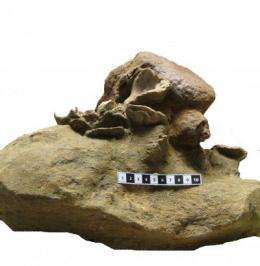
In 2006, a team of Spanish and American researchers found the fossil remains of a whale, 4.5 million years old, in Bonares, Huelva. Now they have published, for the first time, the results of the decay and fossilisation process that started with the death of the young cetacean, possibly a baleen whale from the Mysticeti group.
This is not the first discovery of the partial fossil remains of a whale from the Lower Pliocene (five million years ago) in the Huelva Sands sedimentary formation, but it is the first time that the results of the processes of fossilisation and fossil deposition following the death of a whale have been published.
The work of this international group, published in the latest issue of Geologica Acta, is the first taphonomic (fossilisation process) study done on cetacean remains combined with other paleontological disciplines such as ichnology (the study of trace fossils).
"Once the whale was dead, its body was at the mercy of scavengers such as sharks, and we know that one of these voracious attacks resulted in one of its fins being pulled off and moved about ten metres. It remained in this position in the deposit studied", Fernando Muñiz, one of the study's authors and a researcher in the University of Huelva's "Tectonics and Paleontology" research group, currently working as a palaeontologist for the City Council of Lepe, in Huelva, tells SINC.
The researchers have described the fossil remains discovered in Bonares, Huelva, at an altitude of 80 metres above sea level and 24 kilometres from the sea, and have studied the main taxonomic characteristics and associated fauna. The team also created a paleoenvironmental model to explain how the skeleton - which is incomplete apart from some pieces such as its three-metre-long hemimandibular jaw bones - was deposited.
The results show that these remains came from a "juvenile whale that died and became buried on the sea floor, at a depth of around 30-50 metres, and were subject to intense activity by invertebrate and vertebrate scavengers (as can be seen from the presence of numerous shark teeth associated with the bones)", says Muñiz. Based on the remains studied, it is hard for the researchers to say whether the cause of death was illness, old age, or attack by a larger predator.
In terms of its taxonomic description, the researchers say this is "difficult", although the morphology of the scapula (shoulder blade) suggests it is "from the Balaenopteridae (rorqual) family, belonging to the group of baleen whales from the Mysticeti sub-order", says the paleontologist.
Dead bodies as a source of nutrients
The occasional presence of a cetacean corpse on the sea floor represents an exceptional provision of nutrients for various ecological communities. According to recent studies of current-day phenomena, four ecological phases associated with whales have been recognised "that can be partially recognised in the fossil record" - the presence of mobile scavengers (sharks and bony fish), opportunists (especially polychaetes and crustaceans), sulphophilic extremophiles (micro organisms) and hard coral.
Once the bones deposited on the sea floor, free of organic material, were exposed, bivalve molluscs of the species Neopycnodonte cochlear colonised them. The presence of these bivalves suggests that the process to transform the biological remains after death was "relatively lengthy before it was definitively buried", explains the researcher.
"The fat and other elements resulting from the decomposition of the organic material would have enriched the sediment around and above the body, and this can be seen in the numerous burrowing structures in this sediment, created by endobiotic organisms, such as crustaceans and polychaete annelids", adds Muñíz. The bones were also "used", not only as a base to which these could attach themselves, but also as food.
According to the paleontologists, the presence of bioerosion structures indicates that the contents of the bones were used as an extraordinary source of nutrients, possibly by decapod crustaceans. This would be the first known evidence in the fossil record of a whale bone being consumed by decapod crustaceans with osteophagic feeding habits. The material is currently undergoing in-depth analysis by the authors of the study.
More information: Esperante, R.; Muñiz Guinea, F.; Nick, K.E. "Taphonomy of a Mysticeti whale in the Lower Pliocene Huelva Sands Formation (Southern Spain)" Geologica Acta 7(4): 489-504, Dec 2009.
Provided by FECYT - Spanish Foundation for Science and Technology


