World's first skeletal mount of Paluxysaurus jonesi reveals new biology
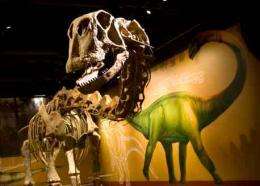
(PhysOrg.com) -- The Early Cretaceous sauropod Paluxysaurus jonesi weighed 20 tons, was 60 feet long and had a neck 26 feet long, according to scientists who prepared the world's first full skeletal mount of the dinosaur.
The massive Paluxysaurus jonesi, prepared for the Fort Worth Museum of Science and History in Fort Worth, was unveiled Nov. 20 when the museum opened in a new $80 million facility. The Paluxysaurus mount enables Texans to see their state dinosaur in three dimensions for the first time.
The reconstructed skeleton is yielding clues to the biology of the animal and its relationship to other similar dinosaurs, says Dale Winkler, lead consultant for anatomy and posture on the skeletal mount. Winkler is director of the Shuler Museum of Paleontology at Southern Methodist University in Dallas and an SMU Earth Sciences research professor.
Winkler has worked with Paluxysaurus bones since crews from SMU and the Fort Worth museum began to unearth them in the early 1990s. In preparing the mount, Winkler was surprised to see how extremely long the neck was — at 26 feet — compared to the tail, and he found the head especially striking.
"It was really exciting to see what the head looked like," Winkler says. "Paluxysaurus had very high cheeks compared to its relatives. Once the bones defining the opening of the nose were connected, it showed that the nostrils were turned up on top of the snout, instead of out like Brachiosaurus."
Similar, but different
A relative of Brachiosaurus and Camarasaurus, Paluxysaurus lived about 110 million to 115 million years ago. The dinosaur was identified and named in 2007. The Fort Worth skeleton was assembled from a combination of actual fossil bones from at least four different dinosaurs found on private ranch land in North Central Texas and from cast lightweight foam pieces modeled on original bones. The mount enables scientists to better understand the animal's anatomy, size and stature on questions like "How were the legs situated, and how did the shoulders relate to the hips?"
From the skeletal mount, the scientists learned that Paluxysaurus was more than 6 feet wide and nearly 12 feet tall at the shoulder, although built fairly light, Winkler says. Its teeth are a lot slimmer than those of its closest relatives, indicating Paluxysaurus gathered and processed food differently, using its teeth not for chewing, but to grab food, he says.
Paluxysaurus had a long neck like Brachiosaurus, and a tail almost as long, but wasn't quite so gigantic. Scientists also learned Paluxysaurus had relatively long front arms, unlike Diplodocus, making its back more level. The dinosaur's shoulder turned out fairly high, and the hips were wide, Winkler says, and it had reached a more advanced stage of evolution than Late Jurassic sauropods.
Paluxysaurus' massive pelvis and its sacrum have never before been viewed by the public, he says. Its ilium, the largest bone in the pelvis, is similar to that of titanosaurids of the Late Cretaceous, mainly found in South America. However, one titanosaurid, called Alamosaurus, entered North America and is known from Big Bend National Park in southwest Texas.
The bones assembled for Fort Worth's Paluxysaurus mount were recovered by students, faculty, staff and hundreds of volunteers over the past 16 years. Most bones were found in masses of hardened sandstone dug from a Hood County quarry on the private ranch of Bill and Decie Jones. It took more than a decade to remove the specimens because they were contained in a hard sandstone matrix, said Louis L. Jacobs, a world-renowned paleontologist, dinosaur fossil hunter and SMU Earth Sciences professor. Jacobs helped unearth and prepare the bones.
The end result is a skeleton that is "absolutely awe-inspiring," Jacobs says. "Paluxysaurus and the plants and animals it lived among show us the truly unique position Texas held in the Cretaceous world. The exhibits at the Fort Worth museum tell that story to the people who now live where the giants used to walk."
Sauropods weren't common during the Early Cretaceous. The Fort Worth specimen is morphologically distinct from all other sauropods described and named in North America at that time, according to Peter J. Rose, now a doctoral student at the University of Minnesota. Rose identified the type specimen and named the animal while a graduate student in geology at SMU.
The Paluxysaurus dinosaurs lived near the shore of the rising Cretaceous seas that eventually covered the Texas, amid large-trunked conifer trees that are now extinct. The semi-arid environment nurtured relatives of sago palms but few flowering plants, which were just beginning to spread out across the Earth, Winkler says.
The scientists say the Jones Ranch bone bed is one of the richest accumulations of sauropod bones in North America. A group apparently died together there in a common death, perhaps a forest fire, according to earlier research by Winkler and Rose. The quarry has produced hundreds of bones, all within an area of 400 square meters. Fossil hunters found 60 to 70 percent of the bones needed to reconstruct a single Paluxysaurus skeleton, says Aaron Pan, curator of the Fort Worth museum. Most of the bones, however, are too fragile or deformed to be mounted 15 feet in the air, Pan says.
"We were happy to have as much of it as we do," Pan says, noting that the museum welcomes fossil researchers. "Most of our material is available. So if a researcher did want to see any of it, we'd be happy to have them come."
Paleontologists from both the museum and SMU helped the exhibit fabricator and model-maker Robert Reid Studios, located near Fort Worth, mount the bones. About 15 to 20 percent of the skeleton is actual fossil bone, while the remainder are casts, says Pan.
Preparing the fossils for mounting and modeling was a huge, multi-year project. The cast bones were computer modeled using laser scanning, says Michael J. Polcyn, director of the image analysis lab in SMU's Earth Sciences department.
"I was able to scan available bones in 3D and manipulate them in the computer to remove distortion, create mirrored pieces — for example right or left — and model missing portions," Polcyn says. "I was then able to use the computer models to produce life-sized physical models of the bones using computer-controlled machining techniques."
Many of the very large bones remain all or partially embedded in blocks of quarry rock, due primarily to the logistical challenge of removing them. For example, the 11-ton block containing the pelvis and sacrum required hoisting with an industrial crane. For some large blocks, tons of rock were painstakingly cut with diamond-blade saws from around the various bones to make them manageable in the SMU labs, Winkler says.
Rock was partially removed from the pelvis and sacrum so that Polcyn could scan them. The scientists then constructed a model using dense foam that was cut to form the basic shape. Crews from Robert Reid Studios coated them with epoxy resin to give them hardness, then added a layer of bone texture and painted them to match.
In the case of the long neck, much was preserved, but many of the bones were distorted by sediment load, which essentially crushed the bone, Polcyn says. He studied the neck vertebrae and made a model. Only two of the skull bones were recovered: the left maxilla and a nasal bone, which defined the top front of the face. Polcyn worked closely with a sculptor to reconstruct the skull by studying related groups of dinosaurs.
More information:
Paluxysaurus jonesi -- en.wikipedia.org/wiki/Paluxysaurus
palaeo-electronica.org/2007_2/ … 0063/description.htm
Provided by Southern Methodist University


