Micromachined piezoelectric harvester drives fully autonomous wireless sensor
December 15, 2009
Fully autonomous wireless temperature sensor powered by a vibrational energy harvester
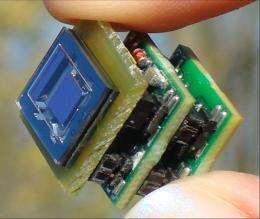
For the first time, a piezoelectric harvesting device fabricated by MEMS technology generates a record of 85μW electrical power from vibrations. A wafer level packaging method was developed for robustness. The packaged MEMS-based harvester is used to power a wireless sensor node. Within the Holst Centre program on Micropower Generation and Storage, imec researchers developed a temperature sensor that can wirelessly transmit data in a fully autonomous way.
Micromachined vibrational energy harvesters operating in the frequency domain between 150 and 1000Hz are ideal devices to convert vibrations from machines, engines and other industrial appliances into electricity. Thanks to their smaller dimensions, the micromachined devices are the prefered candidates for powering miniaturized autonomous sensor nodes.
Record and novel material
By using cost-effective, CMOS compatible MEMS processes on 6' silicon wafers, imec developed piezoelectric energy harvesters capable of generating up to 85μW of power.
The harvester consists of a Si mass that is suspended on a beam with Aluminum Nitride (AlN) as piezoelectric material. By changing the dimensions of the beam and mass, the resonance frequency of the harvester can be designed for any value in the 150-1200Hz domain.
Not only the record power output, but also the use of AlN as piezoelectric layer, is a notable achievement. AlN has several advantages in terms of materials parameters and ease of processing compared to the commonly used PZT (Lead zirconate titanate). Just to name two: AlN can be deposited up to three times faster while composition control is not an issue, thanks to the stoichiometric nature of the material.
Vacuum package
Final achievement in the research is the development of a wafer-scale process to protect the piezoelectric devices by a package. It was shown that the power output significantly increases by the use of the vacuum package compared to packaging in atmospheric pressure. In a three step process, glass covers are coated with an adhesive, vacuum bonded on top and bottom of the processed wafer and diced.
Fully autonomous
The piezoelectric harvester was connected to a wireless temperature sensor, built op from of-the-shelf components. After power optimization, the consumption of the sensor was reduced from 1.5mW to ±10μW, which is an improvement by three orders of magnitude. When subjected to vibrations at 353Hz at 0.64g (indicating a realistic amplitude of the vibrations), the system generated sufficient power to measure the environmental temperature and transmit it to a base station with an interval of fifteen seconds. The result proves the feasibility of building fully autonomous harvesters for industrial applications.
Once fully mature, the technology can be used to power sensors in industrial applications such as tire-pressure monitoring and predictive maintenance of moving or rotating machine parts. Imec and Holst Centre do not go to market themselves, but perform the research together with industrial players interested in commercializing the technology.
The result was obtained within the Micropower Program at Holst Centre, an open-innovation initiative by IMEC and TNO (The Netherlands). All details of the research were presented during the 2009 IEEE International Electron Devices Meeting (IEDM) in Baltimore (December 7-9).
Provided by IMEC
-
IMEC reports 40 microwatt from micromachined piezoelectric energy harvester
Jun 21, 2007 |
not rated yet |
0
-
Modern ceramics help advance technology
May 08, 2008 |
not rated yet |
0
-
Pickin' Up Good Vibrations to Produce Green Electricity
Nov 30, 2009 |
not rated yet |
0
-
Goodbye to batteries and power sockets
Jun 03, 2008 |
not rated yet |
0
-
IMEC, AIXTRON set important step towards low-cost GaN power devices
Jun 03, 2008 |
not rated yet |
0
-
Engineers build first sub-10-nm carbon nanotube transistor
Feb 01, 2012 |
4.9 / 5 (31) |
30
-
Something old, something new: Evolution and the structural divergence of duplicate genes
Jan 31, 2012 |
4.6 / 5 (7) |
1
-
The hidden nanoworld of ice crystals: Revealing the dynamic behavior of quasi-liquid layers
Jan 30, 2012 |
5 / 5 (3) |
1
-
Stock market network reveals investor clustering
Jan 27, 2012 |
3.9 / 5 (23) |
8
-
Of microchemistry and molecules: Electronic microfluidic device synthesizes biocompatible probes
Jan 26, 2012 |
5 / 5 (1) |
0
-
Calling function with no input argument
15 hours ago
-
Force free body diagram problem on gym equipment
16 hours ago
-
Empirical data regarding shower heads and water
Feb 10, 2012
-
feed hold button on CNC lathe
Feb 09, 2012
-
RFAC in Fortran
Feb 09, 2012
-
dynamics 2/32
Feb 08, 2012
- More from Physics Forums - General Engineering
More news stories
Anonymous knocks CIA website offline (Update)
The website of the Central Intelligence Agency was inaccessible on Friday after the hacker group Anonymous claimed to have knocked it offline.
10 hours ago |
5 / 5 (9) |
16
Google users warned of threat to smartphone wallets
Users of Google smartphone wallets were being warned on Friday that there is a way to crack pass codes intended to thwart thieves from going on illicit shopping sprees.
8 hours ago |
5 / 5 (2) |
0
New error-correcting codes guarantee the fastest possible rate of data transmission
Error-correcting codes are one of the triumphs of the digital age. Theyre a way of encoding information so that it can be transmitted across a communication channel such as an optical fiber o ...
Technology / Computer Sciences
18 hours ago |
4.9 / 5 (8) |
6
|
New power source discovered
(PhysOrg.com) -- Researchers at the Massachusetts Institute of Technology (MIT) and RMIT University have made a breakthrough in energy storage and power generation.
Technology / Energy & Green Tech
17 hours ago |
4.7 / 5 (30) |
8
|
Small modular reactor design could be a 'SUPERSTAR'
(PhysOrg.com) -- Though most of today's nuclear reactors are cooled by water, we've long known that there are alternatives; in fact, the world's first nuclear-powered electricity in 1951 came from a reactor ...
Technology / Energy & Green Tech
18 hours ago |
4.4 / 5 (13) |
23
|
Humans may have helped the decline of African rainforests 3000 years ago
(PhysOrg.com) -- Large areas of rainforests in Central Africa mysteriously disappeared over three thousand years ago, to be replaced by savannas. The prevailing theory has been that the cause was a change ...
The power of estrogen -- male snakes attract other males
A new study has shown that boosting the estrogen levels of male garter snakes causes them to secrete the same pheromones that females use to attract suitors, and turned the males into just about the sexiest ...
Complex wiring of the nervous system may rely on a just a handful of genes and proteins
Researchers at the Salk Institute have discovered a startling feature of early brain development that helps to explain how complex neuron wiring patterns are programmed using just a handful of critical genes. ...
Could Venus be shifting gear?
(PhysOrg.com) -- ESAs Venus Express spacecraft has discovered that our cloud-covered neighbour spins a little slower than previously measured. Peering through the dense atmosphere in the infrared, the ...
Advanced power-grid model finds low-cost, low-carbon future in West
(PhysOrg.com) -- The least expensive way for the Western U.S. to reduce greenhouse gas emissions enough to help prevent the worst consequences of global warming is to replace coal with renewable and other ...
Fool's gold may prove an unlikely alternative to overexploited catalytic materials
Catalytic materials, which lower the energy barriers for chemical reactions, are used in everything from the commercial production of chemicals to catalytic converters in car engines. However, with current catalytic materials ...
Dec 15, 2009
Rank: 5 / 5 (1)