Researchers find cells move in mysterious ways (w/ Video)
December 16, 2009
Researchers find cells move in mysterious ways

Enlarge

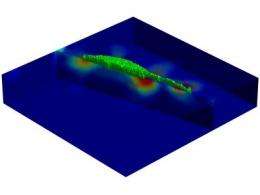
Scientists at Brown University and the California Institute of Technology have for the first time tracked how cells move by measuring the force exerted by them on their surroundings. The method could lead to better understanding how healthy cells differ from malignant cells. Credit: Christian Franck, Brown University

Our cells are more like us than we may think. They're sensitive to their environment, poking and prodding deliberately at their surroundings with hand-like feelers and chemical signals as they decide whether and where to move. Such caution serves us well but has vexed engineers who seek to create synthetic tissue, heart valves, implants and other devices that the human body will accept.

To overcome that obstacle, scientists have sought to learn more about how cells explore what's around them. While numerous studies have looked at cellular movement in two dimensions and a few recent experiments involved cellular motion in three dimensions, scientists remained unsure just how much cells interacted with their surroundings. Now, a study involving Brown University and the California Institute of Technology has recorded for the first time how cells move in three dimensions by measuring the force exerted by cells on their environs. The research gives scientists their most complete assessment to date about how cells move.

"We've learned that cells move in much more complex ways than previously believed," said Christian Franck, assistant professor in engineering at Brown and the co-lead author of the study published online in the . "Now, we can start to really put numbers on how much cells push and pull on their environment and how much cells stick to tissues as they move around and interact."

This video is not supported by your browser at this time.

Scientists at Brown University and the California Institute of Technology have for the first time tracked how cells move in three dimensions by measuring the force exerted by them on their surroundings. The video shows how cells engage in "pushing and pulling" as they probe their surroundings and move. Credit: Christian Franck, Brown University

In the study, Franck and co-lead author Stacey Maskarinec, who both conducted the experiments while graduate students at the California Institute of Technology, placed cells on top of a 50-micron-thick water-based gel designed to mimic human tissue. They added into the gel spheres about a half-micron in diameter that lit up when jostled by the cells' actions. By combining two techniques — laser scanning confocal microscopy and digital volume correlation — the scientists tracked the cells' movement by quantifying exactly how the environment changed each time the cell moved. The team recorded results every 35 minutes over a 24-hour period.

What they found was cells move in intriguing ways. In one experiment, a cell is clearly shown operating in three dimensions by extending feelers into the gel, probing at depth, as if thrusting a leg downward in a pool. The Brown and Caltech scientists also found that as a cell moves, it engages in a host of push-pull actions: It redistributes its weight, it coils and elongates its body, and it varies the force with which it "grips," or adheres, to a surface. Combined, the actions help the cell generate momentum and create a "rolling motion," as Franck described it, that is more like walking than shuffling, as many scientists had previously characterized the movement.

"The motion itself is in three dimensions," Franck said.

Franck's lab plans to use the new force-measurement technique to examine how the movement of normal healthy differs from mutant or malignant ones. "That promises to give us greater insight in how cells' behavior changes when they become diseased," Franck said.

Provided by Brown University (news : web)


Rank 4 /5 (2 votes)
Relevant PhysicsForums posts

More news stories

Protein libraries in a snap

(PhysOrg.com) -- A Rice University undergraduate will depart with not only a degree but also a possible patent for his invention of an efficient way to create protein libraries, an important component of biomolecular ...

Biology / Cell & Microbiology

created 14 minutes ago | popularity not rated yet | comments 0 | with audio podcast

Miami battling invasion of giant African snails

No one knows how they got there. But an invasion of African giant snails has southern Florida in a panic over potential crop damage, disease and general yuckiness surrounding the slimy gastropods.

Biology / Ecology

created 53 minutes ago | popularity not rated yet | comments 0

Fighting crimes against biodiversity: How to catch a killer weed

Invasive species which have the potential to destroy biodiversity and influence global change could be tracked and controlled in the same way as wanted criminals, according to new research from Queen Mary, University of London.

Biology / Ecology

created 1 hour ago | popularity not rated yet | comments 0

Ultraviolet protection molecule in plants yields its secrets

Lying around in the sun all day is hazardous not just for humans but also for plants, which have no means of escape. Ultraviolet (UV) radiation from the sun can damage proteins and DNA inside cells, leading ...

Biology / Plants & Animals

created 15 hours ago | popularity 5 / 5 (5) | comments 0 | with audio podcast

Deadly bird parasite evolves at exceptionally fast rate

A new study of a devastating bird disease that spread from poultry to house finches in the mid-1990s reveals that the bacteria responsible for the disease evolves at an exceptionally fast rate. What's more, ...

Biology / Biotechnology

created 13 hours ago | popularity 5 / 5 (2) | comments 0 | with audio podcast


Humans may have helped the decline of African rainforests 3000 years ago

(PhysOrg.com) -- Large areas of rainforests in Central Africa mysteriously disappeared over three thousand years ago, to be replaced by savannas. The prevailing theory has been that the cause was a change ...

Sleep breathing machine shows clear benefits in children with sleep apnea

Children and adolescents with obstructive sleep apnea had substantial improvements in attention, anxiety and quality of life after treatment with positive airway pressure (PAP)—a nighttime therapy in which a machine ...

Neurologic improvement detected in rats receiving stem cell transplant

In a study to be presented today at the Society for Maternal-Fetal Medicine's annual meeting, The Pregnancy Meeting, in Dallas, Texas, researchers will report that early transplantation of human placenta-derived mesenchymal ...

NASA budget will axe Mars deal with Europe: scientists

US President Barack Obama's budget proposal to be submitted next week for 2013 will cut NASA's budget by 20 percent and eliminate a major partnership with Europe on Mars exploration, scientists said Thursday.

Breastfeeding protects against asthma up to six years of age

(Medical Xpress) -- Research by the University of Otago in Christchurch and Wellington has shown that breastfeeding of infants has a clear protective effect against children developing asthma or wheezing up to six years of ...

Researchers show benefits of local anesthesia after knee replacement surgery

Researchers at the Rothman Institute at Jefferson have shown that local anesthesia delivered through a catheter in the joint, intraarticularly, may be more beneficial than traditional opioids such as morphine and Oxycontin ...