Everlasting Quantum Wave: Physicists Predict New Form of Soliton in Ultracold Gases
December 16, 2009
Everlasting Quantum Wave: Physicists Predict New Form of Soliton in Ultracold Gases

Enlarge

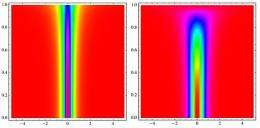
A newly predicted “immortal” soliton (left) as compared to a conventional “dark” soliton (right). The horizontal axis depicts the width of the soliton wavefronts (bounded by yellow in the left panel and purple on the right panel, with different colors representing different wave heights). The vertical axis corresponds to the speed of the soliton as a fraction of the velocity of sound. The immortal soliton on the left maintains its shape right up to the sound barrier. Credit: I. Satija et al., JQI

(PhysOrg.com) -- Solitary waves that run a long distance without losing their shape or dying out are a special class of waves called solitons. These everlasting waves are exotic enough, but theoreticians at the Joint Quantum Institute (JQI) , a collaboration of the National Institute of Standards and Technology and the University of Maryland, and their colleagues in India and the George Mason University, now believe that there may be a new kind of soliton that’s even more special. Expected to be found in certain types of ultracold gases, the new soliton would not be just a low-temperature atomic curiosity, it also may provide profound insights into other physical systems, including the early universe.

Solitons can occur everywhere. In the 1830s, Scottish scientist John Scott Russell first identified them while riding along a narrow canal, where he saw a water wave maintaining its shape over long distances, instead of dying away.

his “singular and beautiful” phenomenon, as Russell termed it, has since been observed, created and exploited in many systems, including light waves in optical-fiber telecommunications, the vibrational waves that sweep through atomic crystals, and even “atom waves” in Bose-Einstein condensates (BECs), an ultracold state of matter. Atoms in BECs can join together to form single large waves that travel through the gas. The atom waves in BECs can even split up, interfere with one another, and cancel each other out.

In BECs with weakly interacting atoms, this has resulted in observations of “dark solitons,” long-lasting waves that represent absences of atoms propagating through the gas, and “bright” solitons (those carrying actual matter).

By taking a new theoretical approach, the JQI work predicts a third, even more exotic “immortal” soliton—never before seen in any other physical system. This new soliton can occur in BECs made of “hard-core bosons”—atoms that repel each other strongly and thus interact intensely —organized in an egg-crate-like arrangement known as an “optical lattice.” In 1990, one of the coauthors of the present work, Radha Balakrishnan of the Institute of Mathematical Sciences in India, wrote down the mathematical description of these new solitons, but considered her work merely to approximate the behavior of a BEC made of strongly interacting gas atoms.

With the subsequent observations of BECs, the JQI researchers recently realized both that Balakrishnan’s equations provide an almost exact description of a BEC with strongly interacting atoms, and that this previously unknown type of soliton actually can exist. While all previously known solitons die down as their wave velocity approaches the speed of sound, this new soliton would survive, maintaining its wave height (amplitude) even at sonic speeds.

If the “immortal” soliton could be created to order, it could provide a new avenue for investigating the behavior of strongly interacting quantum systems, whose members include high-temperature superconductors and magnets. As atoms cooling into a BEC represent a phase transition (like water turning to ice), the new soliton could also serve as an important tool for better understanding phase transitions, even those that took place in the early universe as it expanded and cooled.

More information: R. Balakrishnan, I.I. Satija and C.W. Clark, “Particle-hole asymmetry and brightening of solitons in a strongly repulsive Bose-Einstein condensate,” Physical Review Letters, vol. 103, p. 230403; published online Dec. 4, 2009.

4.7 /5 (10 votes)  

Filter


Move the slider to adjust rank threshold, so that you can hide some of the comments.


Display comments: newest first

designmemetic
Dec 17, 2009

Rank: not rated yet
the article choice words. . . “immortal” soliton. . . is an interesting phrasing. Any information pattern such as a wave that is long standing has a higher probability of meeting the reproduction and evolution requirements for life. Does there exist an environment or could one be engineered with conditions whereby solitions can reproduce, grow, and express variation and competition?
Jarek
Dec 17, 2009

Rank: not rated yet
deignemetic - yes - look at quantum phase - it's tendency to choose some 'angle' in each point allows it to create topological spin-like singularities, which should be stable, fulfills conservation laws, create discrete family...
http://demonstrat...arities/
While annihilating such particle-antiparticle pair, there are created nontoplogical excitations - photons, like in nice animations in
http://en.wikiped...l_defect
Expanding the concept of quantum phase a bit to ellipsoid field, makes its fundamental topological excitations have spin 1/2, appears in 3 generations (the number of spatial dimensions), give them mass ... further excitations are similar to leptons, mesons, baryons, nucleuses, with mass gradation and decay modes as expected. Dynamics of local spatial rotations gives them EM interaction, rotations of time axis gives the Lorentz invariant gravitational interaction(4,5 section of http://arxiv.org/abs/0910.2724 )
Rank 4.7 /5 (10 votes)
Related Stories
Relevant PhysicsForums posts
  • Membrane Beam Transition Modelling Transition
    created57 minutes ago
  • second law of thermodynamics
    created14 hours ago
  • Static Electric Orbiting of H2O Droplet to Knitting Needle
    created14 hours ago
  • Acousto optical modulators
    created16 hours ago
  • Jerk during Gravitation
    created17 hours ago
  • 2 springs attached by a rigid massless bar
    created17 hours ago
  • More from Physics Forums - Classical Physics

More news stories

Physics research suggests new pathways for cancer progression

Observing that certain cancer cells may exhibit greater flexibility than normal cells, some scientists believe that this capability promotes rapid tumor growth. Now computer simulations developed by Boston University Biomedical ...

Physics / General Physics

created 22 hours ago | popularity 5 / 5 (1) | comments 0

Quantum physicist explains $100K offer for proof scaled-up quantum computing is impossible

(PhysOrg.com) -- MIT researcher Scott Aaronson has certainly riled the physics community with his offer this past Friday, of $100,000 to anyone who can prove that scaled-up quantum computing is impossible. ...

Physics / Quantum Physics

created Feb 08, 2012 | popularity 4.1 / 5 (11) | comments 32 | with audio podcast weblog

Explained: Sigma

It's a question that arises with virtually every major new finding in science or medicine: What makes a result reliable enough to be taken seriously? The answer has to do with statistical significance -- but ...

Physics / General Physics

created Feb 09, 2012 | popularity 5 / 5 (13) | comments 32

Physicists 'record' magnetic breakthrough

An international team of scientists has demonstrated a revolutionary new way of magnetic recording which will allow information to be processed hundreds of times faster than by current hard drive technology.

Physics / General Physics

created Feb 07, 2012 | popularity 4.5 / 5 (39) | comments 14 | with audio podcast

Diamond light, brighter than the sun

It’s the size of five football pitches and generates light 10 billion times brighter than the sun. As the Diamond Light Source celebrates its tenth anniversary this year, Penny Bailey visits one of the ...

Physics / General Physics

created Feb 07, 2012 | popularity 4.3 / 5 (7) | comments 15 | with audio podcast


New error-correcting codes guarantee the fastest possible rate of data transmission

Error-correcting codes are one of the triumphs of the digital age. They’re a way of encoding information so that it can be transmitted across a communication channel — such as an optical fiber o ...

A frank discussion of the power law and linking correlation to causation

(PhysOrg.com) -- Michael Stumpf a mathematics professor at Imperial College in London, and Mason Porter a lecturer at Oxford have teamed together to write and publish a perspective piece in Science regarding the in ...

High school students test best with 7 hours' rest

(Medical Xpress) -- Whether or not you know any high school students that actually get nine hours of sleep each night, that’s what federal guidelines currently prescribe.

The question of life in the ancient world

There’s a general feeling that we don’t get the Greeks – ancient or modern. Many, including heads of state like Angela Merkel, visibly shake their head in exasperation, rightly or wrongly, at ...

Soccer -- the link between managers and captains

Soccer managers regard their captains as an extension of themselves, according to new research from Northumbria University, which could explain why Fabio Capello quit as England manager following the FA row ...

Using economic evaluations for drug reimbursement decisions - what have we achieved?

Researchers at the University of York perform evaluations of the clinical and cost-effectiveness of drugs for the National Institute for Health and Clinical Excellence (NICE).