NASA, Google offer more precise emissions tracking
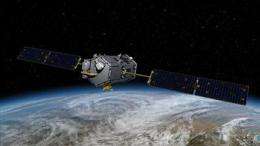
(AP) -- The question is a potential deal-killer: If nations ever agree to slash greenhouse gas emissions, how will the world know if they live up to their pledges?
The answer is in space, experts say - both outer space and cyberspace.
NASA, the wonder agency of the 1960s, and Google, the go-to company of the early 21st Century, are trying to give the world the ability to monitor both the carbon dioxide pollution and the levels of forest destruction that contribute to global warming.
"Just having the thing flying around there imaging would just about make everybody act differently," said professor Steve Pacala, director of the Princeton Environmental Institute. "The idea that you could pull a fast one would be different."
Google, meanwhile, has rolled out a new program call Earth Engine which essentially is a massive storehouse for satellite and other data that forest countries will be able to access for free by the time of the next U.N. climate conference in Mexico next year.
Deforestation is the biggest climate change culprit in much of the developing world, and industrial countries plan to pay billions of dollars to poor countries to stop deforestation. The Google system could help everyone keep track of what forests are saved.
"The science is out there, but the ability to run it on large numbers of machines by countries in previous years who couldn't afford it is now possible," said Brian McClen, vice president of engineering for the Google Geo Group, who demonstrated the new program in Copenhagen.
But technology alone cannot solve the problem, because there must be cooperation between countries like China and the U.S. about how to ensure that greenhouse gas emissions cuts are enforced, said U.S. Sen. John Kerry, chairman of the Foreign Relations Committee.
Kerry told The Associated Press that talks with Chinese officials Wednesday made progress on the problem of monitoring emissions, which were a sticking point earlier. It's an especially big problem in the view of the U.S. Congress, which has demanded that China and India back up their commitments with verifiable action.
China, meanwhile, acknowledged "positive exchanges" with Kerry but brushed aside suggestions that China should be part of any international verification system.
"We have always followed a principle of openness and transparency regarding information of China's national measures taken to address climate change and greenhouse gases," said Su Wei, China's lead negotiator at the Copenhagen talks. "I don't see the necessity for others to worry about the sincerity of China's efforts in addressing climate change."
The monitoring problem "is a big one because we don't know what we're counting," said Melinda Kimball, senior vice president of the U.N. Foundation and a former top U.S. climate negotiator. "It reminds me of arms control."
Part of the problem is that so many new coal-fired plants are being built in China - many of them so small they are hard to keep track of - that it is difficult for international energy experts to have a good handle on precise carbon dioxide output.
That's where a relaunch of the NASA satellite comes in. The decision is awaiting White House approval and is going through the budget process for next year.
"I'm optimistic," White House science adviser John Holdren told reporters at climate talks Wednesday.
Until another satellite actually gets into the air, the way the world knows about carbon dioxide involves a lot of guesswork, math and monitoring machines - and a good amount of trust.
Experts' estimates of carbon dioxide emissions are based on fuel going into power plants and complex formulas based on power plant efficiency. But those estimates are also dependent on reliable information about fuel and efficiency, so they could be skewed by inaccurate input. In the United States and some other places, there are monitors on many power plants, which mean better accuracy.
An individual coal-fired power plant produces "a dome of carbon dioxide" and a satellite like NASA's could measure the emissions, said Princeton's Pacala, who also chaired a study by the U.S. National Research Council on what NASA should do after the launch failure.
Another satellite is a must, Pacala said.
Being able to tell what individual power plants spew is crucial to the cap-and-trade programs to reduce carbon emissions, like the one being proposed in the United States. Under that, companies buy credits - essentially the right to pollute - from companies that cut pollution. To carry that out, you need good international figures, Kimball said.
Because NASA already designed the original satellite, a new one could be up in the air only 28 months after White House approval, NASA's Freilich said.
Measuring carbon is also crucial to a forest plan being negotiated at the U.N. talks. It calls for rich nations to pay poor ones for reducing their deforestation. That's a challenge because most of the deforestation is in countries with wide corruption and few systems to monitor the loss of forests.
©2009 The Associated Press. All rights reserved. This material may not be published, broadcast, rewritten or redistributed.


