Japan mines toxic e-waste for precious materials
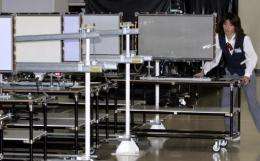
Seeking to turn an environmental problem into an economic opportunity, high-tech companies in resource-poor Japan are mining mountains of toxic e-waste for precious materials.
One model project, the sprawling Panasonic Eco Technology Centre, sits in lush rice fields an hour's drive outside of Osaka city.
Inside, workers and humming machines disassemble flat-panel televisions, refrigerators and air conditioners, sorting their metal and plastic components into boxes for recycling.
About 90 percent of dismantled parts are reused in one way or another, says Yutaka Maehara, a manager at the plant.
Among the most precious parts are metals such as copper that are becoming more expensive on the world market, while the plant also isolates toxic components such as heavy metals and dangerous gases.
The plant aims to leave a minimal environmental footprint and to be a good neighbour in its quaint rural setting.
"In the beginning residents here had some concerns," said Panasonic spokeswoman Kyoko Ishii. "But as you see, we've been operating the plant without polluting the water and the rice is growing without problems."
Japan has come a long way since the 1950s, 60s and 70s when it emerged at breakneck speed as Asia's economic engine room, boosting living standards but often at a devastating environmental cost.
The skies over Tokyo, Yokohama and other industrial centres then were often choked with pollution, in the way those over parts of China are today, while waterways darkened with industrial effluent.
Since then Japan has tightened many emission standards and other safeguards and launched in 2001 a recycling system that separates paper, glass and aluminium cans from household rubbish that can be incinerated.
Today people who want to dispose of electronic appliances have to pay an average of 28 dollars for a washing machine, 32 dollars for a TV set and 54 dollars for a fridge, according to the industry ministry.
The volume of garbage dumped in landfills every year has shrunk to roughly one third of 1990 levels.
Used mobile phone handsets and digital cameras are now often called 'city mines' for the precious metals they contain, such as gold, silver and copper.
The government recently launched a campaign to encourage cellphone users to return their old handsets to mobile phone companies for recycling.
One pioneer in Japan has been camera maker Canon, which started recycling toner cartridges from its printers about 20 years ago and now reuses 90 percent of the components of its photocopiers.
"Our system is closed loop recycling, which means used parts from our products are used again in our products," said Tomonori Iwashita, the executive officer in charge of Canon's environmental policy.
"Because we are a corporate entity, we don't make recycling efforts unless it is useful for our business. If you can recycle cheaply and reduce the burden on the environment then that's good for your business too."
But despite manufacturers' efforts to go green, some disposal companies still dump dangerous materials, said Tetsuya Sekiguchi, an activist who has joined several residents' lawsuits against waste landfills.
"I've been working on the problems of garbage pollution for decades, but the situation of illegal dumping has not improved a bit as there are few conscientious recycling companies," he said.
Another challenge is "the impact of economic globalisation on the recycling industry," said Yuichi Moriguchi, head of the waste and recycling research centre at the National Institute for Environmental Studies.
"Asian countries, led by China, are absorbing Japanese waste materials and thereby causing a shortage of materials for the Japanese recycling industry" which has the most sophisticated technologies, Moriguchi said.
Because of very basic and dangerous extraction methods -- for example by burning the plastic off metal parts in the open -- waste from Japan often causes health and environmental problems in other Asian countries, he said.
"We need to build an international system of recycling" so that Japan's technologies can be fully utilised, Moriguchi said.
In the long term, he said, "it's important to seek materials made from sustainable resources, such as plants, with less energy and less pollution ... because relying on limited resources such as petroleum will bring trouble in the future".
Canon and synthetic fibre maker Toray Industries Inc. have jointly developed a high quality plastic made from corn, which has been used in keyboards and components of its office machines.
"Even though it is made from corn, its fire resistance is about the same as that of conventional plastic," Iwashita said.
To expand research into sustainable materials, he said, Canon needs other companies, including major materials manufacturers, to come on board.
"We can't do it alone," he said. "We have to work as a wider group."
(c) 2009 AFP


