Exploring the Stone Age pantry
December 17, 2009
Exploring the Stone Age pantry

Enlarge

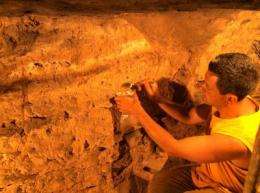
This is University of Calgary archaeologist Julio Mercader at work in the Ngalue cave site, Mozambique. Credit: Courtesy of University of Calgary

The consumption of wild cereals among prehistoric hunters and gatherers appears to be far more ancient than previously thought, according to a University of Calgary archaeologist who has found the oldest example of extensive reliance on cereal and root staples in the diet of early Homo sapiens more than 100,000 years ago.

Julio Mercader, holder of the Canada Research Chair in Tropical Archaeology in the U of C's Department of Archaeology, recovered dozens of stone tools from a deep cave in Mozambique showing that wild sorghum, the ancestor of the chief cereal consumed today in sub-Saharan Africa for flours, breads, porridges and , was in Homo sapiens' pantry along with the African wine palm, the false banana, pigeon peas, wild oranges and the African "potato." This is the earliest direct evidence of humans using pre-domesticated cereals anywhere in the world. Mercader's findings are published in the December 18 issue of the prestigious research journal Science.

"This broadens the timeline for the use of grass seeds by our species, and is proof of an expanded and sophisticated diet much earlier than we believed," Mercader said. "This happened during the Middle , a time when the collecting of wild grains has conventionally been perceived as an irrelevant activity and not as important as that of roots, fruits and nuts."

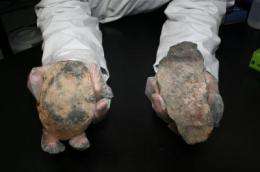
In 2007, Mercader and colleagues from Mozambique's University of Eduardo Mondlane excavated a limestone cave near Lake Niassa that was used intermittently by ancient foragers over the course of more than 60,000 years. Deep in this cave, they uncovered dozens of stone tools, animal bones and plant remains indicative of prehistoric dietary practices. The discovery of several thousand starch grains on the excavated plant grinders and scrapers showed that wild sorghum was being brought to the cave and processed systematically.
Exploring the Stone Age pantry
Enlarge

These are Middle Stone Age food processing tools recovered from the Ngalue cave site, Mozambique. Credit: Grady Semmens, University of Calgary

"It has been hypothesized that starch use represents a critical step in human evolution by improving the quality of the diet in the African savannas and woodlands where the modern human line first evolved. This could be considered one of the earliest examples of this dietary transformation," Mercader said. "The inclusion of cereals in our diet is considered an important step in human evolution because of the technical complexity and the culinary manipulation that are required to turn grains into staples."

Mercader said the evidence is on par with grass seed use by hunter-gatherers in many parts of the world during the closing stages of the last Ice Age, approximately 12,000 years ago. In this case, the trend dates back to the beginnings of the Ice Age, some 90,000 years earlier.

More information: The paper "Mozambican grass seed consumption during the Middle Stone Age" will be available in the December 18, 2009 issue of Science at: http://www.sciencemag.org .

Provided by University of Calgary (news : web)

4.2 /5 (6 votes)  

Rank 4.2 /5 (6 votes)
Related Stories
Relevant PhysicsForums posts
  • Protease cleavage
    created4 hours ago
  • Pertubance in a model
    created11 hours ago
  • Cancer drugs and Alzheimer's, Oh my!
    created19 hours ago
  • Squishing cells
    created19 hours ago
  • Any books/articles for evolutionary stable strategy models in humans?
    createdFeb 09, 2012
  • Science behind the bore feeling?
    createdFeb 09, 2012
  • More from Physics Forums - Biology

More news stories

Employers feel no love for unscrupulous practice of 'service sweethearting'

A new study led by two Florida State University marketing professors finds that some frontline service employees who are rewarded for hikes in customer loyalty and satisfaction also may engage in "service ...

Other Sciences / Economics & Business

created 5 hours ago | popularity 4 / 5 (1) | comments 4

A frank discussion of the power law and linking correlation to causation

(PhysOrg.com) -- Michael Stumpf a mathematics professor at Imperial College in London, and Mason Porter a lecturer at Oxford have teamed together to write and publish a perspective piece in Science regarding the in ...

Other Sciences / Mathematics

created 11 hours ago | popularity 5 / 5 (2) | comments 2 | with audio podcast report

The question of life in the ancient world

There’s a general feeling that we don’t get the Greeks – ancient or modern. Many, including heads of state like Angela Merkel, visibly shake their head in exasperation, rightly or wrongly, at ...

Other Sciences / Archaeology & Fossils

created 10 hours ago | popularity 1 / 5 (1) | comments 4

Sonic Cradle lands spot in TED exhibition

A Simon Fraser University graduate student project that melds music, meditation and modern technology has landed a rare spot as an exhibit at TEDActive 2012 in Palm Springs, California this month.

Other Sciences / Other

created 7 hours ago | popularity not rated yet | comments 0

Chilean miners' rescue capsule on show in London

The capsule used to rescue Chilean miners trapped underground for two months goes on display Saturday at the Science Museum in London -- the first time it has been seen in Europe.

Other Sciences / Other

created 9 hours ago | popularity not rated yet | comments 0


Google users warned of threat to smartphone wallets

Users of Google smartphone wallets were being warned on Friday that there is a way to crack pass codes intended to thwart thieves from going on illicit shopping sprees.

Anonymous knocks CIA website offline (Update)

The website of the Central Intelligence Agency was inaccessible on Friday after the hacker group Anonymous claimed to have knocked it offline.

Complex wiring of the nervous system may rely on a just a handful of genes and proteins

Researchers at the Salk Institute have discovered a startling feature of early brain development that helps to explain how complex neuron wiring patterns are programmed using just a handful of critical genes. ...

NASA sees wide-eyed cyclone Jasmine

Cyclone Jasmine's eye has opened wider on NASA satellite imagery, as it moves through the Southern Pacific Ocean.

NASA sees Giovanna reach cyclone strength, threaten Madagascar

Tropical Storm 12S built up steam and became a cyclone on February 10, 2012 as NASA's Terra satellite passed overhead. Residents of east-central Madagascar should prepare for this cyclone to make landfall ...

Putting the squeeze on planets outside our solar system

(PhysOrg.com) -- Using high-powered lasers, scientists at Lawrence Livermore National Laboratory and collaborators discovered that molten magnesium silicate undergoes a phase change in the liquid state, abruptly ...