Research finds happiest US States match a million Americans' own happiness states
December 17, 2009
Research finds happiest US States match a million Americans' own happiness states

Enlarge

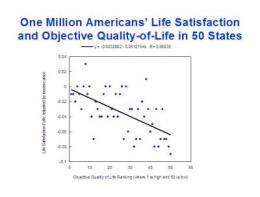
This is a graph for the Oswald/Wu research. Credit: Oswald / Wu University of Warwick

New research by the UK's University of Warwick and Hamilton College in the US into the happiness levels of a million individual US citizens have revealed their personal happiness levels closely correlate with earlier research that ranked the quality of life available in the US's 50 states plus the District of Columbia. This research provides a unique external validation of people's self reported levels of happiness and will be of great value to future economic and clinical research in this field.

The new research published in the journal Science on 17th December 2009 is by Professor Andrew Oswald of the UK's University of Warwick and Stephen Wu of Hamilton College in the US.

The researchers examined a 2005- 2008 Behavioral Risk Factor Surveillance System random sample of 1.3 million United States citizens in which Life-satisfaction in each U.S. state is measured. This provided a league table of by US State reproduced below.

This is the first large scale analysis of happiness levels in the US but the researchers were content with simply having this large data set and ranking. They decided to use the data to try and resolve one of the most significant issues facing economists and clinical scientists carrying out research into happiness.

Researchers have to rely on people's self declared levels of happiness - not how can you rely on those self declarations. There have been useful studies trying to match those levels of happiness to clinical signs of happiness and stress such as blood pressure. That has been useful but one cannot know for sure whether those clinical signs are themselves driving happiness or whether the reverse is true. Researchers have longed for a more clearly external set of data to test their results.

On this occasion the researchers found another parallel data set that might for the first time provide that external validation or challenge their findings. They discovered research by Stuart Gabriel published in 2003 which considered objective indicators for each individual State of the USA such as: precipitation; temperature; wind speed; sunshine; coastal land; inland water; public land; National Parks; hazardous waste sites; environmental 'greenness'; commuting time; violent crime; air quality; student-teacher ratio; local taxes; local spending on education and highways; cost of living. This essentially allowed the creation of a rank order of US states showing which should provide the happiest living experience. This then was a truly external data set that could be used to check against the self declared levels of happiness

When the two tables were compared they found a very close correlation between people's subjective life-satisfaction scores and objectively estimated quality of life.

The lead researcher on the study, Professor Andrew Oswald from the University of Warwick said:

"The beauty of our statistical method is that we are able to look below the surface of American life -- to identify the deep patterns in people's underlying happiness from Alabama to Wyoming. This type of study has been done for a few European countries but it is new to the United States. We are the first to be able to do this calculation -- partly because we are fortunate enough to have a random anonymized sample of 1.3 million Americans."

"The state-by-state pattern seems interesting in itself. But it also matters scientifically. We wanted to study whether people's feelings of satisfaction with their own lives are reliable, that is, whether they match up to reality -- of sunshine hours, congestion, air quality, etc -- in their own state. And they do match. When human beings give you an answer on a numerical scale about how satisfied they are with their lives, it is best to pay attention. Their answers are reliable. This suggests that survey data might be very useful for governments to use in the design of economic and social policies."

Professor Oswald expressed some caution in how the results should be interpreted for the state of Louisiana in the survey following the disruption caused by Hurricane Katrina but was confident that the data on the other states was a true reflection of happiness levels saying:

"We have been asked a lot whether we expected that states like New York and California would do so badly in the happiness ranking. Having visited and lived in various parts of the US, I am only a little surprised. Many people think these states would be marvellous places to live in. The problem is that if too many individuals think that way, they move into those states, and the resulting congestion and house prices make it a non-fulfilling prophecy. In a way, it is like the stock market. If everyone thinks it would be great to buy stock X, that stock is generally already overvalued. Bargains in life are usually found outside the spotlight. It may be that exactly the same is true of the best places to live."

Andrew Oswald/ Wu ranking of happiness levels by US State


  1. Louisiana
  2. Hawaii
  3. Florida
  4. Tennessee
  5. Arizona
  6. Mississippi
  7. Montana
  8. South Carolina
  9. Alabama
  10. Maine
  11. Alaska
  12. North Carolina
  13. Wyoming
  14. Idaho
  15. South Dakota
  16. Texas
  17. Arkansas
  18. Vermont
  19. Georgia
  20. Oklahoma
  21. Colorado
  22. Delaware
  23. Utah
  24. New Mexico
  25. North Dakota
  26. Minnesota
  27. New Hampshire
  28. Virginia
  29. Wisconsin
  30. Oregon
  31. Iowa
  32. Kansas
  33. Nebraska
  34. West Virginia
  35. Kentucky
  36. Washington
  37. District of Columbia
  38. Missouri
  39. Nevada
  40. Maryland
  41. Pennsylvania
  42. Rhode Island
  43. Massachusetts
  44. Ohio
  45. Illinois
  46. California
  47. Indiana
  48. Michigan
  49. New Jersey
  50. Connecticut
  51. New York

Provided by University of Warwick (news : web)

Filter


Move the slider to adjust rank threshold, so that you can hide some of the comments.


Display comments: newest first

frajo
Dec 17, 2009

Rank: 1 / 5 (1)
The close correlation of objective estimators with subjective estimators of happiness is quite interesting. It could be interpreted in a different way, though.
Maybe the average US citizen's internal picture of happiness is unconsciously defined by just these external estimators. Of course, this hypothesis is based on the assumption that a person's internal picture of happiness is not necessarily identical with her real mental/emotional well-being which might be more correlated to answering the question "would you prefer to lead another person's life?".
DocWand
Dec 18, 2009

Rank: not rated yet
These statistics might mean something but they appear highly subjective to me. However, the States can be ranked SCIENTIFICALLY based on the mental health of their citizens. Depression rates per capita, suicide rates, substance abuse rates and etc. Looking at the states from the mental health perspective yields a much differant ranking than the University of Warwick exercise.
Mike22
Dec 18, 2009

Rank: not rated yet
Amazing that they left out the most important of all objective happiness indicators in the survey! - how much and the quality of nature surrounding you.
Velanarris
Dec 18, 2009

Rank: 3 / 5 (4)
Amazing that they left out the most important of all objective happiness indicators in the survey! - how much and the quality of nature surrounding you.

Contrary to your belief, not everyone enjoys nature.

Most likely the scale would be quite different if that was the case as Lousiana's last major bout with nature certainly drove people to cities, not away from them.
otto1923
Dec 19, 2009

Rank: 1 / 5 (1)
Louisiana, Mississippi, Tennesses, Alabama, these are also some of the fattest states per capita in the US. Meaningful correlation?
marjon
Dec 19, 2009

Rank: not rated yet
I post data showing that 3 of the top five 'happiest' states have lower taxes based upon 'tax freedom day. and the Bottom five least happy states have the some of the highest taxes.
This information was censored by the editors.
Imagine, a reader conducting a bit of science on his own and the editors of a 'science' web site censor it!
How long will it be before this comment is censored?
otto1923
Dec 19, 2009

Rank: 1 / 5 (1)
Louisiana, Mississippi, Tennesses, Alabama, these are also some of the fattest states... you from any of those states Marjam? I mean, maybe you could corroberate-
marjon
Dec 19, 2009

Rank: not rated yet
Louisiana, Mississippi, Tennesses, Alabama, these are also some of the fattest states... you from any of those states Marjam? I mean, maybe you could corroberate-

These states have a high church tradition and attendance. Maybe that is a reason. They have hope for the future.
otto1923
Dec 20, 2009

Rank: not rated yet
They seek absolution for their slothful gluttony and other neglectful self-destructive tendencies. Alas no god can restore what they themselves have destroyed. Religion is just one more palliative, something else to gorge oneself on for temporary relief. Like entenmans. Probably they think they're happy because they're so good at self-deception, is my guess. Or because everybody else in the neighborhood is equally as decrepit.
otto1923
Dec 20, 2009

Rank: not rated yet
Those new orleans flood victims floating down the bayou- I hate to be the one to point it out, but those unfortunates weren't bloated, they were just fat. In times of natural disaster it pays to be in shape. Or any time you don't want to feel like a potential victim. I can't believe Louisiana is in that list.
marjon
Dec 20, 2009

Rank: not rated yet
They seek absolution for their slothful gluttony and other neglectful self-destructive tendencies. Alas no god can restore what they themselves have destroyed. Religion is just one more palliative, something else to gorge oneself on for temporary relief. Like entenmans. Probably they think they're happy because they're so good at self-deception, is my guess. Or because everybody else in the neighborhood is equally as decrepit.

Such a tolerant 'liberal'!
otto1923
Dec 20, 2009

Rank: 1 / 5 (1)
Then too, the buildup of plaque and cholesterol in their brains as well as overall reduced circulation, O2 delivery and removal of crud, leaves them in a chronic state of semi-stupor which is exhibited in all manner of affectations, neuroticisms, and character defects, such as fishing for attention from innocent posters in science blogs; and of course overeating. Self-delusion is bliss I guess, but better than facing ones own ruination and catastrophe.
frajo
Dec 20, 2009

Rank: 1 / 5 (1)
character defects, such as fishing for attention from innocent posters in science blogs
by using ostentatious pseudonyms?
ForFreeMinds
Dec 20, 2009

Rank: 5 / 5 (1)
A cursory examination suggests the data appears correlated with states that vote Republican vs. Democrat, or states with lots of government vs. less government. Interesting.
marjon
Dec 20, 2009

Rank: 1 / 5 (1)
Amazing that they left out the most important of all objective happiness indicators in the survey! - how much and the quality of nature surrounding you.

Hawaii is a beautiful place and one would think have all anyone could ever need, except opportunities and challenges.
marjon
Dec 20, 2009

Rank: not rated yet
Then too, the buildup of plaque and cholesterol in their brains as well as overall reduced circulation, O2 delivery and removal of crud, leaves them in a chronic state of semi-stupor which is exhibited in all manner of affectations, neuroticisms, and character defects, such as fishing for attention from innocent posters in science blogs; and of course overeating. Self-delusion is bliss I guess, but better than facing ones own ruination and catastrophe.

Be careful. You could be accused of racism as such places have a higher percentage of minorities.
otto1923
Dec 20, 2009

Rank: not rated yet
ostentatious pseudonyms

Herr Otto Von Deutlich sprächt:
nicht so viel... Pudel
-the morbidly obese are a significant minority with their own weighty advocacy groups.
stonehat
Dec 21, 2009

Rank: 5 / 5 (1)
Could you please make the attached graph even smaller and the labels more illegible so as to make it meaningless to your readers ?
Rank 2 /5 (6 votes)
Related Stories
Relevant PhysicsForums posts
  • Can I forget a language?
    created4 hours ago
  • The Biggest Lie Ever
    createdFeb 09, 2012
  • What are the limits of learning?
    createdFeb 06, 2012
  • Isn't that grammatically wrong?
    createdFeb 06, 2012
  • What does it mean when traders are indifferent?
    createdFeb 04, 2012
  • Peak of Our Civilization
    createdFeb 04, 2012
  • More from Physics Forums - Social Sciences

More news stories

Employers feel no love for unscrupulous practice of 'service sweethearting'

A new study led by two Florida State University marketing professors finds that some frontline service employees who are rewarded for hikes in customer loyalty and satisfaction also may engage in "service ...

Other Sciences / Economics & Business

created 1 hour ago | popularity not rated yet | comments 0

A frank discussion of the power law and linking correlation to causation

(PhysOrg.com) -- Michael Stumpf a mathematics professor at Imperial College in London, and Mason Porter a lecturer at Oxford have teamed together to write and publish a perspective piece in Science regarding the in ...

Other Sciences / Mathematics

created 7 hours ago | popularity 5 / 5 (1) | comments 2 | with audio podcast report

The question of life in the ancient world

There’s a general feeling that we don’t get the Greeks – ancient or modern. Many, including heads of state like Angela Merkel, visibly shake their head in exasperation, rightly or wrongly, at ...

Other Sciences / Archaeology & Fossils

created 6 hours ago | popularity 1 / 5 (1) | comments 2

Sonic Cradle lands spot in TED exhibition

A Simon Fraser University graduate student project that melds music, meditation and modern technology has landed a rare spot as an exhibit at TEDActive 2012 in Palm Springs, California this month.

Other Sciences / Other

created 3 hours ago | popularity not rated yet | comments 0

Chilean miners' rescue capsule on show in London

The capsule used to rescue Chilean miners trapped underground for two months goes on display Saturday at the Science Museum in London -- the first time it has been seen in Europe.

Other Sciences / Other

created 5 hours ago | popularity not rated yet | comments 0


Human cognitive performance suffers following natural disasters, researchers find

Not surprisingly, victims of a natural disaster can experience stress and anxiety, but a new study indicates that it might also cause them to make more errors - some serious - in their daily lives. In their upcoming Human Fa ...

"Twisted Metal" gamers get shot at real gunplay

Fans of "Twisted Metal" will get to welcome a long-awaited sequel of the car-battle videogame with a real-world bang by blasting an ice cream truck to bits with a machine gun.

Putting the squeeze on planets outside our solar system

(PhysOrg.com) -- Using high-powered lasers, scientists at Lawrence Livermore National Laboratory and collaborators discovered that molten magnesium silicate undergoes a phase change in the liquid state, abruptly ...

The power of estrogen -- male snakes attract other males

A new study has shown that boosting the estrogen levels of male garter snakes causes them to secrete the same pheromones that females use to attract suitors, and turned the males into just about the sexiest ...

Both maternal and paternal age linked to autism

Older maternal and paternal age are jointly associated with having a child with autism, according to a recently published study led by researchers at The University of Texas Health Science Center at Houston (UTHealth).

New error-correcting codes guarantee the fastest possible rate of data transmission

Error-correcting codes are one of the triumphs of the digital age. They’re a way of encoding information so that it can be transmitted across a communication channel — such as an optical fiber o ...