Wild chimps have near human understanding of fire, study says
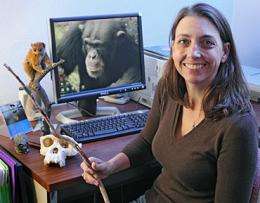
(PhysOrg.com) -- The use and control of fire are behavioral characteristics that distinguish humans from other animals. Now, a new study by Iowa State University anthropologist Jill Pruetz reports that savanna chimpanzees in Senegal have a near human understanding of wildfires and change their behavior in anticipation of the fire's movement.
An ISU associate professor of anthropology, Pruetz and Thomas LaDuke, an associate professor of biological sciences at East Stroudsburg (Pa.) University, co-authored the paper, which will be posted online Friday by the American Journal of Physical Anthropology. It will be published in a 2010 edition of the journal.
Data on the chimps' behavior with seasonal fires was collected by Pruetz during two specific encounters in March and April 2006. She reports that wildfires are set yearly by humans for land clearing and hunting, and most areas within the chimpanzees' home range experience burning to some degree.
Chimps have calm understanding of wildfires
The researchers interpret the chimpanzees' behavior to the wildfires as being predictive, rather than responsive, in that they showed no signals of stress or fear -- other than avoiding the fire as it approached them.
"It was the end of the dry season, so the fires burn so hot and burn up trees really fast, and they [the chimps] were so calm about it. They were a lot better than I was, that's for sure," said Pruetz, who was selected a 2008 National Geographic Emerging Explorer for her previous research on the savanna chimpanzees at the Fongoli research site in Senegal.
"They [the chimps] were experts at predicting where it was going to go," she continued. "I could predict it, sort of, but if it were just me, I would have left. At one time, I actually had to push through them because I could feel the heat from the fire that was on the side of me and I just wasn't that comfortable with it."
Pruetz says it was hard to find previous research on how other animals interacted with fire. But the few examples that she and LaDuke found -- such as elephants' encounters with similar wildfires -- reported that those animals were highly stressed and experienced high mortality rates.
In their paper, the researchers wrote that the control of fire by humans involves the acquisition of these three cognitive stages:
1. Conceptualization of fire. An understanding of the behavior under varying conditions that would allow one to predict its movement, thus permitting activity in close proximity to the fire.
2. The ability to control fire. Involving containment, providing or depriving the fire of fuel and perhaps the ability to put it out.
3. The ability to start a fire.
According to Pruetz, the Fongoli chimpanzees have mastered the first stage, which is the prerequisite to the other two. But she doesn't see them figuring out how to start a fire anytime soon -- at least, not without help.
"I think they could learn. It might be difficult only because of their dexterity, since they're less dexterous than us," she said. "But naturally, I can't ever see them making fire. I think cognitively they are able to control it (stage 2)."
Displaying a new "fire dance"
Yet they are very aware of fire and its power. In fact, Pruetz reports that the chimps have developed a unique "fire dance."
"Chimps everywhere have what is called a 'rain dance' -- Jane Goodall (a famed primatologist) coined that term -- and it's just a big male display (to show dominance)," she said. "Males display all the time for a number of different reasons, but when there's a big thunderstorm approaching, they do this real exaggerated display -- it's almost like slow motion. And when I was with this one party of chimps, the dominant male did the same sort of thing, but it was towards the fire, so I call it the fire dance.
"The other interesting thing was that I heard a vocalization that I never heard before [the fire dance] and I've never heard since," Pruetz continued.
She says the study provides insight into how the earliest human ancestors first developed the ability to control fire.
"If chimps can understand and predict the movement of fire, then maybe that's the thing that allowed some of the very earliest bipedal apes [human ancestors] to eventually be able to control fire," she said.
Pruetz will be continuing her research in Senegal during the spring semester. It is sponsored, in part, by the National Geographic Society, in addition to Iowa State.
Provided by Iowa State University


