Computer simulation strengthens link between climate change and release of subsea methane
December 17, 2009
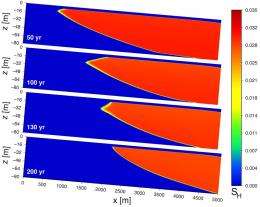
Computer simulations capture the evolution of hydrate saturation underneath the seafloor over a 200-year period. As water temperatures rise, the upper (leftmost) extent of methane gas hydrate (in red) recedes approximately 1,500 meters downslope.
(PhysOrg.com) -- A first-of-its-kind computer simulation that mirrors real-world observations of methane bubbling up from a seabed in the Arctic Ocean provides further evidence that warming oceans may unleash vast quantities of methane trapped in hydrate deposits buried beneath the seafloor.
A first-of-its-kind computer simulation that mirrors real-world observations of methane bubbling up from a seabed in the Arctic Ocean provides further evidence that warming oceans may unleash vast quantities of methane trapped in hydrate deposits buried beneath the seafloor. Methane is one of the most potent greenhouse gases.
The simulations, conducted by Lawrence Berkeley National Laboratory scientists, focus on oceanic gas hydrates, which are solid crystalline compounds in seafloor sediment. Methane molecules are lodged within the compounds’ icy latticework.
Scientists are concerned that climate change-induced ocean warming may cause oceanic hydrates to break apart, potentially releasing large amounts of methane into the atmosphere and further accelerating climate change.
Much more research is needed to understand this process, however, which is why Berkeley Lab scientists George Moridis and Matthew Reagan ran the largest-scale simulation ever conducted on the break up of oceanic gas hydrates.
Reagan will present their research today at the American Geophysical Union’s annual meeting in San Francisco. Their research is also published this week in the scientific journal Geophysical Research Letters.
They based their simulation on a seafloor off the coast of Spitsbergen, a Norwegian island in the Arctic Ocean where a recent scientific expedition observed more than 250 methane plumes.
The methane’s source isn’t known. But there is one intriguing clue: The seabed slopes upward as it approaches the island’s coastline, and the methane vents happen to occur at the depth where the water becomes too warm for methane hydrates to remain stable. Because of this, some scientists speculate that the plumes may be the first visible sign of the dissociation of methane hydrate deposits due to climate change.
To help test this hypothesis, the Berkeley Lab scientists created a simulation that matches the seabed’s slope and depth over a five-kilometer, two-dimensional slice of seafloor. They cranked up the water temperature three degrees Celsius over a 100-year period, matching a temperature increase recorded in the waters off Spitsbergen since 1908. The ocean temperature was also held constant for another 100 years into the future.
They then watched what happened to methane hydrates buried in up to 300 meters of sediment.
As the water warmed, the boundary at which the hydrates remain stable crept deeper down the sloping seabed, dissociating the hydrates in the sediment and creating a receding line of gas plumes along the way. And when the simulation stopped at the water temperature currently found in the waters off Spitsbergen, this boundary line stalled near the depth where the methane vents were spotted by the expedition.
“Our simulations are consistent with what has been suggested based on the field observations: the methane is coming from the dissociation of shallow methane hydrates,” says Moridis of Berkeley Lab’s Earth Sciences Division.
Adds Reagan, “The location of the methane plumes match the receding gas hydrate stability zone in our simulation, which for us was the ’smoking gun’.”
The simulation uses a computer code developed at Berkeley Lab, called TOUGH+HYDRATE, which allows Moridis and Reagan to model the dissociation of hydrates and the migration of gas in the sediments. To model this system, they used 300,000 gridblocks to capture features as small as 25 centimeters.
“This is an extremely high-resolution simulation,” says Moridis. “And this gives us a very accurate description of the system, which is critical because hydrates are very heterogeneous.”
The simulation will help shore up what scientists know about the potential impact of methane hydrates on climate change, which remains hazy. Estimates vary widely over how much methane is trapped in oceanic hydrates. It’s also unclear how much methane will make it to the upper atmosphere, where it can contribute to global warming, as a result of oceanic hydrate dissociation. What is known is the physics of hydrate dissociation, and this offers a way to fill in knowledge gaps from the bottom up.
“We start with well-defined information about hydrates, and then simulate their behavior underneath the seafloor,” says Reagan. “Our simulations can then be coupled to ocean circulation and atmospheric models, which will eventually give us an estimate of the possible effect on global climate.”
More information: Read more about the computer simulation in a paper published in Geophysical Research Letters.
Provided by Lawrence Berkeley National Laboratory (news : web)
-
A new acceleration additive for making 'ice that burns'
Oct 23, 2006 |
not rated yet |
0
-
Warming ocean contributes to global warming
Aug 14, 2009 |
not rated yet |
0
-
Scientists Create, Study Methane Hydrates in 'Ocean Floor' Lab
Mar 14, 2005 |
not rated yet |
0
-
Methane gas likely spewing into the oceans through vents in sea floor (w/ Video)
Sep 02, 2009 |
not rated yet |
0
-
Scientist: Microbe Community Deep Beneath Arctic Permafrost Needs Study
Dec 18, 2008 |
not rated yet |
0
-
Engineers build first sub-10-nm carbon nanotube transistor
Feb 01, 2012 |
4.9 / 5 (31) |
30
-
Something old, something new: Evolution and the structural divergence of duplicate genes
Jan 31, 2012 |
4.6 / 5 (7) |
1
-
The hidden nanoworld of ice crystals: Revealing the dynamic behavior of quasi-liquid layers
Jan 30, 2012 |
5 / 5 (3) |
1
-
Stock market network reveals investor clustering
Jan 27, 2012 |
3.9 / 5 (23) |
8
-
Of microchemistry and molecules: Electronic microfluidic device synthesizes biocompatible probes
Jan 26, 2012 |
5 / 5 (1) |
0
-
Discrepancy between oxygen and carbon-dioxide levels
16 hours ago
-
where gems are found in the world
19 hours ago
-
Wind Waves in Reservoir ~ Wind run-up and Wind set-up
Feb 08, 2012
-
Balance of oxygen in the atmosphere
Feb 01, 2012
-
The case for a methanol-based economy
Jan 30, 2012
-
Weather in a rotating cylinder
Jan 25, 2012
- More from Physics Forums - Earth
More news stories
Could Venus be shifting gear?
(PhysOrg.com) -- ESAs Venus Express spacecraft has discovered that our cloud-covered neighbour spins a little slower than previously measured. Peering through the dense atmosphere in the infrared, the ...
Space & Earth / Space Exploration
4 hours ago |
5 / 5 (5) |
7
|
Humans may have helped the decline of African rainforests 3000 years ago
(PhysOrg.com) -- Large areas of rainforests in Central Africa mysteriously disappeared over three thousand years ago, to be replaced by savannas. The prevailing theory has been that the cause was a change ...
Mars Science Laboratory computer issue resolved
(PhysOrg.com) -- Engineers have found the root cause of a computer reset that occurred two months ago on NASA's Mars Science Laboratory and have determined how to correct it.
Space & Earth / Space Exploration
5 hours ago |
5 / 5 (5) |
3
|
Clam fields found at deep, low-temperature Mariana vents
(PhysOrg.com) -- Scientists have marveled at the unusual life forms thriving at high temperature hydrothermal vents of the deep ocean.
Space & Earth / Earth Sciences
5 hours ago |
not rated yet |
0
|
Two new moons for Jupiter
Advances in technology have lead to the discovery of new planets outside of our Solar System, and now even new moons in our own backyard.
Space & Earth / Space Exploration
4 hours ago |
not rated yet |
2
Putting the squeeze on planets outside our solar system
(PhysOrg.com) -- Using high-powered lasers, scientists at Lawrence Livermore National Laboratory and collaborators discovered that molten magnesium silicate undergoes a phase change in the liquid state, abruptly ...
India probes Google over 'forex transactions'
Indian authorities are probing whether online giant Google broke domestic foreign-exchange transactions rules while shifting funds abroad, the Press Trust of India reported on Friday.
Germany freezes signing of disputed Internet pact
Germany on Friday halted the signing of a controversial international accord billed as a way to beat online piracy that has sparked angry protests, saying it needed more time to consider it.
Health experts, scientists to discuss bird flu studies
The World Health Organization said Friday it will meet next week to determine whether scientists can publish research on a bird flu virus that may be easily passed among humans.
Employers feel no love for unscrupulous practice of 'service sweethearting'
A new study led by two Florida State University marketing professors finds that some frontline service employees who are rewarded for hikes in customer loyalty and satisfaction also may engage in "service ...
Obama forges compromise birth control plan
US President Barack Obama Friday announced a compromise to defuse a row over access to birth control which prompted election-year Republican critics to claim he was waging a war on religion.
Dec 17, 2009
Rank: 2.1 / 5 (16)
Dec 17, 2009
Rank: 2.9 / 5 (15)
Dec 17, 2009
Rank: 2.9 / 5 (7)
If so this theory is incorrect or incomplete.
How do we know that the methane isn't simply leaking from a natural gas field?
However if true, and the planet is warming, we better start mining the methane hydrates and burning them for energy since methane is 77 times the greenhouse gas as CO2.
Dec 17, 2009
Rank: 2.8 / 5 (12)
I have this suspicion about why this is occuring more recently in new articles on global warming, this renewed vigor towards objectivity. Having exposed the work ethic of many scientists through the e-mail incident recently seems to have forced unaffected groups to get their act together in fear of consequences, we might see a lot less of the blabbering morons than we used to.
Hackers couldn't have done society a better service, exploiting the emotional poison saturating all of this research previously. The hit to the scientific community at large was a gift to everyone, now that the rotting appendage of science has been chopped at with an axe, so brutally severed, the research ethics can heal and reapply itself in a much more mature, productive, mannar.
NOW WE GET TO THE ACTUAL SCIENCE! >:]
Things might become a little bit more interesting, if we can prevent fraud from continuing to saturate the scientific process at least...
Dec 17, 2009
Rank: 3.3 / 5 (13)
However we can also use simulation software to subject the bridget to the equivalent of an earthquake to see how it behaves. In the case of the simulation we do not know all of the parameters (such as the behavior of the floor of the span). We let the software tell us about what will most likely happen. This is an important part of modern engineering and science. (I am runnning out of space so I will continue in the next post).
Dec 17, 2009
Rank: 4.2 / 5 (10)
http://en.wikiped...lathrate
A lot is known about the clathrates and what they are doing in this simulation is looking at how heat transfer in the system (also known to enginers to reasonable uncertainty) affects the bonds in the cage. What they saw is that the measured values of ocean temperature match the level at which the bubles are appearing. Note how careful they were to say the origin of the bubles was not known. This is good science. They are producing a careful simulation of a possible source of the bubbles and drawing the conclusion that this is a possible cause. They can then go farther and say that "IF" the temperatues go up this could happen. Good science using computers.
Dec 17, 2009
Rank: 2.2 / 5 (11)
Obviously we should welcome objective evidence towards either side. But as touched on by someone in another thread, there really is no way to conclusively prove AGW theory as there is no scientific or experimental control. And no, historic proxy data, no matter how good or representative of past and current conditions, is not a control - despite AGW theorists trying to pass it off as such.
Furthermore we simply cannot quantify all of the necessary factors that would be required to prove anything conclusively on either side. The science really has nowhere to go beyond where it was 30 years ago:
We know there are thermodynamic and chemical principles backing AGW, it's why our planet is habitable in the first place. But we do not and cannot know how significant that subtle chemistry is in global climate because of the complexity of the system. The natural variability is too great, the science is too incomplete and the models too uncertain.
Dec 17, 2009
Rank: 2.7 / 5 (9)
Dec 17, 2009
Rank: 1.9 / 5 (10)
Here's the thing about architects and engineers though.
They go to jail if they are wrong.
You design a bridge or building and it collapses and kills 40 people, you're going away for life not to mention financial ruin. Engineers ALWAYS err on the side of certainty, they make damn sure they know their structures will hold because if they don't, it's literally their ass.
What can we say about AGW science and it's certainty and accountability?
Furthermore, things like compression and tensile strength, gravity and thermal expansion are much easier to represent mathematically and to quantify than global net irradiance, the interplay between surface and atmospheric albedo and thermal absorption, and natural carbon uptake and release are.
Well, jonnyboy beat me to the punch on a couple points here, but ultimately there is no comparison between the legitimacy of engineering models and climate models.
Dec 17, 2009
Rank: 3.7 / 5 (13)
However, just like everything else in life, we must place our bets where the preponderance of the evidence lies. In the case of AGW, we have a few hacked emails and some smoke and mirror stuff sourced from people who stand to lose big money on changes to the status quo. On the other side we have thousands of reports, model simulations, etc. some more credible than others, supporting AGW. For now, I believe AGW wins hands down as a rational explanation that fits all of the measurements on the table.
Dec 17, 2009
Rank: 1.9 / 5 (11)
That was a wonderfully biased summation. We have a thousand emails demonstrating how the most prominent scientific body in the IPCC is destroying data, preventing peer review and "tricking" data and out right fudging models. You equivocating worm!
Who really is going to lose money from AGW legislation, Parsec? Do you have any clue at all what is being proposed? It doesn't seem you do. It's not the fossil fuel companies. They will pass down the cost of whatever controls, restrictions and cap-and-trades are imposed upon them directly onto the consumer with interest. Wake up man. Not to mention the cost of swelling gov't.
China and India, with the most dynamic and highest potential economies in the world, have fooled H.R. Clinton, at least, to pledge hundreds of BILLIONS $$$ per YEAR to them, when her nation is facing the worst economic future in it's history.
Dec 17, 2009
Rank: 3.7 / 5 (6)
Dec 17, 2009
Rank: 3 / 5 (5)
Dec 17, 2009
Rank: 3.6 / 5 (5)
Dec 18, 2009
Rank: 4.6 / 5 (30)
The relavent quote in regard to computer simulatons being science is above. Naturally computer simulatons are a powerful tool in science as a guide in validating models. However they are not "evidence" nor are they "experiments", because they cannot be used to learn new things. The predicate is already contained in the subject. It's the difference between deductive and inductive reasoning. Science is inductive.
Dec 18, 2009
Rank: 4.3 / 5 (32)
Dec 18, 2009
Rank: 2.6 / 5 (10)
Realistically if the methane clathrates on the ocean's floor were to all release as gas it would be devastating indeed, however, since the sea floor turns over so quickly and clathrates remain stable in their location, one would wonder how often there's a catastrophic release and over what regular time period?
Dec 19, 2009
Rank: 2 / 5 (4)
With underwater vents, volcano eruptions and seeps, how is it that industrial activity is deemed the principal source of climate change?
Dec 20, 2009
Rank: 1.8 / 5 (5)
Of course, I would prefer to see the raw data rather than the new simulation. After what has been seen from the AGW supporters of late I want to fact-check their data at every turn to ensure that something is not being hidden that should not be.
Dec 20, 2009
Rank: 5 / 5 (5)
https://www.agu.o...;search=
-geez am I the only one who uses google around here?
Dec 21, 2009
Rank: 1 / 5 (4)
And, I still have yet to find the full raw data dataset.
Dec 21, 2009
Rank: 1 / 5 (5)
Dec 21, 2009
Rank: 2.3 / 5 (6)
I have a feeling we'll see CO2 level off or decline within a few years.
Dec 21, 2009
Rank: 3 / 5 (6)
I'm gonna call your bluff on this one, especailly as sea levels are continuing to rise (thermal expansion/glacier melt). http://ibis.grdl....ries.php
Dec 21, 2009
Rank: 2.3 / 5 (6)
There's a problem with your source. It's incomplete. It only measures half the global ocean level. 66N to 66S.
Dec 21, 2009
Rank: 3 / 5 (8)
I have three words for you 'SEASONAL SEA ICE'!
LOL!! So how do you think they can have year round records in those areas with all that sea ice floating around each winter!
You deniers are unbelievable, the more gullible may see this as an issue (like yourself they 'forget' about factors such as sea ice).Maybe you genuinely forgot about the sea ice if so I apologise and suggest you look at a globe to see what is above/below 66 degrees.
As you want to join in, show me the data that shows the oceans are cooling, show the beef!
Dec 21, 2009
Rank: 2.3 / 5 (6)
You might want to look at a globe before you spout off nonsense.
Dec 21, 2009
Rank: 2.7 / 5 (7)
http://www.npr.or...88520025
Even the CRU couldn't account for lack of warming. "Hide the data."
Dec 21, 2009
Rank: 2.3 / 5 (6)
So, there has been a slight cooling. In other words, it is a decline. However, I think I want to look at all the raw data before taking the fellow's word at his claim that it is "not anything really significant." :)
Dec 21, 2009
Rank: 1.8 / 5 (5)
Dec 21, 2009
Rank: 1 / 5 (4)
Dec 22, 2009
Rank: 2.5 / 5 (8)
Half the global ocean? Take a look at your globe (the round shaped thing with pictures of continents on it) and look at the surface area compared to the rest of the globe, now come back with an accurate figure.
Benier has mentioned the ice coverage so I won't go into it (does seem guite obvious though) but I wonder what difference missing out the Arctic and Southern Oceans would make to a global trend?
Are you suggesting that the Earth is rotating more rapidly and moving water away from the poles or will you admit that it must be thermal expansion and/or glacial melt?
Dec 22, 2009
Rank: 2.5 / 5 (8)
What's happened since then, sea level has risen approximately 10mm. Now we have a confirmed El Nino we can expect the sea level to rise further.
The ENSO effects are the loudest 'noise' but they are not medium/long term trend setters. Check out the sea level graph and you can clearly see previous ENSO events along the line.
Dec 22, 2009
Rank: 2.8 / 5 (9)
I'd also like to ask where is the data (and please no more nutjob blogs or radio stations)
Dec 22, 2009
Rank: 2.5 / 5 (8)
Sometimes it's easier to find real sources and apply a little application. See my comments above about ENSO
Dec 22, 2009
Rank: 1 / 5 (2)
Now, I can understand the influence of La Nina. In fact, that would go a long way toward explaning the decline seen in 2007-2008.
Of course, a confirmed El Nino is afoot and that explains the warming on your other post in another thread for July 2009.
But, this is the least of your problems. The ARGO data, as mentioned by the lead person involved in the project in an interview, shows that overall there has been zero warming since 2003--present El Nino excluded, of course.
Additionally, the meltwater hitting the ocean is not enough observed to account for the present increases in sea level.
I have a potential suggestion, however. Were you aware that a number of undersea volcanos are spewing huge amounts of heated water back from under the sea floor into the ocean?
Subduction takes water into the crust. Undersea volcanos and vents spew it out. Just a thought... :)
Dec 23, 2009
Rank: 2.6 / 5 (5)
Dec 23, 2009
Rank: 2.3 / 5 (3)
http://earthobser...Cooling/
It is really a good story about how he was a good enough scientist to find his own mistake and correct it.
Dec 23, 2009
Rank: 1 / 5 (2)
It is an interesting coincidence, that. :)
I still want to see *all* the raw data, though, before I take his word at anything.
Dec 23, 2009
Rank: 1 / 5 (2)
It is an interesting coincidence, that. :)
I still want to see *all* the raw data, though, before I take his word at anything. I also want to see exactly how they are correcting the data.
CRU got rid of the decline this way:
I'd be very curious as to seeing how the ARGO scientists are getting rid of the decline.
Dec 24, 2009
Rank: 1 / 5 (2)
GOVERNMENT/EXPERT REVIEW – APRIL-JUNE 2000":
Yet more exaggeration by IPCC. There is more. The scientist who made this statement demanded not to be listed.
Dec 24, 2009
Rank: 2.6 / 5 (5)
Dec 24, 2009
Rank: 2.6 / 5 (5)
Dec 24, 2009
Rank: 2.6 / 5 (5)
Dec 24, 2009
Rank: 3 / 5 (2)
;
; Apply a VERY ARTIFICAL correction for decline!!
;
and the section:
; fudge factor
Was added by someone to the code after it was hacked?
It was always presented to me that those statements were in the code. Without them it has a much different impact. Instead, they are just processing the data to make it work in the model. If the other text is put in it makes it look like this is some nefarious plan. I have to admit that I have never seen the raw code that was hacked into. Now I have to suspect every thing I see as being manipulated to make it appear in the worst light. Thank you for showing us this dishonest reporting of the code.
Dec 24, 2009
Rank: 1 / 5 (1)
Dec 24, 2009
Rank: 1 / 5 (2)
Yes, I know. But, I did not get this from a blog. I have the files. True, the associated code was commented out later. However, please note that the fudge factor code was left uncommented. It was experimental code. Fact is, however, they abandoned that quick fix, anyway. That is what the remainder of the IDL code shows.
They were working on a way to hide the decline (this can be seen from emails dated to the time period of the code in question) and this file shows that they were indeed looking for a way to do just that before determining that it was better and easier just to remove the post-1961 proxy data completely. Problem solved; decline hidden.
Dec 24, 2009
Rank: 1 / 5 (2)
Commented out or not for the rest of the code, it still shows that they were looking for ways to "hide the decline." This entire code combined with the emails and documents is pretty damning evidence when taken altogether.
They left a paper trail of their attempts at finding creative ways of manipulating the data to "hide the decline."
Dec 24, 2009
Rank: 2.3 / 5 (3)
No, the commented code was not added later. It is part of the integral coding. The file was part of experiments to find creative ways to "hide the decline."
If you look at the full source code, you can see several pieces of code were commented out and the more damning piece of code was not commented out.
There are several things that one can do with the variables created besides pass them within the file itself. It also can be used to export data to another program or another program can pull the variable from this program with the right coding.
The question is, why leave the damning code uncommented? Is that not a waste of memory when running programs? Or, is it just the evidence of experimental attempts at altering data that was abandoned when they found a better way?
The structure of the source code overall shows that they were indeed experimenting with this before they came up with the final solution with the data--replacement of post-1961 proxy data.
Dec 24, 2009
Rank: 1 / 5 (2)
Dec 25, 2009
Rank: 1 / 5 (2)
Notice that he keeps referring to blogs when I am referencing no such information.
As I have said several times before, I actually have the files themselves. I have them on my Unix system, where they are displayed as written. I keep them in a read-only archive so as to prevent their modification--even accidentally.
Dec 25, 2009
Rank: 1 / 5 (1)
Dec 25, 2009
Rank: 1 / 5 (2)
Dec 25, 2009
Rank: 1 / 5 (2)
It is all of the above and more. There is radiative forcing as well as radiative output of the sun and so forth. Methane is worse than CO2 and it is water vapor that makes the whole thing work with additional forcing.
Of course, there are a couple even worse GHGs out there than all of these combined. They are created for use in the manufacturing process of thin-film photovoltaic cells and many tons have been released into the atmosphere since 1978.
These are NF3 and SF6. These nasty little gases have over 17,000 and 23,000 times the radiative forcing and potency respectively than CO2 and last many times longer in the atmosphere.
For the longest time the AGW agenda have gone on record to say that solar radiation has little to nothing to do with current climate change. Many of them over the last couple of years have now backtracked on that one but a few still try to hold on. :)
Dec 25, 2009
Rank: 1 / 5 (2)
Dec 25, 2009
Rank: 1 / 5 (2)
What he does not appear to know is that the very same, meaning "identical", fudge factor code in the newer 'e' incarnation of the same source is alive and well, and the code to filter the raw data and interpose the 'fudge factor' upon it is NOT commented out.
The final version in the 'e' incarnation was being used to "hide the decline" before adopting their final solution simply to remove and replace the post-1961 proxy data altogether.
MikeyK's information source references the older 'd' incarnation rather than the fully functional 'e' incarnation of the decline-hiding IDL source code.
Reference: file:///FOIA/documents/harris-tree/briffa_sep98_e.pro
Dec 25, 2009
Rank: 2.3 / 5 (3)
This is followed a few lines later with the following inside the 'for loop':
There be no commenting-out there, MikeyK! :)
Following this is code to "overplot" with the adjusted Harris data. Again, there is no commenting out of code for filtering with "fudge factor."
Dec 25, 2009
Rank: 2.3 / 5 (3)
In this above code, there is one line commented-out but notice carefully what is NOT commented out. Fudge factor is alive and well and used to alter published data for their purposes.
Dec 27, 2009
Rank: 2.6 / 5 (5)
Hmmm, your story just doesn't ring true. If, as you claim, you have all the data, why did you not show the alleged later version instead of the version shown around the blogs? Isn't it convenient that an allegedly later version suddenly appears once the original has been shown to be an early draft? If you do have the actual data then upload it and reference so we can see ALL the emails, including dating, correspondence etc. At least then we can see the context of the information.
The fact you showed the first version instead of the alleged later version I think proves you do not have the information, but are instead embroiled in the campaign of disinformation the soviets or Al Qaeda would be proud of.
Another small point, why have you posted 8 comments on Christmas Day. I am a Christian and I certainly wouldn't post on His day.
Dec 27, 2009
Rank: 1 / 5 (2)
Read "FALSIFICATION OF THE ATMOSPHERIC CO2 GREENHOUSE
EFFECTS WITHIN THE FRAME OF PHYSICS" By GERHARD GERLICH & RALF D. TSCHEUSCHNER (the preprint is at http://arxiv.org/abs/0707.1161 otherwise it's $25 to download the published version at http://www.worlds...4X.html)
The information and conclusions are:
1) Arrhenius' hypothesis was proven wrong as early as 1907. IR & CO2 don't warm a greenhouse.
2) The calculations to model the atmospheric thermodynamics is beyond and computer system available in the near future.
Dec 27, 2009
Rank: 1 / 5 (2)
But, the files exist in spite of your wish to go into denial concerning them. They are available all over the internet so there is no need for me to upload anything. Get them while they are hot and before they start to disappear and get modified to hide the data. I have referenced the locations of the files above. Just download the archive, chmod it to read-only and go to town for yourself. :)
Dec 27, 2009
Rank: 1 / 5 (3)
Dec 27, 2009
Rank: 1 / 5 (3)
dachpy's-mac-pro:harris-tree dachpy$ ls -lT
total 208
drwxr-xr-x 17 dachpy staff 578 Jan 7 07:34:56 2005 banding
-rw-r--r-- 1 dachpy staff 695 Jan 28 10:07:14 1998 boxregions.pro
-rw-r--r-- 1 dachpy staff 4016 Sep 7 13:20:22 1998 briffa_sep98_e.pro
-rw-r--r-- 1 dachpy staff 530 Mar 1 05:52:28 2002 calibrate_batch.pro
-rw-r--r-- 1 dachpy staff 7045 Jan 7 07:34:56 2005 calibrate_nhrecon.pro
-rw-r--r-- 1 dachpy staff 1780 Jan 28 09:58:38 1998 mapregions.pro
* * *
I would have included the whole directory, but see no reason to do so. I also want to note that I had to extract the data from the archive to give you this list but I instructed the archive utility to preserve the original date information although the extraction added my name as the owner.
Dec 28, 2009
Rank: 1 / 5 (3)
Of course, I am positive that you will try to say that I have altered the date information or spin this information another way anyway in an effort to preserve faith in AGW. Have fun. :)
Dec 28, 2009
Rank: 2.6 / 5 (5)
Ohhhh, spooky. So let's get this straight, this 'new' code was plucked from a 'magic' folder that no-one else knows about. Right. Sounds too much like the Roswell files or the Grassy Knoll' file known only to a few Looney Tunes.
So, if you knew about this why did you use the 'old' version if you knew it was updated by the magical 'e' file. As I said your story just doesn't add up and the posts you have just submitted mean nothing, it is all too easy to manipulate data before making it 'Read only'. If you want us 'to believe' then upload YOUR data, no-one else's, and lets look for ourselves.
Dec 28, 2009
Rank: 1 / 5 (3)
Nothing more sinister than that. Where would you like me to upload over 168 MBytes of data? And, why would I need to upload anything when the files are publicly available anyway? Just download the data and you will see what I see. I have provided the location of the data in the archive above.
Aside from this, your latest posts are red herrings. Except for the format of the comments the source code of revision 'e' is identical to revision 'd'. Had I used the code without the comments you would not have known the difference. The fudge factor code in both d&e is identical.
Jan 11, 2010
Rank: 2.7 / 5 (7)
Jan 21, 2010
Rank: 1 / 5 (4)
That version 'd' is earlier originally is seen in both the name of the file and in the fact that the file itself shows experimentation with the source code before the 'e' version was decided and actually put to use on both their and other people's data.
And, there is contextual literature and documentation. You just need to read each and every single file and arrange it by date and timeline. I know you haven't done that or you would not make comments as you have.
Truthfully, I just got hold of the data in December and I still have not finished going through all of it myself. There is much more there than "just a few emails." Anyone who says otherwise is unaquainted with the facts.
Jan 22, 2010
Rank: 3.4 / 5 (5)
Not exactly subterfuge is it? I like the comment " You just need to read each and every single file...."
and then follow it up with ".. I still have not finished going through all of it myself".... priceless!
Jan 22, 2010
Rank: 1 / 5 (3)
The code itself does tell the story. But, that is all well and good considering that repeated requests to SEE the program code were denied to investigators. These codes were never intended for public eyes. In fact, the particular server containing the data was slated for removal from service and erasure.
In addition, it is clear that you misunderstand yet again. Although, I will admit that I could have been more precise in writing. Skimming through every single file and actually taking the time to go through and study each and every one are two different things. I have not finished the latter.
Jan 23, 2010
Rank: 3.7 / 5 (3)
Maybe your extremist criminal friends can help you find the correspondence for the "codes never intended for public eyes", somehow I doubt you can.
Jan 23, 2010
Rank: 1 / 5 (3)
You again need to read my clarifying remarks above and do it very carefully. You may have to unhide the comment, however, by turning ranking off but read it again and again until you get it.
I have skimmed through all of the files but the careful study of the entire collection is not yet complete on my part. It is not all that hard to figure out...
And, for the last time, the code was not for public eyes. When they had requests to see the source code made, they denied them--all of them, even when Congress requested them. That most certainly is contained in the documents and correspondence. That you are not aware of that shows you have not even scratched the surface of the information in the files.
Jan 24, 2010
Rank: 3.7 / 5 (3)
Your paranoia and conspiracy theorist mind set is actually a remarkable phenomenon, mind if I send you details of some friends who could help you?