Avatar's moon Pandora could be real
December 17, 2009
Avatar's moon Pandora could be real

Enlarge

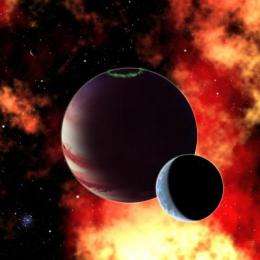
This artist's conception shows a hypothetical gas giant planet with an Earth-like moon similar to the moon Pandora in the movie Avatar. New research shows that, if we find such an "exomoon" in the habitable zone of a nearby star, the James Webb Space Telescope will be able to study its atmosphere and detect key gases like carbon dioxide, oxygen, and water. The key is to find a planet that transits its star, and then find a moon orbiting that planet more than one stellar radius away, so that the moon can be studied independently of the planet. Moreover, an alien moon orbiting the gas giant planet of a red dwarf star may be more likely to be habitable than tidally locked Earth-sized planets or super-Earths. Credit: David A. Aguilar, CfA

In the new blockbuster Avatar, humans visit the habitable - and inhabited - alien moon called Pandora. Life-bearing moons like Pandora or the Star Wars forest moon of Endor are a staple of science fiction. With NASA's Kepler mission showing the potential to detect Earth-sized objects, habitable moons may soon become science fact. If we find them nearby, a new paper by Smithsonian astronomer Lisa Kaltenegger shows that the James Webb Space Telescope (JWST) will be able to study their atmospheres and detect key gases like carbon dioxide, oxygen, and water vapor.

"If Pandora existed, we potentially could detect it and study its atmosphere in the next decade," said Lisa Kaltenegger of the Harvard-Smithsonian Center for Astrophysics (CfA).

So far, planet searches have spotted hundreds of Jupiter-sized objects in a range of orbits. Gas giants, while easier to detect, could not serve as homes for life as we know it. However, scientists have speculated whether a rocky orbiting a gas giant could be life-friendly, if that planet orbited within the star's habitable zone (the region warm enough for liquid water to exist).

"All of the gas giant in our solar system have rocky and icy moons," said Kaltenegger. "That raises the possibility that alien Jupiters will also have moons. Some of those may be Earth-sized and able to hold onto an atmosphere."

Kepler looks for planets that cross in front of their host stars, which creates a mini-eclipse and dims the star by a small but detectable amount. Such a transit lasts only hours and requires exact alignment of star and planet along our line of sight. Kepler will examine thousands of stars to find a few with transiting worlds.

Once they have found an alien Jupiter, astronomers can look for orbiting moons, or exomoons. A moon's gravity would tug on the planet and either speed or slow its transit, depending on whether the moon leads or trails the planet. The resulting transit duration variations would indicate the moon's existence.

Once a moon is found, the next obvious question would be: Does it have an atmosphere? If it does, those gases will absorb a fraction of the star's light during the transit, leaving a tiny, telltale fingerprint to the atmosphere's composition.

The signal is strongest for large worlds with hot, puffy atmospheres, but an Earth-sized moon could be studied if conditions are just right. For example, the separation of moon and planet needs to be large enough that we could catch just the moon in transit, while its planet is off to one side of the star.

Kaltenegger calculated what conditions are best for examining the atmospheres of alien moons. She found that alpha Centauri A, the system featured in Avatar, would be an excellent target.

"Alpha Centauri A is a bright, nearby star very similar to our Sun, so it gives us a strong signal" Kaltenegger explained. "You would only need a handful of transits to find water, oxygen, carbon dioxide, and methane on an Earth-like moon such as Pandora."

"If the Avatar movie is right in its vision, we could characterize that moon with JWST in the near future," she added.

While alpha Centauri A offers tantalizing possibilities, small, dim, red dwarf stars are better targets in the hunt for habitable planets or moons. The habitable zone for a red dwarf is closer to the star, which increases the probability of a transit.

Astronomers have debated whether tidal locking could be a problem for red dwarfs. A planet close enough to be in the habitable zone would also be close enough for the star's gravity to slow it until one side always faces the star. (The same process keeps one side of the Moon always facing Earth.) One side of the planet then would be baked in constant sunlight, while the other side would freeze in constant darkness.

An exomoon in the wouldn't face this dilemma. The moon would be tidally locked to its planet, not to the star, and therefore would have regular day-night cycles just like Earth. Its atmosphere would moderate temperatures, and plant life would have a source of energy moon-wide.

"Alien moons orbiting planets may be more likely to be habitable than tidally locked Earth-sized planets or super-Earths," said Kaltenegger. "We should certainly keep them in mind as we work toward the ultimate goal of finding alien life."

Provided by Harvard-Smithsonian Center for Astrophysics (news : web)

4.3 /5 (28 votes)  

Filter


Move the slider to adjust rank threshold, so that you can hide some of the comments.


Display comments: newest first

mysticshakra
Dec 17, 2009

Rank: 1.6 / 5 (7)
Mars was a moon of another habitable planet and was itself habitable.
Nik_2213
Dec 17, 2009

Rank: 3 / 5 (1)
Sorry, mysticshakra, must ask, which other planet, and how ??
--
FWIW, exomoons would seem more probable than Earth/Moon combos, adding another twist to Drake Equation-- The hypothetical 'They' are looking in the wrong place to find little us...
Parsec
Dec 17, 2009

Rank: 4.3 / 5 (3)
The idea that aliens intelligent enough to have the technology to see us existing simultaneously without also having the imagination to look beyond their exact physical circumstances is silly.

After all puny humans easily can imagine life under all sorts of conditions on all sorts of planet sizes, moon configurations, etc. The idea aliens couldn't... well its just ludicrous.
yyz
Dec 18, 2009

Rank: 3 / 5 (1)
Lisa Kaltenegger's short paper "Characterizing Habitable Exo-Moons" was recently posted at the arXiv site: http://arxiv.org/...3484.pdf .

Abstract:
"We discuss the possibility of screening the atmosphere of exomoons for habitability. We concentrate on Earth-like satellites of extrasolar giant planets (EGP) which orbit in the Habitable Zone of their host stars. The detectability of exomoons for EGP in the Habitable Zone has recently been shown to be feasible with the Kepler Mission or equivalent photometry using transit duration observations. Using the Earth itself as a proxy we show the potential and limits of spectroscopy to detect biomarkers on an Earth-like exomoon and discuss effects of tidal locking for such potential habitats. Transmission spectroscopy of exomoons is a unique potential tool to screen them for habitability in the near future."

Interestingly, James Cameron (Avatar's director) is referenced, in regards to Alpha Centauri A.
WhiteJim
Dec 18, 2009

Rank: 3 / 5 (1)
I believe that with the planet tidaly locked to the star and the moon tidaly locked to the planet this would provide a more stable and uniform climate than that of the earth.
yyz
Dec 18, 2009

Rank: not rated yet
Might not one consider the magnetic/radiation fields that an exomoon might encounter around a distant super-Earth or Earth-sized exoplanet. Remember the fields encountered around Jupiter and Saturn in our own solar system. I didn't see this issue specifically addressed in the paper I linked to above, but this may possibly affect prospects for life around super-Earths closely orbiting their parent stars (and their exomoons that are exposed to these fields).
jselin
Dec 18, 2009

Rank: 4.5 / 5 (2)
Imagine a world where inhabitants looked up at a giant host planet in wonder as we did through history with the moon. As Carl Sagan notes, we got a pretty boring setup here.

"A still more glorious dawn awaits"
taylorphoto
Dec 19, 2009

Rank: 5 / 5 (1)
I've been thinking about the earth sized satellite of gas giant scenario and I can't help but think that the days would be really long in a tidal lock situation. Days on the moon are half a month long and the night is the same.
plasticpower
Dec 20, 2009

Rank: 4.5 / 5 (2)
Not if the planet is orbiting around a red dwarf star. In which case it would be just right. The only issue I have with this idea is the fact that gas giants are basically vacuum cleaners for asteroids and other such unpleasant things, and sometimes their moons are in the way.
GeoffPen
Dec 20, 2009

Rank: not rated yet
In this interview with Debra Fischer she states that a gas giant as described in the movie has been ruled out because their measurements so far would have been able to identify it.
http://marketsaw....ora.html
Rank 4.3 /5 (28 votes)
Related Stories
Relevant PhysicsForums posts
  • Scale of the Universe
    created14 hours ago
  • Titan's lack of impact craters
    createdFeb 09, 2012
  • Real pictures of black hole eating a star?
    createdFeb 08, 2012
  • Hypothetical way to travel faster than light, but not technically exceed lightspeed
    createdFeb 06, 2012
  • How do scientists monitor the Sun's activity?
    createdFeb 05, 2012
  • Search patterns in observational studies
    createdFeb 05, 2012
  • More from Physics Forums - General Astronomy

More news stories

Could Venus be shifting gear?

(PhysOrg.com) -- ESA’s Venus Express spacecraft has discovered that our cloud-covered neighbour spins a little slower than previously measured. Peering through the dense atmosphere in the infrared, the ...

Space & Earth / Space Exploration

created 21 hours ago | popularity 5 / 5 (7) | comments 8 | with audio podcast

Mars Science Laboratory computer issue resolved

(PhysOrg.com) -- Engineers have found the root cause of a computer reset that occurred two months ago on NASA's Mars Science Laboratory and have determined how to correct it.

Space & Earth / Space Exploration

created 22 hours ago | popularity 4.7 / 5 (6) | comments 4 | with audio podcast

Two new moons for Jupiter

Advances in technology have lead to the discovery of new planets outside of our Solar System, and now even new moons in our own backyard.

Space & Earth / Space Exploration

created 21 hours ago | popularity 4 / 5 (1) | comments 7

NASA sees wide-eyed cyclone Jasmine

Cyclone Jasmine's eye has opened wider on NASA satellite imagery, as it moves through the Southern Pacific Ocean.

Space & Earth / Earth Sciences

created 13 hours ago | popularity 3.5 / 5 (2) | comments 2

Clam fields found at deep, low-temperature Mariana vents

(PhysOrg.com) -- Scientists have marveled at the unusual life forms thriving at high temperature hydrothermal vents of the deep ocean.

Space & Earth / Earth Sciences

created 21 hours ago | popularity 4.3 / 5 (3) | comments 0 | with audio podcast


Anonymous knocks CIA website offline (Update)

The website of the Central Intelligence Agency was inaccessible on Friday after the hacker group Anonymous claimed to have knocked it offline.

New error-correcting codes guarantee the fastest possible rate of data transmission

Error-correcting codes are one of the triumphs of the digital age. They’re a way of encoding information so that it can be transmitted across a communication channel — such as an optical fiber o ...

Small modular reactor design could be a 'SUPERSTAR'

(PhysOrg.com) -- Though most of today's nuclear reactors are cooled by water, we've long known that there are alternatives; in fact, the world's first nuclear-powered electricity in 1951 came from a reactor ...

New power source discovered

(PhysOrg.com) -- Researchers at the Massachusetts Institute of Technology (MIT) and RMIT University have made a breakthrough in energy storage and power generation.

The power of estrogen -- male snakes attract other males

A new study has shown that boosting the estrogen levels of male garter snakes causes them to secrete the same pheromones that females use to attract suitors, and turned the males into just about the sexiest ...

Advanced power-grid model finds low-cost, low-carbon future in West

(PhysOrg.com) -- The least expensive way for the Western U.S. to reduce greenhouse gas emissions enough to help prevent the worst consequences of global warming is to replace coal with renewable and other ...