Hot Electrons Could Double Solar Cell Power Efficiency
December 18, 2009 by Lisa Zyga weblog
Hot electron solar cell

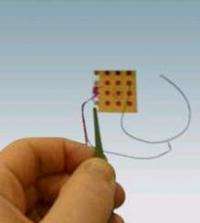
Hot electrons could pass through an ultra-thin solar cell without cooling down, with the potential for doubling solar cell efficiency. Image credit: Michael Naughton.

Scientists have experimentally verified a theory suggesting that hot electrons could double the output of solar cells. The researchers, from Boston College, have built solar cells that successfully use hot electrons to increase the cells' power ouput. Although the power increase is small, the concept could lead to solar cells that break conventional efficiency limits.

Michael Naughton, a physics professor at Boston College, and others have designed an ultra-thin (15-nanometer-thick) solar cell, which hot electrons can quickly pass through before cooling. In conventional, thicker , only the "cooler" lower-energy electrons that have longer wavelengths can pass through.

When a conventional solar cell absorbs a high-energy photon, it produces a hot electron that quickly loses much of its energy as heat before it can pass through the cell and be used to generate electricity. Although solar cells can be designed to absorb high-energy photons and use hot electrons, they aren't able to absorb low-energy photons as well. The new solar cell design, however, can absorb both.

Theoretically, solar cells that can absorb hot and cool electrons could nearly double their . Conventional solar cells can convert at most about 35% of sunlight energy into electricity, and the rest is wasted as heat. By absorbing the hot electrons, solar cells could achieve efficiencies of up to 67%, according to an article in MIT's Technology Review. By doubling the efficiency, the cost of solar power could be cut in half.

There are still challenges with the new ultra-thin solar cells, however. Because they're so thin, most of the light passes through them, so they only convert about 3% of incoming light into electricity. But past research has shown that adding to the could allow them to absorb more light while still keeping a short travel distance for the electrons. In addition, the scientists are investigating incorporating into the to increase the number of electrons collected from the absorbed light.

More information: Elusive 'hot' electrons captured in ultra-thin solar cells

© 2009 PhysOrg.com

4.3 /5 (19 votes)  

Filter


Move the slider to adjust rank threshold, so that you can hide some of the comments.


Display comments: newest first

sender
Dec 18, 2009

Rank: 3 / 5 (1)
maybe capturing 100% of the photonic energy requires a non-blinking brewster prism array, hopefully some scientist will read this comment and build the patent for it :)
Parsec
Dec 19, 2009

Rank: 3 / 5 (1)
Actually, the trick is probably to create a stack of these ultra thin cells. Each layer absorbs some photons and passes the rest thru, until all the light is absorbed and converted into electricity. It would be essential of course to have a very inexpensive manufacturing process so that the stacks wouldn't have to be created one layer at a time, but I don't see why epitaxial growth processes along with diffusion sputtering used for normal silicon manufacturing couldn't be used.
Rank 4.3 /5 (19 votes)
Related Stories
Relevant PhysicsForums posts
  • Liverpool vs Manchester United
    created36 minutes ago
  • Wearing black in a desert
    created1 hour ago
  • Did space exist before mass?
    created1 hour ago
  • How can E&M Waves be polarized?
    created1 hour ago
  • Does light travel for ever?
    created2 hours ago
  • Infinity by Particles
    created3 hours ago
  • More from Physics Forums - General Physics

More news stories

What lies beneath: Mapping hidden nanostructures

The ability to diagnose and predict the properties of materials is vital, particularly in the expanding field of nanotechnology. Electron and atom-probe microscopy can categorize atoms in thin sheets of material, ...

Nanotechnology / Nanophysics

created 12 hours ago | popularity 5 / 5 (1) | comments 1

New kind of solar cell could capture significantly more energy than current cells

New solar cells could increase the maximum efficiency of solar panels by over 25%, according to scientists from the University of Cambridge.

Nanotechnology / Nanophysics

created Feb 08, 2012 | popularity 4.5 / 5 (12) | comments 14 | with audio podcast

'Dark plasmons' transmit energy

Microscopic channels of gold nanoparticles have the ability to transmit electromagnetic energy that starts as light and propagates via "dark plasmons," according to researchers at Rice University.

Nanotechnology / Nanophysics

created Feb 09, 2012 | popularity 5 / 5 (6) | comments 1 | with audio podcast

Nanoshell whispering galleries improve thin solar panels

Visitors to Statuary Hall in the U.S. Capitol Building may have experienced a curious acoustic feature that allows a person to whisper softly at one side of the cavernous, half-domed room and for another on ...

Nanotechnology / Nanomaterials

created Feb 07, 2012 | popularity 4.3 / 5 (6) | comments 6 | with audio podcast

Revealing how a battery material works

Since its discovery 15 years ago, lithium iron phosphate (LiFePO4) has become one of the most promising materials for rechargeable batteries because of its stability, durability, safety and ability to deliver ...

Nanotechnology / Nanomaterials

created Feb 08, 2012 | popularity 5 / 5 (5) | comments 0 | with audio podcast


Google users warned of threat to smartphone wallets

Users of Google smartphone wallets were being warned on Friday that there is a way to crack pass codes intended to thwart thieves from going on illicit shopping sprees.

Anonymous knocks CIA website offline (Update)

The website of the Central Intelligence Agency was inaccessible on Friday after the hacker group Anonymous claimed to have knocked it offline.

Complex wiring of the nervous system may rely on a just a handful of genes and proteins

Researchers at the Salk Institute have discovered a startling feature of early brain development that helps to explain how complex neuron wiring patterns are programmed using just a handful of critical genes. ...

New error-correcting codes guarantee the fastest possible rate of data transmission

Error-correcting codes are one of the triumphs of the digital age. They’re a way of encoding information so that it can be transmitted across a communication channel — such as an optical fiber o ...

The power of estrogen -- male snakes attract other males

A new study has shown that boosting the estrogen levels of male garter snakes causes them to secrete the same pheromones that females use to attract suitors, and turned the males into just about the sexiest ...

Humans may have helped the decline of African rainforests 3000 years ago

(PhysOrg.com) -- Large areas of rainforests in Central Africa mysteriously disappeared over three thousand years ago, to be replaced by savannas. The prevailing theory has been that the cause was a change ...