African leaf-eating monkeys are 'likely to be wiped out' by climate change
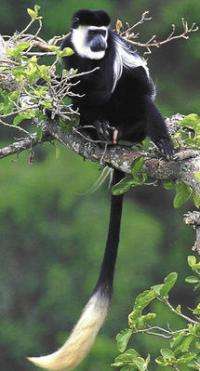
December 18, 2009
Colobus monkeys are one of the primate species most at risk from climate change.
(PhysOrg.com) -- Monkey species will become 'increasingly at risk of extinction' because of global warming, according to new research published this week.
The research reveals that populations of monkeys and apes in Africa that depend largely on a diet of leaves may be wiped out by a rise in annual temperatures of 2°C. The study by researchers from Bournemouth, Roehampton and Oxford Universities suggests that the species most at risk are the already endangered gorillas and colobine monkeys.
The paper, published online in Animal Behaviour, pinpoints which species are most threatened by climate change in a series of new global maps. The maps show current and predicted distributions of primates, comparing the populations according to their diet and the amount of enforced rest they are predicted to need.
The researchers warn that Old World monkey populations in Africa will be hardest hit even by a very modest 2°C increase in global mean temperature, especially those whose diets are mainly leaf-based such as the beautiful colobine monkeys.
In contrast, New World monkeys in South America will be virtually unaffected by a rise of 2°C in mean temperatures.
However, even the South American species will begin to suffer if temperatures rise as much as 4°C because suitable habitats will then become increasingly fragmented, and small fragmented populations are more liable to risks of extinction.
These predictions are based on analyses of ecological constraints that determine how much time animals are forced to rest. The researchers found that animals that have forced rest have less time to forage for food or engage in other biologically essential activities, such as forming friendships.
Although most primates have adaptations that help them cope with the heat, they head for shelter and rest when the sun gets too hot. The researchers show that resting time is influenced by three main factors: the percentage of leaves in the animals’ diet, temperature variation and mean annual temperature. When these three effects come together, susceptible species will be unable to cope and populations will go extinct.
The researchers used climate models coupled with an analysis of quantitative data on the behaviour, diet and group size of different primate species across the world.
African monkeys and apes that have a high percentage of leaves in their diet are geographically more restricted even now, being confined to a relatively narrow region around the equator. However, fruit-eating species like the baboons and guenon monkeys of Africa typically have a much wider latitudinal range and can cope with a wider range of climatic conditions.
This ecological separation between fruit- and leaf-eating species is much less obvious in the Americas, and so these species will be much less badly affected by climate warming.
The contrast between the continents may be due to the fact that African fruit-eating species may have developed a particular ecological adaptation to more challenging habitats than those encountered by species in South America.
Lead author Dr Amanda Korstjens, from Bournemouth University, said: ‘The possibility that enforced resting time might have so strong an effect on where on the map a major mammal group is likely to survive has not previously been appreciated. This study suggests that the amount of time available for monkeys and apes to gather food and socialise may be a key factor when looking at possible effects of climate change on animal distribution patterns in the past and in the future.’
Professor Robin Dunbar, from the Institute of Cognitive and Evolutionary Anthropology at the University of Oxford, said: ‘We often worry about deforestation and hunting as the two main factors threatening the extinction of primate populations, but these results suggest that even if we find ways to solve these problems, it may not save some species of monkeys and apes from extinction. Instead, we perhaps should worry about ensuring that we provide these species with habitats that are more in tune with their capacities to cope with climate change.’
Dr Julia Lehmann, from Roehampton University, said: ‘At overall temperature increases of 2°C and 4°C, the distribution of habitat suitable for species that eat a lot of leaves will be greatly reduced. The distribution of suitable habitat would become progressively restricted and increasingly fragmented. The scale of the effect is sufficiently large that the implications for the survival of the dietetically more specialised primates are worrying.’
-
Global warming cycles threaten endangered primate species
Oct 27, 2009 |
not rated yet |
0
-
Monkeys' grooming habits provide clues to how we socialise
Sep 30, 2009 |
not rated yet |
0
-
Research shows that animals need time to survive
Aug 01, 2009 |
not rated yet |
0
-
British butterfly reveals role of habitat for species responding to climate change
Feb 25, 2009 |
not rated yet |
0
-
Extinction threat growing for mankind's closest relatives
Aug 05, 2008 |
not rated yet |
0
-
Engineers build first sub-10-nm carbon nanotube transistor
Feb 01, 2012 |
4.9 / 5 (31) |
30
-
Something old, something new: Evolution and the structural divergence of duplicate genes
Jan 31, 2012 |
4.6 / 5 (7) |
1
-
The hidden nanoworld of ice crystals: Revealing the dynamic behavior of quasi-liquid layers
Jan 30, 2012 |
5 / 5 (3) |
1
-
Stock market network reveals investor clustering
Jan 27, 2012 |
3.9 / 5 (23) |
8
-
Of microchemistry and molecules: Electronic microfluidic device synthesizes biocompatible probes
Jan 26, 2012 |
5 / 5 (1) |
0
-
Stem cell question.
1 hour ago
-
Protease cleavage
7 hours ago
-
Pertubance in a model
14 hours ago
-
Cancer drugs and Alzheimer's, Oh my!
22 hours ago
-
Squishing cells
23 hours ago
-
Any books/articles for evolutionary stable strategy models in humans?
Feb 09, 2012
- More from Physics Forums - Biology
More news stories
The power of estrogen -- male snakes attract other males
A new study has shown that boosting the estrogen levels of male garter snakes causes them to secrete the same pheromones that females use to attract suitors, and turned the males into just about the sexiest ...
12 hours ago |
4.8 / 5 (5) |
1
|
Grass to gas: Researchers' genome map speeds biofuel development
Researchers at the University of Georgia have taken a major step in the ongoing effort to find sources of cleaner, renewable energy by mapping the genomes of two originator cells of Miscanthus x giganteus, a large perenn ...
9 hours ago |
3.8 / 5 (5) |
0
|
Experts reveal how plants don't get sunburn
(PhysOrg.com) -- Experts at the University of Glasgow have discovered how plants survive the harmful rays of the sun.
12 hours ago |
4.7 / 5 (3) |
0
|
Miami battling invasion of giant African snails
No one knows how they got there. But an invasion of African giant snails has southern Florida in a panic over potential crop damage, disease and general yuckiness surrounding the slimy gastropods.
16 hours ago |
4 / 5 (1) |
4
Protein libraries in a snap
(PhysOrg.com) -- A Rice University undergraduate will depart with not only a degree but also a possible patent for his invention of an efficient way to create protein libraries, an important component of biomolecular ...
16 hours ago |
4.8 / 5 (4) |
0
|
Google users warned of threat to smartphone wallets
Users of Google smartphone wallets were being warned on Friday that there is a way to crack pass codes intended to thwart thieves from going on illicit shopping sprees.
Anonymous knocks CIA website offline (Update)
The website of the Central Intelligence Agency was inaccessible on Friday after the hacker group Anonymous claimed to have knocked it offline.
Complex wiring of the nervous system may rely on a just a handful of genes and proteins
Researchers at the Salk Institute have discovered a startling feature of early brain development that helps to explain how complex neuron wiring patterns are programmed using just a handful of critical genes. ...
New error-correcting codes guarantee the fastest possible rate of data transmission
Error-correcting codes are one of the triumphs of the digital age. Theyre a way of encoding information so that it can be transmitted across a communication channel such as an optical fiber o ...
Humans may have helped the decline of African rainforests 3000 years ago
(PhysOrg.com) -- Large areas of rainforests in Central Africa mysteriously disappeared over three thousand years ago, to be replaced by savannas. The prevailing theory has been that the cause was a change ...
New power source discovered
(PhysOrg.com) -- Researchers at the Massachusetts Institute of Technology (MIT) and RMIT University have made a breakthrough in energy storage and power generation.
Dec 19, 2009
Rank: 1 / 5 (4)
Dec 19, 2009
Rank: 2.3 / 5 (6)
So, what? Ground sloths and Sabre Toothed tigers didn't fair well in the cold weather of the Lesser Dryas, either.
Fact is, species have become extinct for as long as there have been species.
Dec 19, 2009
Rank: 1 / 5 (3)
I doubt the annual temperature will rise that much. I think these so called scientist sould be more concerned about these monkeys freezing to death. To base your research on forged information and corrupt data is not worthy of a scientist. Global warming is more a religion than real science.
Dec 20, 2009
Rank: 1 / 5 (2)
Anyone recall the Mt Graham red squirrel debate? The Mt Graham red squirrel was a native of TX, not AZ. It was brought to Mt Graham for sport. When the U of A wanted to build a telescope on Mt Graham, the red squirrel was used as and excuse to stop construction. Supporters of the red squirrel even tried to feed them at times when their food supplies naturally diminished.
You can't have it both ways. Either support letting nature take its course, no interference, or, interfere and accept the consequences.