Spirit Rover: Right-Front Wheel Rotations
December 18, 2009
Right-Front Wheel Rotations

Enlarge

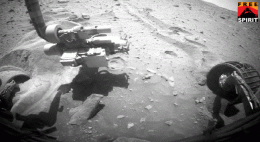
This three-frame animation aids evaluation of performance of the right-front wheel on NASA's Mars Exploration Rover Spirit during a drive on the rover's 2,117th Martian day, or sol (Dec. 16, 2009). Image credit: NASA/JPL-Caltech

(PhysOrg.com) -- Spirit's right-front wheel, which had stopped operating in March 2006, revolved with apparently normal motion during the first three of four driving segments on Sol 2117 (Wednesday, Dec. 16) but stopped early in the fourth segment of the drive.

The rover's right-rear , which stalled nearly three weeks ago, remained immobile during the entire Sol 2117 drive. The other four wheels all drove forward in this part of the continuing attempt to extricate Spirit from the sand trap where it is embedded. The sol's total commanded motion was 10 meters (33 feet) worth of wheel rotations. The resulting movement of the rover was about 2 millimeters (0.08 inch) forward and 4 millimeters (0.16 inch) downward. That ratio of forward to downward is well below what would be necessary over longer distance for extrication. Part of the downward motion on Sol 2117 resulted from the right-front wheel digging in as it rotated about 10 times.

Engineers are analyzing results from the Sol 2117 drive and from electrical tests conducted prior to the drive. Movement of the right-front wheel for about 3.5 minutes was a surprise, despite an indication from an electrical-resistance test on Sol 2113 (Saturday, Dec. 12) that some motion might be possible by the long-disused wheel. It is not clear whether the wheel will work again, since it stopped during the final drive segment. It is also not clear whether extrication from the sand trap would be possible even with an operable right-front wheel.

The drive conducted on Sol 2117 had been planned for one sol earlier, but was delayed after analysis of the Sol 2113 test led to discovery of a new electrical issue on Spirit. Engineers learned that a persistent voltage now exists between the rover electric ground and the rover chassis where no voltage should exist. This condition might be related to problems with the right-rear wheel.

Spirit ran diagnostic tests related to this grounding issue on 2117 prior to driving and during the drive. The single-point ground showed a sustained minus 5 volts that increased to minus 25 volts whenever any of the six wheel-driving motors or four wheel-steering motors were powered. This suggests the unusual electrical behavior is associated with the rover motor controller board since the behavior is seen with all 10 motors associated with that electronics board. The rover has other motors not related to the wheels, but the persistent voltage has not been associated with any of those.

The plan ahead is to perform another set of low-voltage tests on the three right-side wheels and then command another four-step forward drive. This drive would not use the right-front wheel in conjunction with the others, but that wheel would be driven briefly by itself after each step to gain more information about its possible usefulness.

Provided by JPL/NASA (news : web)

4.8 /5 (5 votes)  

Rank 4.8 /5 (5 votes)
Related Stories
Relevant PhysicsForums posts
  • Scale of the Universe
    created8 hours ago
  • Titan's lack of impact craters
    createdFeb 09, 2012
  • Real pictures of black hole eating a star?
    createdFeb 08, 2012
  • Hypothetical way to travel faster than light, but not technically exceed lightspeed
    createdFeb 06, 2012
  • How do scientists monitor the Sun's activity?
    createdFeb 05, 2012
  • Search patterns in observational studies
    createdFeb 05, 2012
  • More from Physics Forums - General Astronomy

More news stories

Humans may have helped the decline of African rainforests 3000 years ago

(PhysOrg.com) -- Large areas of rainforests in Central Africa mysteriously disappeared over three thousand years ago, to be replaced by savannas. The prevailing theory has been that the cause was a change ...

Space & Earth / Environment

created 19 hours ago | popularity 4.3 / 5 (11) | comments 12 | with audio podcast report

Could Venus be shifting gear?

(PhysOrg.com) -- ESA’s Venus Express spacecraft has discovered that our cloud-covered neighbour spins a little slower than previously measured. Peering through the dense atmosphere in the infrared, the ...

Space & Earth / Space Exploration

created 15 hours ago | popularity 5 / 5 (7) | comments 7 | with audio podcast

NASA budget will axe Mars deal with Europe: scientists

US President Barack Obama's budget proposal to be submitted next week for 2013 will cut NASA's budget by 20 percent and eliminate a major partnership with Europe on Mars exploration, scientists said Thursday.

Space & Earth / Space Exploration

created 18 hours ago | popularity 5 / 5 (2) | comments 18

Mars Science Laboratory computer issue resolved

(PhysOrg.com) -- Engineers have found the root cause of a computer reset that occurred two months ago on NASA's Mars Science Laboratory and have determined how to correct it.

Space & Earth / Space Exploration

created 16 hours ago | popularity 4.7 / 5 (6) | comments 3 | with audio podcast

Two new moons for Jupiter

Advances in technology have lead to the discovery of new planets outside of our Solar System, and now even new moons in our own backyard.

Space & Earth / Space Exploration

created 15 hours ago | popularity 4 / 5 (1) | comments 7


Google users warned of threat to smartphone wallets

Users of Google smartphone wallets were being warned on Friday that there is a way to crack pass codes intended to thwart thieves from going on illicit shopping sprees.

Anonymous knocks CIA website offline (Update)

The website of the Central Intelligence Agency was inaccessible on Friday after the hacker group Anonymous claimed to have knocked it offline.

New error-correcting codes guarantee the fastest possible rate of data transmission

Error-correcting codes are one of the triumphs of the digital age. They’re a way of encoding information so that it can be transmitted across a communication channel — such as an optical fiber o ...

New power source discovered

(PhysOrg.com) -- Researchers at the Massachusetts Institute of Technology (MIT) and RMIT University have made a breakthrough in energy storage and power generation.

Complex wiring of the nervous system may rely on a just a handful of genes and proteins

Researchers at the Salk Institute have discovered a startling feature of early brain development that helps to explain how complex neuron wiring patterns are programmed using just a handful of critical genes. ...

The power of estrogen -- male snakes attract other males

A new study has shown that boosting the estrogen levels of male garter snakes causes them to secrete the same pheromones that females use to attract suitors, and turned the males into just about the sexiest ...