How the daisy got its spots... and why
December 18, 2009
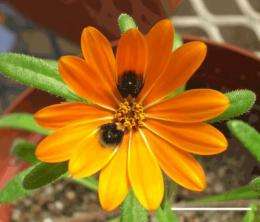
This is the Nieuw morphotype of Gorteria diffusa, which exhibits striking dark petal spots at the bases of some ray florets. Scale bar = 1 cm. Credit: Courtesy Meredith Murphy Thomas.
Dark spots on flower petals are common across many angiosperm plant families and occur on flowers such as some lilies, orchids, and daisies. Much research has been done on the physiological and behavioral mechanisms for how these spots attract pollinators. But have you ever wondered what these spots are composed of, how they develop, or how they only appear on some but not all of the ray florets?
Dr. Meredith Thomas from the University of Cambridge and associates from England and South Africa were interested in exploring these questions and published their findings in the December issue of the American Journal of Botany. They focused on the South African endemic beetle daisy Gorteria diffusa (Asteraceae), which has a unique, raised, dark spot at the base of some of its ray florets.
"I find this plant/pollinator system very exciting to study because of the amazing morphological variation in the flowers between populations," Thomas said. "The spots on the flowers mimic the plant's pollinator, a small fly, which is attracted to the plant because of the spots. The plant is dependent on the pollinator for reproductive success, so it's incredibly important that the plant attracts the flies.
"What we found surprising," Thomas continued, "was how complex the petal spots are in a few populations, when other populations seem to get by with a very simple spot or even no petal spot at all."
By peeling away layers of the tissues that make up the spots on mature ray florets and examining them under a simple dissecting scope, Thomas and associates found that the spots of G. diffusa are more complex than most. These spots are composed of three different types of specialized epidermal cells: the central highlight cells that reflect UV and lack pigment; the interior cells that are shorter, rounder, variously pigmented, and raised above the highlight cells; and, surrounding the spot, a circle of multicellular papillae that are swollen, shiny, and filled with anthocyanin. Moreover, each spot spans four congenitally fused petal lobes, meaning that each lobe contained only part of the spot (and only some cell types) in its genetic makeup.
So what attracts the pollinators? Because there is a lot of spot variation in this species, the authors hypothesize that the elements that are found in common among the various populations, such as the presence of anthocyanin pigment or UV reflectivity, might do the trick.
The authors also wanted to know how only a subset of the floral rays develops a spot. Using scanning electron microscopy the authors looked at how the spot developed, or its ontogeny, over time. They found that only the first few ray florets that develop contain the spots, whereas the rest do not. Thomas noted that "the plant has evolved a very clever way of distributing the pollinator-mimicking spots around the inflorescence so that they appear random, as if a few flies had just landed on the inflorescence, when in fact the position of the spots is mathematically pre-determined according to the plant's phyllotaxy [or the order and location in which new floral organs are initiated]." The authors hypothesize that the genes that control the appearance of the spot are turned on initially and then fade with time, such that only the first, and oldest, rays to develop have the spots. Thus, the development of the spots is complex not only at the cellular level, but at the organismal level as well.
"What we now plan to investigate," concludes Thomas, "is whether the development of this adaptive floral trait is regulated by a similarly complex genetic regulatory pathway, or if this plant has simply co-opted and modified a pathway commonly used in plants to produce other types of specialized surface structures, like hairs."
More information: http://www.amjbot.org/cgi/content/full/96/12/2184
Provided by American Journal of Botany
-
Study looks at fruit fly sexual attraction
Apr 19, 2006 |
not rated yet |
0
-
Chinese takeaway in the Wadden Sea
Sep 25, 2007 |
not rated yet |
0
-
N.Z. Telecom has hot spots for PlayStation
Sep 20, 2005 |
not rated yet |
0
-
The Sun Loses its Spots
Jul 24, 2007 |
not rated yet |
0
-
Gemini Captures Close Encounter of Jupiter's Red Spots
Jul 25, 2006 |
not rated yet |
0
-
Engineers build first sub-10-nm carbon nanotube transistor
Feb 01, 2012 |
4.9 / 5 (31) |
30
-
Something old, something new: Evolution and the structural divergence of duplicate genes
Jan 31, 2012 |
4.6 / 5 (7) |
1
-
The hidden nanoworld of ice crystals: Revealing the dynamic behavior of quasi-liquid layers
Jan 30, 2012 |
5 / 5 (3) |
1
-
Stock market network reveals investor clustering
Jan 27, 2012 |
3.9 / 5 (23) |
8
-
Of microchemistry and molecules: Electronic microfluidic device synthesizes biocompatible probes
Jan 26, 2012 |
5 / 5 (1) |
0
-
Mitosis
4 hours ago
-
Stem cell question.
5 hours ago
-
Protease cleavage
12 hours ago
-
Pertubance in a model
18 hours ago
-
Cancer drugs and Alzheimer's, Oh my!
Feb 09, 2012
-
Squishing cells
Feb 09, 2012
- More from Physics Forums - Biology
More news stories
The power of estrogen -- male snakes attract other males
A new study has shown that boosting the estrogen levels of male garter snakes causes them to secrete the same pheromones that females use to attract suitors, and turned the males into just about the sexiest ...
16 hours ago |
4.8 / 5 (6) |
1
|
Grass to gas: Researchers' genome map speeds biofuel development
Researchers at the University of Georgia have taken a major step in the ongoing effort to find sources of cleaner, renewable energy by mapping the genomes of two originator cells of Miscanthus x giganteus, a large perenn ...
13 hours ago |
3.8 / 5 (5) |
0
|
Miami battling invasion of giant African snails
No one knows how they got there. But an invasion of African giant snails has southern Florida in a panic over potential crop damage, disease and general yuckiness surrounding the slimy gastropods.
20 hours ago |
4 / 5 (1) |
4
Experts reveal how plants don't get sunburn
(PhysOrg.com) -- Experts at the University of Glasgow have discovered how plants survive the harmful rays of the sun.
16 hours ago |
4.8 / 5 (5) |
0
|
Protein libraries in a snap
(PhysOrg.com) -- A Rice University undergraduate will depart with not only a degree but also a possible patent for his invention of an efficient way to create protein libraries, an important component of biomolecular ...
20 hours ago |
4.8 / 5 (4) |
1
|
Anonymous knocks CIA website offline (Update)
The website of the Central Intelligence Agency was inaccessible on Friday after the hacker group Anonymous claimed to have knocked it offline.
Google users warned of threat to smartphone wallets
Users of Google smartphone wallets were being warned on Friday that there is a way to crack pass codes intended to thwart thieves from going on illicit shopping sprees.
New error-correcting codes guarantee the fastest possible rate of data transmission
Error-correcting codes are one of the triumphs of the digital age. Theyre a way of encoding information so that it can be transmitted across a communication channel such as an optical fiber o ...
Humans may have helped the decline of African rainforests 3000 years ago
(PhysOrg.com) -- Large areas of rainforests in Central Africa mysteriously disappeared over three thousand years ago, to be replaced by savannas. The prevailing theory has been that the cause was a change ...
New power source discovered
(PhysOrg.com) -- Researchers at the Massachusetts Institute of Technology (MIT) and RMIT University have made a breakthrough in energy storage and power generation.
Small modular reactor design could be a 'SUPERSTAR'
(PhysOrg.com) -- Though most of today's nuclear reactors are cooled by water, we've long known that there are alternatives; in fact, the world's first nuclear-powered electricity in 1951 came from a reactor ...