Loud and lazy but didn't chew gum: Ancient koalas
December 19, 2009 By Dan Gaffney
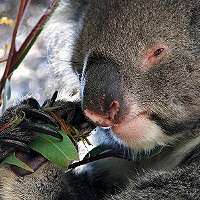
(PhysOrg.com) -- Skull fragments of prehistoric koalas from the Riversleigh rainforests of millions of year ago suggest they shared the modern koala's "lazy" lifestyle and ability to produce loud "bellowing" calls to attract mates and provide warnings about predators.
However, the new findings published as the featured cover article in the current issue of The Journal of Vertebrate Paleontology suggest that the two species of koalas from the Miocene (24 to five million years ago) did not share the uniquely specialized eucalyptus leaf diet of the modern koala (Phascolarctos cinereus).
The shift to a wholly eucalyptus diet by modern koalas was an adaptation that probably came later as Australia drifted north, causing its rainforests to retreat and Eucalypts to become the dominant tree of most Australian forests and woodlands.
Modern koalas - the sole living member of the diprotodontian marsupial family Phascolarctidae -are among the largest of all arboreal leaf-eaters. To attain this remarkable condition on a diet of eucalyptus leaves, a notoriously poor and somewhat toxic food source, the tree-dwelling marsupials developed unique anatomical and physiological adaptations including specialized chewing and digestive anatomies and a highly sedentary lifestyle. The dramatic differences between the skulls of extinct and modern koalas, especially in the facial region, are probably related to the change to a tougher diet of eucalyptus leaves.
Researchers from the University of New South Wales and the CSIRO have drawn these conclusions after making dozens of detailed anatomical comparisons between the brush-tailed possum, the modern koala and the two fossil species (Litokoala kutjamarpensis and Nimiokoala greystanesi).
The fossil species were unearthed from the Riversleigh World Heritage site in Queensland, Australia. The comparisons reveal similarities in the back of the skull between the modern and fossil koalas, but substantial differences in their teeth, palate and jaws.
Koalas are most closely related among living marsupials to wombats but the two species diverged some 30-40 million years ago. Among fossil koalas there are 18 named species representing five genera spanning the period from the late Oligocene (37 million years ago) to the present.
However, they are generally scarce in the fossil record and most species are only known from a few isolated teeth or jaw fragments. Therefore, it has been difficult to develop an accurate picture of their behaviour, diet and evolution.
The researchers believe that the prehistoric koalas also shared with their modern cousins the ability to produce loud "bellows" based on similar large bony prominences - the auditory bullae - that enclose structures in the middle and inner ear. However the auditory bullae of the extinct Nimiokoala and Litokoala species are not as exaggerated as in the modern koala, according to team member UNSW Professor Mike Archer.
"Modern koalas are extremely sedentary and vocal animals," says Archer, who is perhaps best known for leading research into the extraordinary Riversleigh fossil deposits in Queensland, which led to the site being listed on the World Heritage Register.
"They produce low frequency vocalisations that pass through vegetation and can be heard up to 800 metres away - far exceeding the home range limits of male koalas. The fossil koalas share similar large bony ear structures to the modern koala and would have been well adapted to detecting vocalisations in the rainforest environment of Riversleigh in the Miocene era."
"In order to accommodate both the mechanical demands of their new diet, as well as maintaining their auditory sophistication, the koala underwent substantial changes to its cranial anatomy, in particular that of the facial skeleton," says Dr Julien Louys of UNSW's School of Biological, Earth and Environmental Sciences. "The unique cranial configuration of the modern koala is therefore the result of accommodating their masticatory adaptations without compromising their auditory system."
-
Research finds koalas are no dwarves
Dec 11, 2008 |
not rated yet |
0
-
Most koalas in Japan carry leukemia virus: report
Apr 12, 2009 |
not rated yet |
0
-
Vaccine for koala chlamydia close
Jul 17, 2008 |
not rated yet |
0
-
Vaccine trials inject hope into koala's future
Jul 16, 2007 |
not rated yet |
0
-
Koalas calling
Oct 07, 2008 |
not rated yet |
0
-
Engineers build first sub-10-nm carbon nanotube transistor
Feb 01, 2012 |
4.9 / 5 (30) |
30
-
Something old, something new: Evolution and the structural divergence of duplicate genes
Jan 31, 2012 |
4.6 / 5 (7) |
1
-
The hidden nanoworld of ice crystals: Revealing the dynamic behavior of quasi-liquid layers
Jan 30, 2012 |
5 / 5 (3) |
1
-
Stock market network reveals investor clustering
Jan 27, 2012 |
3.9 / 5 (23) |
8
-
Of microchemistry and molecules: Electronic microfluidic device synthesizes biocompatible probes
Jan 26, 2012 |
5 / 5 (1) |
0
-
Cancer drugs and Alzheimer's, Oh my!
3 hours ago
-
Squishing cells
4 hours ago
-
Any books/articles for evolutionary stable strategy models in humans?
15 hours ago
-
Science behind the bore feeling?
22 hours ago
-
Homo Sapien vs. Chimpanzee - Divergence Timeline
Feb 09, 2012
-
a single mRNA strand is attached to sevaral ribosomes?
Feb 08, 2012
- More from Physics Forums - Biology
More news stories
US workers are 'giving away the store,' costing firms billions
Nearly 70 percent of the nation's service employees give away free goods and services from hamburgers to cable TV costing companies billions of dollars a year, according to a groundbreaking study.
Other Sciences / Economics & Business
12 hours ago |
5 / 5 (1) |
8
Storm warning: Financial tsunami heading this way
In today's global village, national coffers are more interconnected than ever before. And as the current economic crisis has proven, a downturn in one country can travel in a wave across the globe, like a financial tsunami. ...
Other Sciences / Economics & Business
13 hours ago |
3 / 5 (2) |
6
Prague gets hold of modern genetics founder Mendel's papers
Germany has handed to the Czech Republic a manuscript of Johann Gregor Mendel, founder of modern genetics, on his plant hybridization experiments, the Czech foreign minister said Thursday.
9 hours ago |
5 / 5 (1) |
1
Kids show cultural gender bias
(PhysOrg.com) -- Talk about gender confusion! A recent study by University of Alberta researchers Elena Nicoladis and Cassandra Foursha-Stevenson in the Journal of Cross-Cultural Psychology into whether speaki ...
Other Sciences / Social Sciences
18 hours ago |
1.5 / 5 (2) |
2
'Flipped classroom' teaching model gains an online community
Researchers at Harvard University have launched the Peer Instruction (PI) Network, a new global social network for users of interactive teaching methods.
Other Sciences / Social Sciences
13 hours ago |
5 / 5 (2) |
0
'Dark plasmons' transmit energy
Microscopic channels of gold nanoparticles have the ability to transmit electromagnetic energy that starts as light and propagates via "dark plasmons," according to researchers at Rice University.
FDA-approved drug rapidly clears amyloid from the brain, reverses Alzheimer's symptoms in mice
Neuroscientists at Case Western Reserve University School of Medicine have made a dramatic breakthrough in their efforts to find a cure for Alzheimer's disease. The researchers' findings, published in the journal Science, show t ...
Hydrogen from acidic water: Researchers develop potential low cost alternative to platinum for splitting water
A technique for creating a new molecule that structurally and chemically replicates the active part of the widely used industrial catalyst molybdenite has been developed by researchers with the Lawrence Berkeley ...
Ultraviolet protection molecule in plants yields its secrets
Lying around in the sun all day is hazardous not just for humans but also for plants, which have no means of escape. Ultraviolet (UV) radiation from the sun can damage proteins and DNA inside cells, leading ...
Soraa LED light may dim 50-watt halogen rivals
(PhysOrg.com) -- Soraa, a Fremont, California company founded in 2008, this week launched its first product, a light that uses LEDS (light emitting diodes). The "Soraa LED MR16 lamp" is the "perfect" replacement ...
Anyone can learn to be more inventive, cognitive researcher says
There will always be a wild and unpredictable quality to creativity and invention, says Anthony McCaffrey, a cognitive psychology researcher at the University of Massachusetts Amherst, because an "Aha moment" is rare and ...