Next generation lens promises more control
December 20, 2009
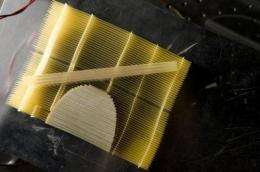
A close-up view of the new lens. Credit: Duke University
(PhysOrg.com) -- Duke University engineers have created a new generation of lens that could greatly improve the capabilities of telecommunications or radar systems to provide a wide field of view and greater detail.
But the lens they fashioned doesn't look anything like a lens. While traditional lenses are made of clear substances - like glass or plastic - with highly polished surfaces, the new lens looks more like a miniature set of tan Venetian blinds. Yet its ability to focus the direction of electromagnetic rays passing through it dramatically surpasses that of a conventional lens, the engineers say.
The latest advance was made possible by the ability to fabricate exotic composite materials known as metamaterials. The metamaterial in these experiments is not so much a single substance, but the entire man-made structure which can be engineered to exhibit properties not readily found in nature.
The prototype lens, which measures four inches by five inches and less than an inch high, is made up of more than 1,000 individual pieces of the same fiberglass material used in circuit boards and is etched with copper. It is the precise arrangement of these pieces in parallel rows, that directs the rays as they pass through.
"For hundreds of years, lens makers have ground the surfaces of a uniform material in such a way as to sculpt the rays as they pass through the surfaces," said Nathan Kundtz, post-doctoral associate in electrical and computer engineering at Duke's Pratt School of Engineering. "While these lenses can focus rays extremely efficiently, they have limitations based on what happens to the rays as they pass through the volume of the lens.
"Instead of using the surfaces of the lens to control rays, we studied altering the material between the surfaces," Kundtz said. "If you can control the volume, or bulk, of the lens, you gain much more freedom and control to design a lens to meet specific needs."
The results of his experiments, which were conducted in the laboratory of senior researcher David R. Smith, the William Bevan Professor of Electrical and Computer Engineering, appeared as an advanced online publication of the journal Nature Materials. This is the first demonstration of what was thought to be theoretically possible.
Recognizing the limitations of traditional lenses, scientists have long been investigating other options, including those known as gradient index (GRIN) lenses. These are typically clear spheres, and while they have advantages over traditional lenses, they are difficult to fabricate and the focus point is spherical. Additionally, because most sensing systems are oriented in two dimensions, the spherical image doesn't always translate clearly on a flat surface.
The new lens, however, has a wide angle of view, almost 180 degrees, and because its focal point is flat, it can be used with standard imaging technologies. The latest experiments were conducted with microwaves, and the researchers say it is theoretically possible to design lenses for wider frequencies.
"We've come up with what is in essence GRIN on steroids," said Smith, whose team used similar metamaterials to create one of the first "cloaking" devices in 2006. "This first in a new class of lenses offers tantalizing possibilities and opens a whole new application for metamaterials.
"While these experiments were conducted in two dimensions, the design should provide a good initial step in developing a three-dimensional lens," Smith said. "The properties of the metamaterials we used should also make it possible to use infrared and optical frequencies."
The researchers say a single metamaterial lens could replace traditional optical systems requiring vast arrays of lenses and provide clearer images. They could also be used in large-scale systems such as radar arrays to better direct beams, a task not possible for traditional lenses, which would need to be too large to be practical.
-
Engineers give industry a moth's eye view
Nov 26, 2007 |
not rated yet |
0
-
Next generation cloaking device demonstrated
Jan 15, 2009 |
not rated yet |
0
-
Liquid lens creates tiny flexible laser on a chip
May 11, 2009 |
not rated yet |
0
-
Mathematical analysis: It may not be possible to create 'perfect lens'
Sep 28, 2004 |
not rated yet |
0
-
Writing patterns, logos and lettering in light
Oct 01, 2008 |
not rated yet |
0
-
Engineers build first sub-10-nm carbon nanotube transistor
Feb 01, 2012 |
4.9 / 5 (31) |
30
-
Something old, something new: Evolution and the structural divergence of duplicate genes
Jan 31, 2012 |
4.6 / 5 (7) |
1
-
The hidden nanoworld of ice crystals: Revealing the dynamic behavior of quasi-liquid layers
Jan 30, 2012 |
5 / 5 (3) |
1
-
Stock market network reveals investor clustering
Jan 27, 2012 |
3.9 / 5 (23) |
8
-
Of microchemistry and molecules: Electronic microfluidic device synthesizes biocompatible probes
Jan 26, 2012 |
5 / 5 (1) |
0
-
excited U-236 decay time in the U235 fission chain
21 hours ago
-
Polar catastrophe?
Feb 09, 2012
-
Large scale field sonication
Feb 09, 2012
-
states and energy of paired electrons in BCS
Feb 08, 2012
-
difference between longitudinal and transverse refractive indices
Feb 08, 2012
-
Monte Carlo simulation
Feb 07, 2012
- More from Physics Forums - Atomic, Solid State, Comp. Physics
More news stories
Putting the squeeze on planets outside our solar system
(PhysOrg.com) -- Using high-powered lasers, scientists at Lawrence Livermore National Laboratory and collaborators discovered that molten magnesium silicate undergoes a phase change in the liquid state, abruptly ...
59 minutes ago |
not rated yet |
0
|
Hovering not hard if you're top-heavy, researchers find
Top-heavy structures are more likely to maintain their balance while hovering in the air than are those that bear a lower center of gravity, researchers at New York University's Courant Institute of Mathematical Sciences ...
2 hours ago |
5 / 5 (1) |
1
|
SLAC, Stanford team focuses on high-energy electrons to treat cancer
Accelerator physicists at SLAC and cancer specialists from Stanford are working on a new technology that could dramatically reduce the time needed for cancer radiation treatments. The team ran an initial experiment ...
5 hours ago |
5 / 5 (1) |
0
Measurements from high-energy collisions lead to better understanding of why meson particles disappear
For several years, physicists at the Relativistic Heavy Ion Collider (RHIC) at Brookhaven National Laboratory (BNL), USA, have studied an unusual state of matter called the quarkgluon plasma, which they ...
5 hours ago |
5 / 5 (1) |
0
Quantum physicist explains $100K offer for proof scaled-up quantum computing is impossible
(PhysOrg.com) -- MIT researcher Scott Aaronson has certainly riled the physics community with his offer this past Friday, of $100,000 to anyone who can prove that scaled-up quantum computing is impossible. ...
Employers feel no love for unscrupulous practice of 'service sweethearting'
A new study led by two Florida State University marketing professors finds that some frontline service employees who are rewarded for hikes in customer loyalty and satisfaction also may engage in "service ...
Expat French get Internet vote for first time
French citizens will for the first time this year be able to vote in a parliamentary election over the Internet, an experiment that could be extended to other elections if successful.
"Twisted Metal" gamers get shot at real gunplay
Fans of "Twisted Metal" will get to welcome a long-awaited sequel of the car-battle videogame with a real-world bang by blasting an ice cream truck to bits with a machine gun.
The power of estrogen -- male snakes attract other males
A new study has shown that boosting the estrogen levels of male garter snakes causes them to secrete the same pheromones that females use to attract suitors, and turned the males into just about the sexiest ...
New error-correcting codes guarantee the fastest possible rate of data transmission
Error-correcting codes are one of the triumphs of the digital age. Theyre a way of encoding information so that it can be transmitted across a communication channel such as an optical fiber o ...
Curry spice component may help slow prostate tumor growth
Curcumin, an active component of the Indian curry spice turmeric, may help slow down tumor growth in castration-resistant prostate cancer patients on androgen deprivation therapy (ADT), a study from researchers ...
Dec 20, 2009
Rank: not rated yet