Researcher explains mystery of golden ratio
December 21, 2009
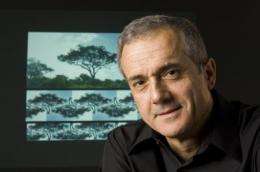
This is Adrian Bejan of Duke University. Credit: Duke University
The Egyptians supposedly used it to guide the construction the Pyramids. The architecture of ancient Athens is thought to have been based on it. Fictional Harvard symbologist Robert Langdon tried to unravel its mysteries in the novel The Da Vinci Code.
"It" is the golden ratio, a geometric proportion that has been theorized to be the most aesthetically pleasing to the eye and has been the root of countless mysteries over the centuries. Now, a Duke University engineer has found it to be a compelling springboard to unify vision, thought and movement under a single law of nature's design.
Also know the divine proportion, the golden ratio describes a rectangle with a length roughly one and a half times its width. Many artists and architects have fashioned their works around this proportion. For example, the Parthenon in Athens and Leonardo da Vinci's painting Mona Lisa are commonly cited examples of the ratio.
Adrian Bejan, professor of mechanical engineering at Duke's Pratt School of Engineering, thinks he knows why the golden ratio pops up everywhere: the eyes scan an image the fastest when it is shaped as a golden-ratio rectangle.
The natural design that connects vision and cognition is a theory that flowing systems -- from airways in the lungs to the formation of river deltas -- evolve in time so that they flow more and more easily. Bejan termed this the constructal law in 1996, and its latest application appears early online in the International Journal of Design & Nature and Ecodynamics.
"When you look atwhat so many people have been drawing and building, you see these proportions everywhere," Bejan said. "It is well known that the eyes take in information more efficiently when they scan side-to-side, as opposed to up and down."
Bejan argues that the world - whether it is a human looking at a painting or a gazelle on the open plain scanning the horizon - is basically oriented on the horizontal. For the gazelle, danger primarily comes from the sides or from behind, not from above or below, so their scope of vision evolved to go side-to-side. As vision developed, he argues, the animals got "smarter" by seeing better and moving faster and more safely.
"As animals developed organs for vision, they minimized the danger from ahead and the sides," Bejan said. "This has made the overall flow of animals on earth safer and more efficient. The flow of animal mass develops for itself flow channels that are efficient and conducive to survival - straighter, with fewer obstacles and predators."
For Bejan, vision and cognition evolved together and are one and the same design as locomotion.The increased efficiency of information flowing from the world through the eyes to the brain corresponds with the transmission of this information through the branching architecture of nerves and the brain.
"Cognition is the name of the constructal evolution of the brain's architecture, every minute and every moment," Bejan said. "This is the phenomenon of thinking, knowing, and then thinking again more efficiently. Getting smarter is the constructal law in action."
While the golden ratio provided a conceptual entryway into this view of nature's design, Bejan sees something even broader.
"It is the oneness of vision, cognition and locomotion as the design of the movement of all animals on earth," he said. "The phenomenon of the golden ratio contributes to this understanding the idea that pattern and diversity coexist as integral and necessary features of the evolutionary design of nature."
In numerous papers and books over past decade, Bejan has demonstrated that the constructal law (www.constructal.org) predicts a wide range of flow system designs seen in nature, from biology and geophysics to social dynamics and technology evolution.
-
Unifying The Animate And The Inanimate Designs Of Nature
Apr 28, 2009 |
not rated yet |
0
-
New Thermodynamic Theory Will Help Engineers 'Go With the Flow'
Jun 19, 2004 |
not rated yet |
0
-
Physics Explains Why University Rankings Won't Change
Feb 13, 2008 |
not rated yet |
0
-
Collaboration of soloists makes the best science
Dec 04, 2008 |
not rated yet |
0
-
Unifying Physics Theory Predicts Global Climate Patterns In Simple Way
Feb 09, 2006 |
not rated yet |
0
-
Engineers build first sub-10-nm carbon nanotube transistor
Feb 01, 2012 |
4.9 / 5 (30) |
30
-
Something old, something new: Evolution and the structural divergence of duplicate genes
Jan 31, 2012 |
4.6 / 5 (7) |
1
-
The hidden nanoworld of ice crystals: Revealing the dynamic behavior of quasi-liquid layers
Jan 30, 2012 |
5 / 5 (3) |
1
-
Stock market network reveals investor clustering
Jan 27, 2012 |
3.9 / 5 (23) |
8
-
Of microchemistry and molecules: Electronic microfluidic device synthesizes biocompatible probes
Jan 26, 2012 |
5 / 5 (1) |
0
-
A discrete logarithm Question
3 hours ago
-
What does it mean to solve a problem 'analytically'?
4 hours ago
-
Heisenberg Nilpotent Lie Group
5 hours ago
-
Operator precedence for: 1/-2/3
9 hours ago
-
simple question about nth-roots of negative numbers
10 hours ago
-
Is the square of a function always positive
10 hours ago
- More from Physics Forums - General Math
More news stories
US workers are 'giving away the store,' costing firms billions
Nearly 70 percent of the nation's service employees give away free goods and services from hamburgers to cable TV costing companies billions of dollars a year, according to a groundbreaking study.
Other Sciences / Economics & Business
12 hours ago |
5 / 5 (1) |
8
Storm warning: Financial tsunami heading this way
In today's global village, national coffers are more interconnected than ever before. And as the current economic crisis has proven, a downturn in one country can travel in a wave across the globe, like a financial tsunami. ...
Other Sciences / Economics & Business
13 hours ago |
3 / 5 (2) |
6
Prague gets hold of modern genetics founder Mendel's papers
Germany has handed to the Czech Republic a manuscript of Johann Gregor Mendel, founder of modern genetics, on his plant hybridization experiments, the Czech foreign minister said Thursday.
9 hours ago |
5 / 5 (1) |
1
Kids show cultural gender bias
(PhysOrg.com) -- Talk about gender confusion! A recent study by University of Alberta researchers Elena Nicoladis and Cassandra Foursha-Stevenson in the Journal of Cross-Cultural Psychology into whether speaki ...
Other Sciences / Social Sciences
18 hours ago |
1.5 / 5 (2) |
2
'Flipped classroom' teaching model gains an online community
Researchers at Harvard University have launched the Peer Instruction (PI) Network, a new global social network for users of interactive teaching methods.
Other Sciences / Social Sciences
13 hours ago |
5 / 5 (2) |
0
'Dark plasmons' transmit energy
Microscopic channels of gold nanoparticles have the ability to transmit electromagnetic energy that starts as light and propagates via "dark plasmons," according to researchers at Rice University.
FDA-approved drug rapidly clears amyloid from the brain, reverses Alzheimer's symptoms in mice
Neuroscientists at Case Western Reserve University School of Medicine have made a dramatic breakthrough in their efforts to find a cure for Alzheimer's disease. The researchers' findings, published in the journal Science, show t ...
Hydrogen from acidic water: Researchers develop potential low cost alternative to platinum for splitting water
A technique for creating a new molecule that structurally and chemically replicates the active part of the widely used industrial catalyst molybdenite has been developed by researchers with the Lawrence Berkeley ...
Ultraviolet protection molecule in plants yields its secrets
Lying around in the sun all day is hazardous not just for humans but also for plants, which have no means of escape. Ultraviolet (UV) radiation from the sun can damage proteins and DNA inside cells, leading ...
Anyone can learn to be more inventive, cognitive researcher says
There will always be a wild and unpredictable quality to creativity and invention, says Anthony McCaffrey, a cognitive psychology researcher at the University of Massachusetts Amherst, because an "Aha moment" is rare and ...
Soraa LED light may dim 50-watt halogen rivals
(PhysOrg.com) -- Soraa, a Fremont, California company founded in 2008, this week launched its first product, a light that uses LEDS (light emitting diodes). The "Soraa LED MR16 lamp" is the "perfect" replacement ...
Dec 21, 2009
Rank: 5 / 5 (4)
Dec 21, 2009
Rank: 4.5 / 5 (8)
Dec 21, 2009
Rank: 5 / 5 (4)
Dec 21, 2009
Rank: 5 / 5 (3)
Also the posters above me make a good point. It's a real shame.
Dec 21, 2009
Rank: not rated yet
In the paper, take a look at "Figure 2" on page 100 for a quick insight into what the article is talking about. I guess you can read the rest of the paper if you want to know the details...
Dec 22, 2009
Rank: 5 / 5 (1)
Dec 23, 2009
Rank: 1 / 5 (1)
Dec 27, 2009
Rank: 5 / 5 (1)
His vision example seems to contradict the existence of a single perfect number since different people have differently spaced eyes and the field of vision for predatory vs non-predatory animals varies dramatically in both extents and proportions. it would indicate something wider than a square but it could be 1 to 1.8 or 1 to 1.2 or lots of other ratios.
There is a mathematical and physical explanation for the golden ratio and why it comes up so much, but applying it to something as complex as the field of vision is an unlikely stretch. Such an extrapolated generalization would be analogous to claiming that competing bee colonies have hexagonal territories because hexagons offer the most efficient consolidation of space with the least area of contention between hives. I suspect the golden section plays a role in vision not because of the eyes, but because of it's commonality.
Feb 01, 2010
Rank: not rated yet
Feb 01, 2010
Rank: 5 / 5 (1)
Feb 06, 2010
Rank: not rated yet
Feb 12, 2010
Rank: not rated yet