Russian railways enter modern age with new express
December 20, 2009 by Eleonore Dermy
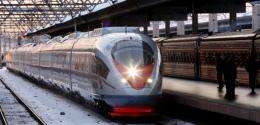
The high speed train named Sapsan moves along the tracks at a station in Saint-Petersburg

Enlarge

The high speed train named Sapsan moves along the tracks at a station in Saint-Petersburg on December 18. Famed for the legendary trains that clank across seven time zones on its Trans-Siberian railroad, Russia this week entered the modern railway age with its first high-tech express train.

Famed for the legendary trains that clank across seven time zones on its Trans-Siberian railroad, Russia this week entered the modern railway age with its first high-tech express train.

The Sapsan train, whose gaudy red bodywork is in sharp contrast to the bottle green that adorns most Russian trains, started running Thursday on the route between Moscow and Saint Petersburg.

The route between the country's two main cities was until now largely served by overnight trains which shared the same romance as the Trans-Siberian railway but crawled to their destination in some eight hours.

But now travellers can take the Sapsan (Peregrine Falcon) which cuts journey time between the two cities to just three hours forty five minutes and appears set to revolutionize the Russian concept of train travel.

It is a centrepiece of Russia's plans to modernize its state-owned railways and integrate a network that extends as far afield as China and Mongolia with the railway systems of Europe.

For all the fanfare, the unveiling of the new pride of Russia's railways was overshadowed by the deadly bombing of the luxury Nevsky Express train last month on the same Moscow-Petersburg railway.

The blast late on November 27 derailed the Nevsky Express, killing 27 people and wounding about 100 more. It was claimed by the so-called "Caucasus Emirate", an umbrella group uniting various militant Islamist factions.

By chance, part of the Sapsan was undergoing tests close to where the blast hit and was involved in rescue efforts, carrying several hundred stranded passengers away from the site of the attack.

In the Soviet-era train stations of Moscow and Saint Petersburg, the Sapsan train looks like it has arrived from another planet as it sits in the tracks next to its long-serving Russian-built brethren.

The train was designed by German engineering giant Siemens, which in 2006 signed a contract with Russian Railways (RZhD) to supply eight of its Velaro trains, in the latest example of German-Russian economic cooperation.

It has a highest speed of 250 kilometres (150 miles) an hour for the 635 kilometre (400 mile) journey, an almost rocket-like velocity compared with the trudge of most Russian trains.

Previous day trains along the route had taken four and a half hours.

The contrast with Russian trains of the past is even more striking inside with automatic doors, huge glass picture windows and innovations like television in first class.

Even more astonishing for anyone who has travelled on Russian trains in the past is the blanket ban on smoking, a major irritant for many train travellers in the country.

"It feels like a TGV!" exclaimed Mikhail, 43, as he climbed aboard in Moscow, referring to the French high speed train that transformed Europeans' expectations of rail travel.

Alexei, 28, a IT consultant decided to buy a one-day return ticket for one of the first journeys for the sheer pleasure of travelling on the train.

"When I compare with other Russian trains, I see that our railways have moved on to another level."

The cost is set at 115 dollars for a single and 175 dollars in first class.

"Usually I take plane. But with the Sapsan it's quicker now that we leave from the middle of the city and arrive in the middle of the city. In the end, it costs less," said Mikhail, a resident of Saint Petersburg.

Vladimir Yakunin, head of RZhD which is running the new train, hailed the Sapsan as "not just a train, but another life, another technology, another form of transport."

The Moscow-Petersburg has the heaviest passenger traffic of any rail line in , and, in 2008, 6.5 million people took trains between the two cities, according to RZhD spokesman Sergei Slutskov.

"We are sure that we will attract many people who now take the plane," he said.

(c) 2009 AFP


Rank 4 /5 (5 votes)
Related Stories
Relevant PhysicsForums posts
  • Calling function with no input argument
    created9 hours ago
  • Force free body diagram problem on gym equipment
    created10 hours ago
  • Empirical data regarding shower heads and water
    created18 hours ago
  • feed hold button on CNC lathe
    createdFeb 09, 2012
  • RFAC in Fortran
    createdFeb 09, 2012
  • dynamics 2/32
    createdFeb 08, 2012
  • More from Physics Forums - General Engineering

More news stories

Google users warned of threat to smartphone wallets

Users of Google smartphone wallets were being warned on Friday that there is a way to crack pass codes intended to thwart thieves from going on illicit shopping sprees.

Technology / Internet

created 3 hours ago | popularity 5 / 5 (1) | comments 0

Anonymous knocks CIA website offline (Update)

The website of the Central Intelligence Agency was inaccessible on Friday after the hacker group Anonymous claimed to have knocked it offline.

Technology / Internet

created 4 hours ago | popularity 5 / 5 (6) | comments 10

New error-correcting codes guarantee the fastest possible rate of data transmission

Error-correcting codes are one of the triumphs of the digital age. They’re a way of encoding information so that it can be transmitted across a communication channel — such as an optical fiber o ...

Technology / Computer Sciences

created 13 hours ago | popularity 5 / 5 (4) | comments 5 | with audio podcast

New power source discovered

(PhysOrg.com) -- Researchers at the Massachusetts Institute of Technology (MIT) and RMIT University have made a breakthrough in energy storage and power generation.

Technology / Energy & Green Tech

created 12 hours ago | popularity 4.8 / 5 (19) | comments 7 | with audio podcast

Small modular reactor design could be a 'SUPERSTAR'

(PhysOrg.com) -- Though most of today's nuclear reactors are cooled by water, we've long known that there are alternatives; in fact, the world's first nuclear-powered electricity in 1951 came from a reactor ...

Technology / Energy & Green Tech

created 12 hours ago | popularity 4.3 / 5 (11) | comments 20 | with audio podcast


Complex wiring of the nervous system may rely on a just a handful of genes and proteins

Researchers at the Salk Institute have discovered a startling feature of early brain development that helps to explain how complex neuron wiring patterns are programmed using just a handful of critical genes. ...

Putting the squeeze on planets outside our solar system

(PhysOrg.com) -- Using high-powered lasers, scientists at Lawrence Livermore National Laboratory and collaborators discovered that molten magnesium silicate undergoes a phase change in the liquid state, abruptly ...

The power of estrogen -- male snakes attract other males

A new study has shown that boosting the estrogen levels of male garter snakes causes them to secrete the same pheromones that females use to attract suitors, and turned the males into just about the sexiest ...

NASA sees wide-eyed cyclone Jasmine

Cyclone Jasmine's eye has opened wider on NASA satellite imagery, as it moves through the Southern Pacific Ocean.

Humans may have helped the decline of African rainforests 3000 years ago

(PhysOrg.com) -- Large areas of rainforests in Central Africa mysteriously disappeared over three thousand years ago, to be replaced by savannas. The prevailing theory has been that the cause was a change ...

NASA sees Giovanna reach cyclone strength, threaten Madagascar

Tropical Storm 12S built up steam and became a cyclone on February 10, 2012 as NASA's Terra satellite passed overhead. Residents of east-central Madagascar should prepare for this cyclone to make landfall ...