Brown dwarf pair mystifies astronomers
December 21, 2009
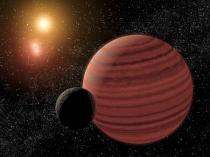
Artist's rendition of a brown dwarf and its moon orbiting a triple star system. Image: NASA
(PhysOrg.com) -- Two brown dwarf-sized objects orbiting a giant old star show that planets may assemble around stars more quickly and efficiently than anyone thought possible, according to an international team of astronomers.
"We have found two brown dwarf-sized masses around an ordinary star, which is very rare," said Alex Wolszczan, Evan Pugh professor of astronomy and astrophysics, Penn State and lead scientist on the project.
The star, BD +20 2457, is a K2 giant -- an old bloated star nearing the end of its life. Seeing a pair of brown dwarfs around a K-type giant is a first for astronomers and offers a unique window into how they can be produced. The researchers from the Torun Center for Astronomy, Poland and the Center for Exoplanets and Habitable Worlds, Penn State report their findings in the current issue of the Astrophysical Journal.
Brown dwarfs are dim, elusive objects that straddle the dividing line between planets and stars. They are too massive to be planets, but not massive enough to generate the fusion-powered energy of a star. These stellar cousins represent a kind of "missing link" between planets and stars, but little is known about how they are made.
"If we find one brown dwarf, we are not sure where it came from," Wolszczan explained. "It could be either from the process of planet formation or it could be a direct product of star formation."
Seeing two of them around a parent star means they must have originally formed from the enormous supply of raw materials that surrounded the star when it was young. Astronomers call this thick, solar system-sized pancake of gas and dust the "circumstellar disk."
"If that is the case," he continued, "then if we add up the minimum masses of these two objects, we know the disk had to be extremely massive."
To find these faint companions, the astronomers used the High Resolution Spectrograph on the Hobby-Eberly Telescope in west Texas to split up the light of BD +20 2457. This technique is similar to the way a prism breaks light into a rainbow -- spectrum -- of colors. They looked for shifts in color of certain features in the spectrum, called spectral lines, as the dwarfs moved around the star and caused the star to wobble back and forth from their gravitational tugs.
When the brown dwarfs' gravitational influence causes BD +20 2457 to move towards Earth slightly, its spectral lines decrease in wavelength, becoming slightly bluer. As it moves away, the wavelengths increase, becoming slightly redder. By noting how quickly and strongly the spectral lines shift, astronomers can infer the objects' masses, as well as the sizes and shapes of their orbits.
The scientists determined that the two companions are at least 21 and 13 times the mass of Jupiter. Therefore, they are likely to exceed the minimum mass of a brown dwarf, 13 times the mass of Jupiter. They are separated from their star by about 1.5 and 2 times the distance between the Earth and the sun and complete a "year" in 380 and 622 days, respectively.
What is even more unusual is the timescale involved in making these brown dwarfs.
Several million years ago, BD +20 2457 was on the "main sequence," the stage in stellar evolution where the star produced light by burning its hydrogen fuel, much like our sun does now. Except this star, three times the mass of the sun, was much hotter and more luminous.
"The intense radiation of this star would have heated up and evaporated anything that was still forming around it," Wolszczan said. "The fact that these dwarfs are still here means that they had to accumulate a lot of material very quickly and be fully formed by the time the star 'switched on.' "
A star like BD +20 2457 takes about 10 million years to form and enter the main sequence. As a rough estimate, in order keep up with their parent star, the dwarfs would have to accrue as much mass as the Earth's moon every year.
"The lesson from this is that a combination of physical mechanisms may be responsible for making brown dwarfs," Wolszsczan said. "Instead of just growth by accretion (the steady accumulation of material), the dwarfs' own gravity may help them gather more mass and speed up their formation."
-
Smashing young stars leave dwarfs in their wake
Jun 09, 2006 |
not rated yet |
0
-
The star, the dwarf and the planet
Oct 19, 2006 |
not rated yet |
0
-
Brown Dwarfs Don't Hang Out With Stars
Jan 05, 2009 |
not rated yet |
0
-
Astronomers Weigh Adopted Twin Brown Dwarfs
Mar 29, 2006 |
not rated yet |
0
-
White dwarf and ultra-cool dwarf keep their distance
Apr 18, 2007 |
not rated yet |
0
-
Engineers build first sub-10-nm carbon nanotube transistor
Feb 01, 2012 |
4.9 / 5 (30) |
30
-
Something old, something new: Evolution and the structural divergence of duplicate genes
Jan 31, 2012 |
4.6 / 5 (7) |
1
-
The hidden nanoworld of ice crystals: Revealing the dynamic behavior of quasi-liquid layers
Jan 30, 2012 |
5 / 5 (3) |
1
-
Stock market network reveals investor clustering
Jan 27, 2012 |
3.9 / 5 (23) |
8
-
Of microchemistry and molecules: Electronic microfluidic device synthesizes biocompatible probes
Jan 26, 2012 |
5 / 5 (1) |
0
-
Titan's lack of impact craters
22 hours ago
-
Real pictures of black hole eating a star?
Feb 08, 2012
-
Hypothetical way to travel faster than light, but not technically exceed lightspeed
Feb 06, 2012
-
How do scientists monitor the Sun's activity?
Feb 05, 2012
-
Search patterns in observational studies
Feb 05, 2012
-
Derivation of Pogson's law
Feb 03, 2012
- More from Physics Forums - General Astronomy
More news stories
Clam fields found at deep, low-temperature Mariana vents
(PhysOrg.com) -- Scientists have marveled at the unusual life forms thriving at high temperature hydrothermal vents of the deep ocean.
Space & Earth / Earth Sciences
48 minutes ago |
not rated yet |
0
|
Could Venus be shifting gear?
(PhysOrg.com) -- ESAs Venus Express spacecraft has discovered that our cloud-covered neighbour spins a little slower than previously measured. Peering through the dense atmosphere in the infrared, the ...
Space & Earth / Space Exploration
16 minutes ago |
5 / 5 (1) |
0
|
Streams need trees to withstand climate change
(PhysOrg.com) -- More than twenty years of biological monitoring have confirmed the importance of vegetation for protecting Australia's freshwater streams and rivers against the ravages of drought and climate ...
57 minutes ago |
not rated yet |
0
The turbulent birth of super star clusters in galaxy mergers
By combining two of the most advanced telescopes in the world -- the new Atacama Large Millimeter Array (ALMA) and the Very Large Telescope (VLT) of ESO -- a team of French astronomers from the Institut d'astrophysique ...
39 minutes ago |
not rated yet |
0
What does a nebula sound like?
What do things sound like out in the cosmos? Of course, sound waves cant travel through the vacuum of space; however, electromagnetic waves can. These electromagnetic waves can be recorded by devices called spectrographs ...
Space & Earth / Space Exploration
23 minutes ago |
5 / 5 (1) |
0
Seeing colors in music, tasting flavors in shapes may happen in life's early months
Famed violinist Itzhak Perlman sees a deep forest green whenever he plays a B-flat on his Stradivarius' G string. The A on the E string is red.
Is that sleepiness during pregnancy normal or a sign of sleep apnea?
(Medical Xpress) -- Most pregnant women complain of being tired. Some of them however, could be suffering more than normal fatigue associated with their pregnancy; they may have developed obstructive sleep apnea (OSA), a ...
Engineering images bring life to submerged city
(PhysOrg.com) -- Photo-realistic 3D mapping and digital reconstruction of an ancient underwater city in Greece have earned a team from the University of Sydney's Faculty of Engineering and Information Technologies ...
Numeracy: The educational gift that keeps on giving?
(Medical Xpress) -- Cancer risks. Investment alternatives. Calories. Numbers are everywhere in daily life, and they figure into all sorts of decisions. A new article published in Current Directions in Psychological Science, a journal of the Association for Psychological Science, examin ...
New power source discovered
(PhysOrg.com) -- Researchers at the Massachusetts Institute of Technology (MIT) and RMIT University have made a breakthrough in energy storage and power generation.
Measurements from high-energy collisions lead to better understanding of why meson particles disappear
For several years, physicists at the Relativistic Heavy Ion Collider (RHIC) at Brookhaven National Laboratory (BNL), USA, have studied an unusual state of matter called the quarkgluon plasma, which they ...
Dec 28, 2009
Rank: 1 / 5 (2)
I doubt if this will be as important as the 1992 discovery of rocky planets orbiting a pulsar by yourself and Dale Frail [“A Planetary System around the Millisecond Pulsar PSR 1257+12”, Nature 355 (1992) 145].
One technical comment: Neutron repulsion is the primary energy source of the Sun, not fusion, and Hydrogen is a waste product generated by neutron decay.
It is therefore misleading to report that brown dwarfs are "not massive enough to generate the fusion-powered energy of a star."
Again, congratulations!
With kind regards,
Oliver K. Manuel