The next medical frontier: nano-surgery
December 21, 2009
The next medical frontier: nano-surgery

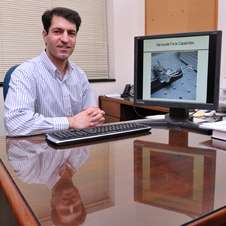
Associate mechanical and industrial enginnering professor Nader Jalili displays an image of a nanorobot on his office computer. Photo by Craig Bailey.

(PhysOrg.com) -- Engineering professor's nanorobot could be performing non-invasive surgical procedures on patients with tumors within the next decade.

Nader Jalili, an associate professor of mechanical and industrial engineering at Northeastern University, is working to create a controlled nanorobot that will be capable of performing non-invasive with a degree of precision not possible through existing surgical procedures.

At about the size of a ring box, nanorobots could revolutionize surgical practice within the next five to 10 years by making procedures of all sorts more precise and safer, said Jalili.

“Precision,” he said, “is one of the most important aspects of a .”

Guided by image-based information, the futuristic mechanical device would rely on a number of motors that move in tiny, exact increments, enabling it to pinpoint the exact location of a tumor or other surgical object.

“While a surgeon’s instruments cannot get to within a millimeter of a tumor, we will be able to precisely guide the robot to a location at a sub-nanometer or nanometer resolution, making us able to see things that we could never see before,” Jalili said. A nanometer is .000001 millimeters, and a nanotube is 1/1,000th of the thickness of a human hair.

His nanorobots could also be used to take minute skin samples for pathological testing as well as for diagnostic purposes, or to inject medicine or other fluids very precisely into a patient’s body in order to destroy a tumor.

Jalili is currently designing motion algorithms and preparing to test his nanorobots for different tasks.

Nanorobots are made up of sensors and actuators derived from special , such as synthetic , quartz and gold, which have unique features in the nanoscale.

Applying to these nanomaterials produces electrical energy, turning some into sensors that track motion, movement and direction, and others into actuators that convert electrical energy into mechanical motion, to move parts such as a nanorobot’s gripper.

Effective nanorobots would not put surgeons out of work, said Jalili. Rather, they would take on supervisory roles in the operating room. He likened the role of a surgeon who works with a nanorobot to that of a pilot who puts his plane on cruise control.

“You don’t want to go to sleep when you’re in cruise control,” he said. “Surgeons will follow the procedure and will be supervisors in case something goes wrong.”

Jalili’s research has been backed by a five-year, $400,000 National Science Foundation (NSF) CAREER Award. He also won a $350,000 NSF instrumentation grant to purchase a laser-based micro-system analyzer to view and measure nano-objects—and other materials—in the .

Provided by Northeastern University (news : web)

Filter


Move the slider to adjust rank threshold, so that you can hide some of the comments.


Display comments: newest first

asiwel
Dec 27, 2009

Rank: not rated yet
These exciting and promising surgical aids do not appear to be really what one would call "nano-robots" but rather appear to be rather small devices ("size of a ring box") that can control their positions with extreme accuracy. This in itself is amazing but not quite yet a "fantastic voyager."
marjon
Dec 27, 2009

Rank: 1 / 5 (1)
They had better hurry and get this product to market before the government takes over health care and ends all incentives (profit) for innovation.
powerup1
Jan 04, 2010

Rank: not rated yet
marjon, your post is inane and adds nothing of value to this forum.
Rank 5 /5 (6 votes)
Relevant PhysicsForums posts
  • Pertubance in a model
    created6 hours ago
  • Cancer drugs and Alzheimer's, Oh my!
    created14 hours ago
  • Squishing cells
    created14 hours ago
  • Any books/articles for evolutionary stable strategy models in humans?
    createdFeb 09, 2012
  • Science behind the bore feeling?
    createdFeb 09, 2012
  • Homo Sapien vs. Chimpanzee - Divergence Timeline
    createdFeb 09, 2012
  • More from Physics Forums - Biology

More news stories

What lies beneath: Mapping hidden nanostructures

The ability to diagnose and predict the properties of materials is vital, particularly in the expanding field of nanotechnology. Electron and atom-probe microscopy can categorize atoms in thin sheets of material, ...

Nanotechnology / Nanophysics

created 4 hours ago | popularity 5 / 5 (1) | comments 1

'Dark plasmons' transmit energy

Microscopic channels of gold nanoparticles have the ability to transmit electromagnetic energy that starts as light and propagates via "dark plasmons," according to researchers at Rice University.

Nanotechnology / Nanophysics

created 20 hours ago | popularity 5 / 5 (6) | comments 1 | with audio podcast

New kind of solar cell could capture significantly more energy than current cells

New solar cells could increase the maximum efficiency of solar panels by over 25%, according to scientists from the University of Cambridge.

Nanotechnology / Nanophysics

created Feb 08, 2012 | popularity 4.5 / 5 (12) | comments 14 | with audio podcast

Nanoshell whispering galleries improve thin solar panels

Visitors to Statuary Hall in the U.S. Capitol Building may have experienced a curious acoustic feature that allows a person to whisper softly at one side of the cavernous, half-domed room and for another on ...

Nanotechnology / Nanomaterials

created Feb 07, 2012 | popularity 4.3 / 5 (6) | comments 6 | with audio podcast

Nanotube therapy takes aim at breast cancer stem cells

Wake Forest Baptist Medical Center researchers have again proven that injecting multiwalled carbon nanotubes (MWCNTs) into tumors and heating them with a quick, 30-second laser treatment can kill them.

Nanotechnology / Bio & Medicine

created Feb 09, 2012 | popularity 5 / 5 (1) | comments 0 | with audio podcast


Putting the squeeze on planets outside our solar system

(PhysOrg.com) -- Using high-powered lasers, scientists at Lawrence Livermore National Laboratory and collaborators discovered that molten magnesium silicate undergoes a phase change in the liquid state, abruptly ...

India probes Google over 'forex transactions'

Indian authorities are probing whether online giant Google broke domestic foreign-exchange transactions rules while shifting funds abroad, the Press Trust of India reported on Friday.

Germany freezes signing of disputed Internet pact

Germany on Friday halted the signing of a controversial international accord billed as a way to beat online piracy that has sparked angry protests, saying it needed more time to consider it.

Health experts, scientists to discuss bird flu studies

The World Health Organization said Friday it will meet next week to determine whether scientists can publish research on a bird flu virus that may be easily passed among humans.

Employers feel no love for unscrupulous practice of 'service sweethearting'

A new study led by two Florida State University marketing professors finds that some frontline service employees who are rewarded for hikes in customer loyalty and satisfaction also may engage in "service ...

Obama forges compromise birth control plan

US President Barack Obama Friday announced a compromise to defuse a row over access to birth control which prompted election-year Republican critics to claim he was waging a war on religion.