Astronomers discover 'tilted planets'
December 22, 2009
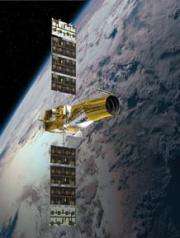
The COROT satellite
(PhysOrg.com) -- University of Exeter, UK, research has added to a growing evidence that several giant planets have orbits so tilted that their orbits can be perpendicular or even backwards relative to their parent star’s rotation.
Known as ‘extrasolar planets’, because they are located outside our solar system, these planets orbit very closely to their star.
Planets are formed from a swirling disk of gas and dust that surrounds young stars. Because the disk rotates in the same direction as the star, the planets spawned by the disk should revolve in the same direction. In an overcrowded planetary system, however, planets can push one body outward while flinging the other inward, elongating and tilting the inner planet’s orbit.
Published as a letter to the Monthly Notices of the Royal Astronomical Society, the research involved examining the orbit of the first extrasolar planet discovered by the European satellite COROT. Known as COROT-Exo-1b, the planet can periodically be seen from Earth by telescope, as it passes across the face of its star. The research team observed the spectra of the star with the Keck telescope in Hawaii and discovered that its orbital axis was tilted at an angle of around 77 degrees.
The University of Exeter had already participated in the detection of two of these tilted planets in the past year, including the first know case, a planet known as “XO-3b”.
Since then astronomers worldwide have added their observations of tilted planets, making this one of the most talked-about phenomena of the year in astronomy. Currently between 25 and 50 percent of all extrasolar planets whose angles of inclination have been measured have tilts exceeding 30 degrees. Of the planets in the solar system, Earth has the greatest orbital tilt relative to the sun’s axis of rotation, at an angle of 7.1 degrees.
Frédéric Pont of the University of Exeter's School of Engineering, Mathematics and Physical Sciences, said: “The presence of advanced life on Earth may be contingent on our planetary system having avoided the brunt of planet-planet scatter, keeping Earth on a circular orbit—neither too hot nor too cold for life as we know it. In this scenario, the solar system may have been unusually lucky. Either it avoided catastrophic gravitational encounters between massive planets or it suffered such interactions so long ago that most of the planets had the chance to resettle into nearly circular orbits with little or no tilt.”
-
Is The Solar System Unique in The Universe?
Aug 03, 2004 |
not rated yet |
0
-
Missing planets attest to destructive power of stars' tides
Apr 27, 2009 |
not rated yet |
0
-
Discovery of a Retrograde or Highly Tilted Extrasolar Planet
Nov 18, 2009 |
not rated yet |
0
-
Team finds smallest transiting extrasolar planet ever
Feb 03, 2009 |
not rated yet |
0
-
Wobbly planets could reveal Earth-like moons
Dec 11, 2008 |
not rated yet |
0
-
Engineers build first sub-10-nm carbon nanotube transistor
Feb 01, 2012 |
4.9 / 5 (30) |
30
-
Something old, something new: Evolution and the structural divergence of duplicate genes
Jan 31, 2012 |
4.6 / 5 (7) |
1
-
The hidden nanoworld of ice crystals: Revealing the dynamic behavior of quasi-liquid layers
Jan 30, 2012 |
5 / 5 (3) |
1
-
Stock market network reveals investor clustering
Jan 27, 2012 |
3.9 / 5 (23) |
8
-
Of microchemistry and molecules: Electronic microfluidic device synthesizes biocompatible probes
Jan 26, 2012 |
5 / 5 (1) |
0
-
Titan's lack of impact craters
Feb 09, 2012
-
Real pictures of black hole eating a star?
Feb 08, 2012
-
Hypothetical way to travel faster than light, but not technically exceed lightspeed
Feb 06, 2012
-
How do scientists monitor the Sun's activity?
Feb 05, 2012
-
Search patterns in observational studies
Feb 05, 2012
-
Derivation of Pogson's law
Feb 03, 2012
- More from Physics Forums - General Astronomy
More news stories
Could Venus be shifting gear?
(PhysOrg.com) -- ESAs Venus Express spacecraft has discovered that our cloud-covered neighbour spins a little slower than previously measured. Peering through the dense atmosphere in the infrared, the ...
Space & Earth / Space Exploration
2 hours ago |
5 / 5 (3) |
4
|
Clam fields found at deep, low-temperature Mariana vents
(PhysOrg.com) -- Scientists have marveled at the unusual life forms thriving at high temperature hydrothermal vents of the deep ocean.
Space & Earth / Earth Sciences
3 hours ago |
not rated yet |
0
|
Mars Science Laboratory computer issue resolved
(PhysOrg.com) -- Engineers have found the root cause of a computer reset that occurred two months ago on NASA's Mars Science Laboratory and have determined how to correct it.
Space & Earth / Space Exploration
3 hours ago |
5 / 5 (4) |
2
|
Humans may have helped the decline of African rainforests 3000 years ago
(PhysOrg.com) -- Large areas of rainforests in Central Africa mysteriously disappeared over three thousand years ago, to be replaced by savannas. The prevailing theory has been that the cause was a change ...
Two new moons for Jupiter
Advances in technology have lead to the discovery of new planets outside of our Solar System, and now even new moons in our own backyard.
Space & Earth / Space Exploration
2 hours ago |
not rated yet |
2
Zuckerberg's focus drives Facebook's ascent
When Mark Zuckerberg showed up to rent Judy Fusco's Los Altos, Calif., house in the fall of 2004, soon after he'd arrived in Silicon Valley, the landlord was immediately struck by his confidence.
Antidepressants and pregnancy: Women must consider the impact of drugs on baby, and of depression on baby, themselves
Upon learning they are pregnant, most women dutifully nix the alcohol, sushi and caffeine. But what about antidepressants?
Both maternal and paternal age linked to autism
Older maternal and paternal age are jointly associated with having a child with autism, according to a recently published study led by researchers at The University of Texas Health Science Center at Houston (UTHealth).
Curry spice component may help slow prostate tumor growth
Curcumin, an active component of the Indian curry spice turmeric, may help slow down tumor growth in castration-resistant prostate cancer patients on androgen deprivation therapy (ADT), a study from researchers ...
The power of estrogen -- male snakes attract other males
A new study has shown that boosting the estrogen levels of male garter snakes causes them to secrete the same pheromones that females use to attract suitors, and turned the males into just about the sexiest ...
Netflix light on flicks as viewers soak up TV shows
Like most fresh faces that arrive in Hollywood, Netflix wanted to be a movie star. But now it's learning what many in Tinseltown have known for decades: Movies are sexy, but the real money is in television.
Dec 22, 2009
Rank: not rated yet
Dec 22, 2009
Rank: not rated yet
Dec 22, 2009
Rank: not rated yet
Dec 28, 2009
Rank: not rated yet
no sweat buddy! The title of "Tilted Planets" did that to me too! Blame the journos! they don' write proper! [joking they have to make a buck too.] But the title should have been "Tilted Orbits".
I tend to think that if the planets of our Solar system all had very steeply tilted orbits relative to each other, it would lead to all sorts of traumatic instabilities. In other words we would not have evolved if, for example, a very elongated and tilted elliptical orbit for Earth meant that periodically the oceans froze solid, or that periodically the Earth's surface was blasted by great squadrons of thousands of comets drifting in from the Oort cloud.
Or some such.
It could be that we have come about only because Earth and the Solar system is a rather boring place by cosmological standards; like the "Hitch hikers guide" remarked: "Mostly harmless" :-)