Novel nanotechnology heals abscesses caused by resistant staph bacteria
Researchers at the Albert Einstein College of Medicine of Yeshiva University have developed a new approach for treating and healing skin abscesses caused by bacteria resistant to most antibiotics. The study appears in the journal PLoS One.
Abscesses are deep skin infections that often resist antibiotics and may require surgical drainage. For their new treatment strategy, the Einstein scientists developed tiny nanoparticles — smaller than a grain of pollen — that carry nitric oxide (NO), a gas that helps in the body's natural immune response to infection.
When topically applied to abscesses in mice, the particles released NO that traveled deep into the skin, clearing up the infections and helping to heal tissue.
"Our work shows that nitric oxide-releasing nanoparticles developed here at Einstein can effectively treat experimental skin abscesses caused by antibiotic-resistant Staphylococcus aureus, even without surgical drainage," says Joshua D. Nosanchuk, M.D., senior author of the study and associate professor of medicine and of microbiology & immunology.
"This is important," he notes, "because several million people are treated for staph infections every year in the U.S. Increasingly, these infections are caused by methicillin-resistant Staph aureus — or MRSA — the serious and potentially fatal "superbug" that we tackled in this study."
According to the Centers for Disease Control and Prevention, approximately 94,000 cases of invasive MRSA infections occur each year, resulting in 19,000 deaths. In a 2006 study involving multiple emergency rooms across the U.S., MRSA was isolated from 61 percent of abscesses.
"To have a topical medication for staph infections instead of one that you have to take orally and systemically would revolutionize the way we take care of our patients," Dr. Nosanchuk adds.
In research published earlier this year in the Journal of Investigative Dermatology, the interdisciplinary Einstein team showed that NO-containing nanoparticles could clear up superficial skin infections caused by MRSA. The current study of abscesses was designed to learn whether the nanoparticles could combat infections deep in the skin.
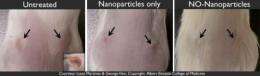
The researchers experimentally induced MRSA abscesses in 60 mice. The abscesses were either left untreated, topically treated with "empty" nanoparticles, or topically treated with nanoparticles containing NO and were evaluated four days later.
The microbial concentration in the abscesses of mice treated with NO-containing nanoparticles was significantly reduced compared with abscesses in the other two groups. In addition, the abscesses of mice treated with NO-containing nanoparticles had undergone much more healing, as shown by their improved appearance and by the far greater amounts of collagen (a protein important in maintaining the structure of skin) deposited within them.
The Einstein nanoparticle technology was developed by Joel M. Friedman, M.D., Ph.D., the Young Men's Division Chair of Physiology and professor of physiology & biophysics and of medicine, and Adam Friedman, M.D., currently the chief resident in the division of dermatology of the department of medicine at Montefiore Medical Center, The University Hospital and Academic Medical Center for Einstein.
When introduced on the skin or into the body, the tiny nanoparticles absorb water, swell up, and start releasing their cargo in a sustained manner. The nanoparticles can carry and release a variety of drugs as well as chemicals, including NO.
Produced naturally by cells throughout the body, NO has important biological properties including killing bacteria, healing wounds, and increasing blood flow by dilating blood vessels. "But NO is a very short-lived gas," notes Dr. Joel Friedman, "and, until now, methods to deliver it to targeted tissues in the proper doses have proven elusive."
Einstein researchers are also pursuing other potential therapeutic uses for their nanoparticles. For example, along with Kelvin Davies, Ph.D., associate professor of urology, the Friedmans recently showed that nanoparticles loaded with either NO or tadalafil (Cialis) show promise as a topical cream-like treatment for erectile dysfunction.
Earlier this month, Makefield Therapeutics, Inc., a biotechnology company based in Newtown, PA, licensed patent rights to Einstein's NO-containing nanoparticle technology. The company plans to use topical formulations of the NO-containing nanoparticles to treat antibiotic-resistant infections and erectile dysfunction.
More information: The paper, "Nitric Oxide Releasing Nanoparticles Are Therapeutic for Staphylococcus aureus Abscesses in a Murine Model of Infection," was published in the November 12, 2009 issue of PLoS ONE.
Provided by Albert Einstein College of Medicine


