Volcanic Quakes Help Forecast Eruptions
December 22, 2009 By Emilie Lorditch, ISNS
Volcanic Quakes Help Forecast Eruptions

Enlarge

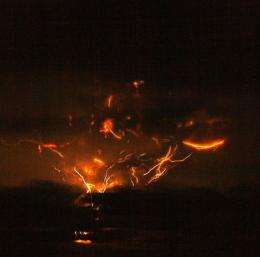
Magma becomes lava after leaving the Earth's crust, shown here on Mount Redoubt. Credit: Bretwood Higman

Monitoring the earthquakes caused from magma movements inside an active volcano could help to improve the accuracy of forecasting an eruption.

According to Emily Brodsky, the magma inside a appears to be the real driving force of pre-eruption quakes, indicating how soon an will follow.

"It is really that simple," said Brodsky, an associate professor of Earth and Planetary Sciences at the University of California, Santa Cruz. "It all comes back to physics and the fluid dynamics of magma in the volcano."

Brodsky worked with Luigi Passarelli, a visiting graduate student from the University of Bologna in Italy, who observed 54 eruptions around the world.

"Passarelli collected the data, and it revealed obvious patterns in eruption activity," said Brodsky. "This kind of work isn’t glamorous, but it is very important to find these patterns, and they have led to something that is really very simple."

What Brodsky and Passarelli discovered is that they can use a volcano's "run-up" time -- the time between the beginning of pre-eruption earthquakes and the actual volcanic eruption itself -- to improve the accuracy of future volcanic eruption alerts.

A volcano with frequent eruptions has a short run-up time. These volcanoes have little activity due to the runny magma within that contains very little silica. The magma flows easily, filling the internal chamber before quickly exiting the mouth of the volcano and allowing only a small amount of time to issue an eruption warning.

Alternatively, a dormant volcano has a very long run-up period. Dormant volcanoes contain magma that is full of thick, slow moving silica. It takes much more time for this kind of magma to fill a volcano and reach its mouth. As the thick magma pushes its way up the volcanic neck and presses on the surrounding rock causing earthquakes that provide more advanced warning of an upcoming eruption.

Brodsky and Passarelli hope that this information will be applied to volcanoes around the world.

"Volcanoes like Mount Rainer are already monitored by the USGS Cascades Volcano Observatory, but there are many other unmonitored volcanoes around the world," said Brodsky. "By applying what we've found, we can improve eruption forecasts and provide better alerts."

"Volcanoes are complex beasts and this research is telling us that they are all controlled by -- it's really a very simple process," she said. Brodsky presented her work with Passarelli in a December meeting of the American Geophysical Union meeting in San Francisco, Calif.

© 2009 Inside Science News Service

Filter


Move the slider to adjust rank threshold, so that you can hide some of the comments.


Display comments: newest first

gwrede
Dec 22, 2009

Rank: not rated yet
Boring. Actually, the same patterns exist with regular earth quakes. In other words, small earth quakes before a volcanic eruption serve as very good examples of regular earth quakes before a major one.

But with today's 5-minute-fame, everybody feels an urge to demonize, "amazinase", and "urgenaze" any research findings, lest they die of lack of fame, funding, or acknowledgement.

A piece of software that has two sliders: one for amplitude and one for temporal extent, would let any seismologist learn that many of the patterns are actually the same. This would remove a lot of the exotic elusiveness, and let the scientists simply tackle the issues.
mandika76
Dec 22, 2009

Rank: not rated yet
qwrede - you said exactly what I was thinking. Reading this article was like reading a 3rd grade text on what causes volcanic eruptions that was written 50 years ago.

Can we get to some real science here - and not something that's simply regurgitated information circa mid-1900's?
Rank 3 /5 (6 votes)
Related Stories
Relevant PhysicsForums posts
  • Discrepancy between oxygen and carbon-dioxide levels
    created17 hours ago
  • where gems are found in the world
    created20 hours ago
  • Wind Waves in Reservoir ~ Wind run-up and Wind set-up
    createdFeb 08, 2012
  • Balance of oxygen in the atmosphere
    createdFeb 01, 2012
  • The case for a methanol-based economy
    createdJan 30, 2012
  • Weather in a rotating cylinder
    createdJan 25, 2012
  • More from Physics Forums - Earth

More news stories

Humans may have helped the decline of African rainforests 3000 years ago

(PhysOrg.com) -- Large areas of rainforests in Central Africa mysteriously disappeared over three thousand years ago, to be replaced by savannas. The prevailing theory has been that the cause was a change ...

Space & Earth / Environment

created 10 hours ago | popularity 5 / 5 (3) | comments 9 | with audio podcast report

Could Venus be shifting gear?

(PhysOrg.com) -- ESA’s Venus Express spacecraft has discovered that our cloud-covered neighbour spins a little slower than previously measured. Peering through the dense atmosphere in the infrared, the ...

Space & Earth / Space Exploration

created 6 hours ago | popularity 5 / 5 (5) | comments 7 | with audio podcast

Mars Science Laboratory computer issue resolved

(PhysOrg.com) -- Engineers have found the root cause of a computer reset that occurred two months ago on NASA's Mars Science Laboratory and have determined how to correct it.

Space & Earth / Space Exploration

created 7 hours ago | popularity 5 / 5 (5) | comments 3 | with audio podcast

Clam fields found at deep, low-temperature Mariana vents

(PhysOrg.com) -- Scientists have marveled at the unusual life forms thriving at high temperature hydrothermal vents of the deep ocean.

Space & Earth / Earth Sciences

created 6 hours ago | popularity not rated yet | comments 0 | with audio podcast

Two new moons for Jupiter

Advances in technology have lead to the discovery of new planets outside of our Solar System, and now even new moons in our own backyard.

Space & Earth / Space Exploration

created 6 hours ago | popularity not rated yet | comments 3


Human cognitive performance suffers following natural disasters, researchers find

Not surprisingly, victims of a natural disaster can experience stress and anxiety, but a new study indicates that it might also cause them to make more errors - some serious - in their daily lives. In their upcoming Human Fa ...

The power of estrogen -- male snakes attract other males

A new study has shown that boosting the estrogen levels of male garter snakes causes them to secrete the same pheromones that females use to attract suitors, and turned the males into just about the sexiest ...

New error-correcting codes guarantee the fastest possible rate of data transmission

Error-correcting codes are one of the triumphs of the digital age. They’re a way of encoding information so that it can be transmitted across a communication channel — such as an optical fiber o ...

Putting the squeeze on planets outside our solar system

(PhysOrg.com) -- Using high-powered lasers, scientists at Lawrence Livermore National Laboratory and collaborators discovered that molten magnesium silicate undergoes a phase change in the liquid state, abruptly ...

Both maternal and paternal age linked to autism

Older maternal and paternal age are jointly associated with having a child with autism, according to a recently published study led by researchers at The University of Texas Health Science Center at Houston (UTHealth).

Curry spice component may help slow prostate tumor growth

Curcumin, an active component of the Indian curry spice turmeric, may help slow down tumor growth in castration-resistant prostate cancer patients on androgen deprivation therapy (ADT), a study from researchers ...