Bees show off the perfect landing
December 23, 2009
bee

Enlarge

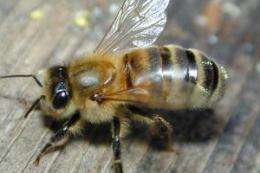
(PhysOrg.com) -- Honey bees undergo a sudden transition from speeding aircraft to hovering helicopter as they perform the delicate art of landing on a flower.

Unlike the ‘controlled crash’ of a fly , the bee lands with utmost delicacy after ‘reading’ its airspeed visually, hovering above its ground and sensing it with vision, feelers and legs.

Scientists worldwide have devoted decades to studying how honeybees navigate their way around the landscape but now a team from The Vision Centre, The Queensland Brain Institute at The University of Queensland, and Lund University has revealed for the first time how they perform the final, but tricky art of landing.

“As any trainee pilot knows, landing is one of the hardest things to do, as everything around you is changing so quickly,” Professor Mandyam Srinivasan said.

“It requires excellent co-ordination to get the speed, angle, distance and touchdown point exactly right - especially if, as in the case of the bee, the landing surface is sloping or even upside down.”

The team used a special tiltable bee-landing platform and a to film the in the final moments of touchdown, and identify each of their separate actions.

On approach to their target the bees use ‘optic flow’, the stream of visual signals provided by their eyes as the landscape speeds past, to slow down and move from forward-flight to stable hover mode about 16mm from the platform, where they came to a dead stop.

They hovered for a few thousandths of a second until their hind legs contacted the landing ground, and the lowered themselves gently onto it - regardless of the angle at which it was tilted.

However, when the bees landed on surfaces ranging from vertical to upside down, their antennae came closest to the surface during the hover phase. The team saw the antennae graze the surface and this mechanical contact triggered the bees to reach up with the front legs, grasp hold of the surface and then slowly heave their middle and hind legs up too.

“We hadn’t expected the antennae to play a role and it adds a further dimension to the ‘instrumentation’ the bee is using in order to achieve the perfect landing,” said Professor Srinivasan, who has been studying honey bees for more than 20 years.

More subtly still the bee appears to use its visual system to correctly position its antennae, in order to ‘read’ the actual slope of the landing surface. However this creates a puzzle: because the bee is hovering and no longer experiencing optic flow from its forward motion, it must be using some other kind of visual sensing, such as stereo vision.

“We are keen to explore this possibility,” Professor Srinivasan said.

Another intriguing question is raised by the fact the are most comfortable on - indeed seem perfectly adapted for - slopes of about 60 degrees.

“We’ll have to see if that is the typical slope presented by the petals of the average flower,” he adds.

More information: The research “The moment before touchdown: landing manoeuvres of the honeybee Apis mellifera” by C. Evangelista, P. Kraft, M. Dacke, J. Reinhard and M. V. Srinivasan appears in the latest issue of the Journal of Experimental Biology.

Provided by University of Queensland (news : web)

4.6 /5 (9 votes)  

Rank 4.6 /5 (9 votes)
Related Stories
Relevant PhysicsForums posts
  • Mitosis
    created3 hours ago
  • Stem cell question.
    created4 hours ago
  • Protease cleavage
    created11 hours ago
  • Pertubance in a model
    created17 hours ago
  • Cancer drugs and Alzheimer's, Oh my!
    createdFeb 09, 2012
  • Squishing cells
    createdFeb 09, 2012
  • More from Physics Forums - Biology

More news stories

The power of estrogen -- male snakes attract other males

A new study has shown that boosting the estrogen levels of male garter snakes causes them to secrete the same pheromones that females use to attract suitors, and turned the males into just about the sexiest ...

Biology / Plants & Animals

created 15 hours ago | popularity 4.8 / 5 (6) | comments 1 | with audio podcast

Grass to gas: Researchers' genome map speeds biofuel development

Researchers at the University of Georgia have taken a major step in the ongoing effort to find sources of cleaner, renewable energy by mapping the genomes of two originator cells of Miscanthus x giganteus, a large perenn ...

Biology / Biotechnology

created 12 hours ago | popularity 3.8 / 5 (5) | comments 0 | with audio podcast

Miami battling invasion of giant African snails

No one knows how they got there. But an invasion of African giant snails has southern Florida in a panic over potential crop damage, disease and general yuckiness surrounding the slimy gastropods.

Biology / Ecology

created 19 hours ago | popularity 4 / 5 (1) | comments 4

Experts reveal how plants don't get sunburn

(PhysOrg.com) -- Experts at the University of Glasgow have discovered how plants survive the harmful rays of the sun.

Biology / Cell & Microbiology

created 15 hours ago | popularity 4.8 / 5 (5) | comments 0 | with audio podcast

Protein libraries in a snap

(PhysOrg.com) -- A Rice University undergraduate will depart with not only a degree but also a possible patent for his invention of an efficient way to create protein libraries, an important component of biomolecular ...

Biology / Cell & Microbiology

created 19 hours ago | popularity 4.8 / 5 (4) | comments 1 | with audio podcast


Anonymous knocks CIA website offline (Update)

The website of the Central Intelligence Agency was inaccessible on Friday after the hacker group Anonymous claimed to have knocked it offline.

Google users warned of threat to smartphone wallets

Users of Google smartphone wallets were being warned on Friday that there is a way to crack pass codes intended to thwart thieves from going on illicit shopping sprees.

New error-correcting codes guarantee the fastest possible rate of data transmission

Error-correcting codes are one of the triumphs of the digital age. They’re a way of encoding information so that it can be transmitted across a communication channel — such as an optical fiber o ...

Humans may have helped the decline of African rainforests 3000 years ago

(PhysOrg.com) -- Large areas of rainforests in Central Africa mysteriously disappeared over three thousand years ago, to be replaced by savannas. The prevailing theory has been that the cause was a change ...

New power source discovered

(PhysOrg.com) -- Researchers at the Massachusetts Institute of Technology (MIT) and RMIT University have made a breakthrough in energy storage and power generation.

Small modular reactor design could be a 'SUPERSTAR'

(PhysOrg.com) -- Though most of today's nuclear reactors are cooled by water, we've long known that there are alternatives; in fact, the world's first nuclear-powered electricity in 1951 came from a reactor ...