Scientists create world's first molecular transistor
December 23, 2009
Molecular Transistor

Enlarge

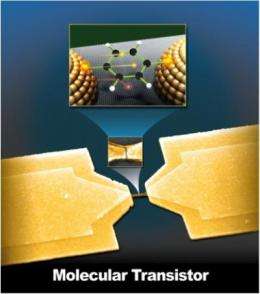
Engineers adjusted the voltage applied via gold contacts to a benzene molecule, allowing them to raise and lower the molecule’s energy states and demonstrate that it could be used exactly like a traditional transistor at the molecular level. Credit: Hyunwook Song and Takhee Lee

A group of scientists has succeeded in creating the first transistor made from a single molecule. The team, which includes researchers from Yale University and the Gwangju Institute of Science and Technology in South Korea, published their findings in the December 24 issue of the journal Nature.

The team, including Mark Reed, the Harold Hodgkinson Professor of Engineering & Applied Science at Yale, showed that a benzene molecule attached to gold contacts could behave just like a transistor.

The researchers were able to manipulate the molecule's different energy states depending on the voltage they applied to it through the contacts. By manipulating the energy states, they were able to control the current passing through the molecule.

"It's like rolling a ball up and over a hill, where the ball represents electrical current and the height of the hill represents the molecule's different energy states," Reed said. "We were able to adjust the height of the hill, allowing current to get through when it was low, and stopping the current when it was high." In this way, the team was able to use the molecule in much the same way as regular transistors are used.

The work builds on previous research Reed did in the 1990s, which demonstrated that individual molecules could be trapped between electrical contacts. Since then, he and Takhee Lee, a former Yale postdoctoral associate and now a professor at the Gwangju Institute of Science and Technology, developed additional techniques over the years that allowed them to "see" what was happening at the molecular level.

Being able to fabricate the electrical contacts on such small scales, identifying the ideal molecules to use, and figuring out where to place them and how to connect them to the contacts were also key components of the discovery. "There were a lot of technological advances and understanding we built up over many years to make this happen," Reed said.

There is a lot of interest in using molecules in computer circuits because traditional transistors are not feasible at such small scales. But Reed stressed that this is strictly a scientific breakthrough and that practical applications such as smaller and faster "molecular computers"—if possible at all—are many decades away.

"We're not about to create the next generation of integrated circuits," he said. "But after many years of work gearing up to this, we have fulfilled a decade-long quest and shown that molecules can act as transistors."

Provided by Yale University (news : web)

4.7 /5 (33 votes)  

Filter


Move the slider to adjust rank threshold, so that you can hide some of the comments.


Display comments: newest first

RealScience
Dec 24, 2009

Rank: not rated yet
Benzene may be the SMALLEST single-molecule that has been made into a transistor.

But single-walled carbon nanotubes are 'single molecules', and transistors have been made in single swCNTs before (Multiple transistors have even been made in a single carbon nanotube).
Bob_B
Dec 26, 2009

Rank: not rated yet
What about the transistor made from a single atom? It was in the news just a few weeks ago.
Rank 4.7 /5 (33 votes)
Related Stories
Relevant PhysicsForums posts
  • perturbance in a model
    created1 hour ago
  • Combustion: where does the heat come from?
    created3 hours ago
  • How does dynamic pressure affect static pressure?
    created3 hours ago
  • Sonication energy
    created3 hours ago
  • How physicists handle the idea of Free Will?
    created5 hours ago
  • Orbital Decay Question
    created6 hours ago
  • More from Physics Forums - General Physics

More news stories

Nanotube therapy takes aim at breast cancer stem cells

Wake Forest Baptist Medical Center researchers have again proven that injecting multiwalled carbon nanotubes (MWCNTs) into tumors and heating them with a quick, 30-second laser treatment can kill them.

Nanotechnology / Bio & Medicine

created 3 hours ago | popularity 5 / 5 (1) | comments 0 | with audio podcast

Inspired by steel, nanomanufacturing gets wear-resistant carbide tip

(PhysOrg.com) -- Scientists at the University of Pennsylvania, the University of Wisconsin-Madison and IBM Research - Zurich have fabricated an ultrasharp silicon carbide tip possessing such high strength ...

Nanotechnology / Nanophysics

created 8 hours ago | popularity 5 / 5 (2) | comments 1 | with audio podcast

New technology platform for molecule-based electronics

Researchers at the Nano-Science Center at the University of Copenhagen have developed a new nano-technology platform for the development of molecule-based electronic components using the wonder material graphene. At the same ...

Nanotechnology / Nanomaterials

created 5 hours ago | popularity 5 / 5 (2) | comments 0

Australians risking skin cancer to avoid nanoparticles

More than three in five Australians are concerned enough about the health implications of nanoparticles in sunscreens to want to know more about their impact. And while the initial scientific information released suggests ...

Nanotechnology / Bio & Medicine

created 6 hours ago | popularity 5 / 5 (1) | comments 0

New kind of solar cell could capture significantly more energy than current cells

New solar cells could increase the maximum efficiency of solar panels by over 25%, according to scientists from the University of Cambridge.

Nanotechnology / Nanophysics

created Feb 08, 2012 | popularity 4.3 / 5 (9) | comments 14 | with audio podcast


Hydrogen from acidic water: Researchers develop potential low cost alternative to platinum for splitting water

A technique for creating a new molecule that structurally and chemically replicates the active part of the widely used industrial catalyst molybdenite has been developed by researchers with the Lawrence Berkeley ...

Ultraviolet protection molecule in plants yields its secrets

Lying around in the sun all day is hazardous not just for humans but also for plants, which have no means of escape. Ultraviolet (UV) radiation from the sun can damage proteins and DNA inside cells, leading ...

To perform with less effort, practice beyond perfection

Whether you are an athlete, a musician or a stroke patient learning to walk again, practice can make perfect, but more practice may make you more efficient, according to a surprising new University of Colorado Boulder study.

Scientists identify most lethal known species of prion protein

Scientists from the Florida campus of The Scripps Research Institute have identified a single prion protein that causes neuronal death similar to that seen in "mad cow" disease, but is at least 10 times more ...

Researchers weigh in on ethics of H5N1 research

(Medical Xpress) -- In a commentary on the biosecurity controversy surrounding publication of bird flu research details, a bioethicist and a vaccine expert at Johns Hopkins reaffirm that "all scientists have an affirmativ ...

Deconstructing a mystery: What caused Snowmaggedon?

In the quiet after the storms, streets and cars had all but disappeared under piles of snow. The U.S. Postal Service suspended service for the first time in 30 years. Snow plows struggled to push the evidence ...