Keck Telescopes Take Deeper Look at Planetary Nurseries
December 23, 2009
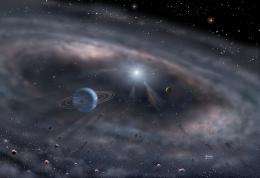
This artist's concept shows the development of planets within a dust disk around a young star. The Keck Interferometer probed the temperature and density of the dust disk around MWC 419 to within a fraction of an astronomical unit from the star. Credit: David A. Hardy
(PhysOrg.com) -- Astronomers using the W. M. Keck Observatory have peered far into a young planetary system, giving an unprecedented view of dust and gas that might eventually form planets similar to Jupiter, Venus, or even Earth. The researchers used the Keck Interferometer, which combines the light-gathering power of both 10-meter Keck telescopes to act as an 85-meter telescopemuch larger than any existing or planned telescope.
“Because the gas, dust and debris that orbit young stars provide the raw materials for planets, probing the inner regions of those stars lets us learn about how Earth-like planets form,” said astronomer Sam Ragland of Keck Observatory. He and his collaborators recently measured the properties of a young planetary system at distances closer to the star than Venus is to the Sun.
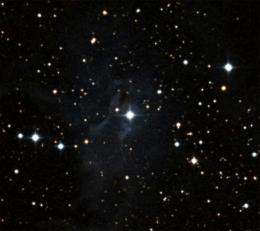
MWC 419, also known as V594 Cas, is a young, blue variable star located 2,100 light years away in the constellation Cassiopeia. Credit: DSS/STScI/AURUA
The researchers used the Keck Interferometer, which combines the light-gathering power of both 10-meter Keck telescopes to act as an 85-meter telescope, much larger than any existing or planned telescope.“Nothing else in the world provides us with the types of measurements the Keck Interferometer does,” said Wesley Traub of Caltech’s Jet Propulsion Laboratory. “In effect, it’s a zoom lens for the Keck telescopes.”
The “zoom lens” allowed the researchers to probe MWC 419, a blue, B-type star that has several times the mass of the Sun and lies about 2,100 light-years away in the constellation Cassiopeia. With an age less than ten million years, MWC 419 ranks as a stellar kindergartener.
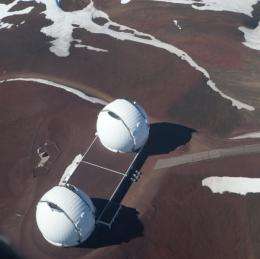
W. M. Keck Observatory operates two 10-meter optical/infrared telescopes on the summit of Mauna Kea. Credit: Joey Stein/ WMKO
With the interferometer and the increased ability to observe fine detail, the team measured temperatures in the planet-forming disk to within about 50 million miles of the star. “That’s about half of Earth’s distance from the Sun, and well within the orbit of Venus,” said team member William Danchi of NASA’s Goddard Space Flight Center in Greenbelt, Md.For comparison, astronomers using a single telescope have directly observed HR 8799, Fomalhaut and GJ 758 and their orbiting planets, which are 40 to 100 times farther away from their stars.
The interferometry results were taken in near-infrared light (3.5 to 4.1 micrometers), which is a wavelength slightly longer than red light and is invisible to the human eye. The researchers used a newly implemented infrared camera, which is the only one of its kind on Earth, to make the first “L-band” interferometric observations of MWC 419.
“This unique infrared capability adds a new dimension to the Keck Interferometer in probing the density and temperature of planet-forming regions around young stars. This wavelength region is relatively unexplored,” Ragland said. “Basically, anything we see through this camera is brand new information.”
With the data, Ragland and his collaborators measured the temperature of dust at various regions throughout MWC 419’s inner disk. Temperature differences throughout the disk may indicate that the dust has different chemical compositions and physical properties that may affect how planets form. For example, in the Solar System, conditions were just right to allow rocky worlds to form closer to the Sun, while gas giants and icy moons assembled farther our in the system. The team reported their findings in the Sept. 20 issue of the Astrophysical Journal.
The observations are an “important first step” in a larger program to collect data on young stars that span the lower-mass T Tauri stars, which are the progenitors of Sun-like stars, to their more massive counterparts, like MWC 419, explained John Monnier, an interferometry scientist at the University of Michigan who was not involved with the study.
The astronomers want to study the range of developing stars because their mass, size and luminosity might affect the composition and physical characteristics of the surrounding disk. Ragland and his collaborators are continuing to collect data on young stars and will combine their infrared observations with new data from the Keck Interferometer’s “nulling” mode, a technique which will block out the light from the central star in a young planetary system.
Provided by W. M. Keck Observatory
-
First Detection of a Planet-Forming Disk Near Environment of a Dying Star
Jan 09, 2007 |
not rated yet |
0
-
AMBER looks into the cradle of planets
Nov 28, 2005 |
not rated yet |
0
-
Twin Keck telescopes probe dual dust disks
Sep 24, 2009 |
not rated yet |
0
-
Astronomers get best view yet of infant stars at feeding time
Oct 10, 2008 |
not rated yet |
0
-
Making Jupiters
Aug 21, 2009 |
not rated yet |
0
-
Engineers build first sub-10-nm carbon nanotube transistor
Feb 01, 2012 |
4.9 / 5 (30) |
30
-
Something old, something new: Evolution and the structural divergence of duplicate genes
Jan 31, 2012 |
4.6 / 5 (7) |
1
-
The hidden nanoworld of ice crystals: Revealing the dynamic behavior of quasi-liquid layers
Jan 30, 2012 |
5 / 5 (3) |
1
-
Stock market network reveals investor clustering
Jan 27, 2012 |
3.9 / 5 (23) |
8
-
Of microchemistry and molecules: Electronic microfluidic device synthesizes biocompatible probes
Jan 26, 2012 |
5 / 5 (1) |
0
-
Titan's lack of impact craters
Feb 09, 2012
-
Real pictures of black hole eating a star?
Feb 08, 2012
-
Hypothetical way to travel faster than light, but not technically exceed lightspeed
Feb 06, 2012
-
How do scientists monitor the Sun's activity?
Feb 05, 2012
-
Search patterns in observational studies
Feb 05, 2012
-
Derivation of Pogson's law
Feb 03, 2012
- More from Physics Forums - General Astronomy
More news stories
Could Venus be shifting gear?
(PhysOrg.com) -- ESAs Venus Express spacecraft has discovered that our cloud-covered neighbour spins a little slower than previously measured. Peering through the dense atmosphere in the infrared, the ...
Space & Earth / Space Exploration
3 hours ago |
5 / 5 (4) |
4
|
Humans may have helped the decline of African rainforests 3000 years ago
(PhysOrg.com) -- Large areas of rainforests in Central Africa mysteriously disappeared over three thousand years ago, to be replaced by savannas. The prevailing theory has been that the cause was a change ...
Clam fields found at deep, low-temperature Mariana vents
(PhysOrg.com) -- Scientists have marveled at the unusual life forms thriving at high temperature hydrothermal vents of the deep ocean.
Space & Earth / Earth Sciences
4 hours ago |
not rated yet |
0
|
Mars Science Laboratory computer issue resolved
(PhysOrg.com) -- Engineers have found the root cause of a computer reset that occurred two months ago on NASA's Mars Science Laboratory and have determined how to correct it.
Space & Earth / Space Exploration
4 hours ago |
5 / 5 (5) |
2
|
Two new moons for Jupiter
Advances in technology have lead to the discovery of new planets outside of our Solar System, and now even new moons in our own backyard.
Space & Earth / Space Exploration
3 hours ago |
not rated yet |
2
New understanding of DNA repair could eventually lead to cancer therapy
A research group in the Faculty of Medicine & Dentistry at the University of Alberta is hoping its latest discovery could one day be used to develop new therapies that target certain types of cancers.
Hovering not hard if you're top-heavy, researchers find
Top-heavy structures are more likely to maintain their balance while hovering in the air than are those that bear a lower center of gravity, researchers at New York University's Courant Institute of Mathematical Sciences ...
Grass to gas: Researchers' genome map speeds biofuel development
Researchers at the University of Georgia have taken a major step in the ongoing effort to find sources of cleaner, renewable energy by mapping the genomes of two originator cells of Miscanthus x giganteus, a large perenn ...
Night, weekend delivery OK for babies with birth defects
Weekday delivery is no better than night or weekend delivery for infants with birth defects, according to a new study presented today at The Pregnancy Meeting, the Society for Maternal-Fetal Medicine's annual conference. ...
Sonic Cradle lands spot in TED exhibition
A Simon Fraser University graduate student project that melds music, meditation and modern technology has landed a rare spot as an exhibit at TEDActive 2012 in Palm Springs, California this month.
Drug halts organ damage in inflammatory genetic disorder
A new study shows that Kineret (anakinra), a medication approved for the treatment of rheumatoid arthritis, is effective in stopping the progression of organ damage in people with neonatal-onset multisystem inflammatory disease ...


Dec 26, 2009
Rank: not rated yet
Dec 27, 2009
Rank: 1 / 5 (1)
Professor Karl K. Turekian and S. P. Clark, Jr. solved this problem in 1969. See "Inhomogeneous accumulation of the earth from the primitive solar nebula", Earth Planet. Sci. Lett. 6 (1969) 346-348.
With kind regards,
Oliver K. Manuel