Cockroaches offer inspiration for running robots
December 28, 2009
Researchers at Oregon State University are using studies of guinea hens and other animals such as cockroaches to learn more about the mechanics of their running ability, with the goal of developing robots that can run easily over rough terrain.
The sight of a cockroach scurrying for cover may be nauseating, but the insect is also a biological and engineering marvel, and is providing researchers at Oregon State University with what they call "bioinspiration" in a quest to build the world's first legged robot that is capable of running effortlessly over rough terrain.
If the engineers succeed, they may owe their success to what's being learned from these insects and other animals, such as the guinea hen, that have their own remarkable abilities.
The latest findings - just published in the professional journal Bioinspiration and Biomimetics - outline how animals use their legs to manage energy storage and expenditure, and why this is so important for running stability. The work is being supported by the National Science Foundation.
"Humans can run, but frankly our capabilities are nothing compared to what insects and some other animals can do," said John Schmitt, an assistant professor in the School of Mechanical, Industrial and Manufacturing Engineering at OSU. "Cockroaches are incredible. They can run fast, turn on a dime, move easily over rough terrain, and react to perturbations faster than a nerve impulse can travel."
Within certain limitations, Schmitt said, cockroaches don't even have to think about running - they just do it, with muscle action that is instinctive and doesn't require reflex control. That, in fact, is part of what the engineers are trying to achieve. Right now some robots have been built that can walk, but none of them can run as well as their animal counterparts. Even walking robots absorb far too much energy and computing power to be very useful.
"If we ever develop robots that can really run over rough ground, they can't afford to use so much of their computing abilities and energy demand to accomplish it," Schmitt said. "A cockroach doesn't think much about running, it just runs. And it only slows down about 20 percent when going over blocks that are three times higher than its hips. That's just remarkable, and an indication that their stability has to do with how they are built, rather than how they react."
If successful, Schmitt said, running robots could serve valuable roles in difficult jobs, such as military operations, law enforcement or space exploration. Related technology might also be applied to improve the function of prosthetic limbs for amputees, or serve other needs.
The OSU researchers are trying to identify some of the basic biological and mechanical principles that allow certain animals to run so well and effortlessly. A guinea hen, for instance, can change the length and angle of its spring-like legs to almost automatically adjust to an unexpected change in a ground surface as much as 40 percent of its hip height. That would be like a human running at full speed, stepping into a 16-inch-deep hole and never missing a beat.
Researchers are getting closer to their goal.
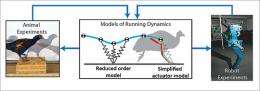
In a computer model, they've created a concept that would allow a running robot to recover from a change in ground surface almost as well as a guinea hen. They are studying how the interplay of concepts such as energy storage and expenditure, sensor and feedback requirements, and leg angles can produce recovery from such perturbations. Ultimately, a team of OSU engineers hopes to use knowledge such as this to actually build robots that can efficiently run over rough terrain without using significant computing power.
And some day, a robot - instead of a human - might be used to run into a dangerous area, check things out and report back for further instructions.
-
Study: Long legs are more efficient
Mar 12, 2007 |
not rated yet |
0
-
Researcher designs robot that jumps like a grasshopper
Dec 04, 2008 |
not rated yet |
0
-
Cornell robot fails to break a record, but students learn
Apr 03, 2008 |
not rated yet |
0
-
From nature, robots
Sep 25, 2009 |
not rated yet |
0
-
Researchers learn why robots get stuck in the sand -- and how to keep them going (Video)
Feb 09, 2009 |
not rated yet |
0
-
Engineers build first sub-10-nm carbon nanotube transistor
Feb 01, 2012 |
4.9 / 5 (31) |
30
-
Something old, something new: Evolution and the structural divergence of duplicate genes
Jan 31, 2012 |
4.6 / 5 (7) |
1
-
The hidden nanoworld of ice crystals: Revealing the dynamic behavior of quasi-liquid layers
Jan 30, 2012 |
5 / 5 (3) |
1
-
Stock market network reveals investor clustering
Jan 27, 2012 |
3.9 / 5 (23) |
8
-
Of microchemistry and molecules: Electronic microfluidic device synthesizes biocompatible probes
Jan 26, 2012 |
5 / 5 (1) |
0
-
Calling function with no input argument
4 hours ago
-
Force free body diagram problem on gym equipment
5 hours ago
-
Empirical data regarding shower heads and water
13 hours ago
-
feed hold button on CNC lathe
Feb 09, 2012
-
RFAC in Fortran
Feb 09, 2012
-
dynamics 2/32
Feb 08, 2012
- More from Physics Forums - General Engineering
More news stories
Japan scientist makes 'Avatar' robot
A Japanese-developed robot that mimics the movements of its human controller is bringing the Hollywood blockbuster "Avatar" one step closer to reality.
9 hours ago |
5 / 5 (5) |
4
Google to make home entertainment system: report
Google will mirror Apple's winning hardware-software formula with an Android-powered entertainment system that wirelessly streams content through homes, the Wall Street Journal reported on Thursday.
Electronics / Consumer & Gadgets
21 hours ago |
4.5 / 5 (2) |
0
Barriers fall between TV, Internet
You say TV, I say Internet. Toe-mate-o, toe-mah-to.
Electronics / Consumer & Gadgets
23 hours ago |
not rated yet |
0
Intel packs performance and reliability into its latest SSD 520 series
Intel Corporation announced today its fastest, most robust client/consumer solid-state drive (SSD) to date, the Intel Solid-State Drive 520 Series (Intel SSD 520), a 6 gigabit-per-second (gbps) SATA III SSD ...
Feb 07, 2012 |
5 / 5 (1) |
4
Google rumored to have built Heads-Up-Display glasses prototype
(PhysOrg.com) -- 9to5Google is reporting that they have received a tip from someone they believe to be a reliable source saying that Google is working on a Heads-Up-Display (HUD) pair of eye-glasses. The per ...
Putting the squeeze on planets outside our solar system
(PhysOrg.com) -- Using high-powered lasers, scientists at Lawrence Livermore National Laboratory and collaborators discovered that molten magnesium silicate undergoes a phase change in the liquid state, abruptly ...
Employers feel no love for unscrupulous practice of 'service sweethearting'
A new study led by two Florida State University marketing professors finds that some frontline service employees who are rewarded for hikes in customer loyalty and satisfaction also may engage in "service ...
US issues guidelines to avoid heparin contamination
Four years after US drug-maker Baxter International's blood thinner heparin was contaminated in China, causing dozens of deaths, US regulators on Friday issued draft guidelines for safe production.
Expat French get Internet vote for first time
French citizens will for the first time this year be able to vote in a parliamentary election over the Internet, an experiment that could be extended to other elections if successful.
"Twisted Metal" gamers get shot at real gunplay
Fans of "Twisted Metal" will get to welcome a long-awaited sequel of the car-battle videogame with a real-world bang by blasting an ice cream truck to bits with a machine gun.
The power of estrogen -- male snakes attract other males
A new study has shown that boosting the estrogen levels of male garter snakes causes them to secrete the same pheromones that females use to attract suitors, and turned the males into just about the sexiest ...