Scientists discover a controller of brain circuitry
December 28, 2009
Johns Hopkins scientists discover a controller of brain circuitry

Enlarge

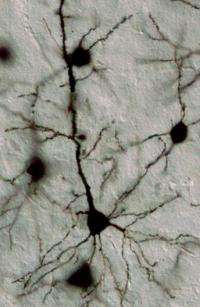
A pyramidal neuron in the mouse cerebral cortex is labeled using the Golgi technique. Credit: Image by Tracy Tran, David Ginty and Alex Kolodkin of Johns Hopkins Medicine

By combining a research technique that dates back 136 years with modern molecular genetics, a Johns Hopkins neuroscientist has been able to see how a mammal's brain shrewdly revisits and reuses the same molecular cues to control the complex design of its circuits.

Details of the observation in lab mice, published Dec. 24 in Nature, reveal that semaphorin, a protein found in the developing nervous system that guides filament-like processes, called axons, from to their appropriate targets during embryonic life, apparently assumes an entirely different role later on, once axons reach their targets. In postnatal development and adulthood, semaphorins appear to be regulating the creation of synapses — those connections that chemically link nerve cells.

"With this discovery we're able to understand how semaphorins regulate the number of synapses and their distribution in the part of the brain involved in conscious thought," says David Ginty, Ph.D., a professor in the neuroscience department at the Johns Hopkins University School of Medicine and a Howard Hughes Medical Institute investigator. "It's a major step forward, we believe, in our understanding of the assembly of neural circuits that underlie behavior."

Because the brain's activity is determined by how and where these connections form, Ginty says that semaphorin's newly defined role could have an impact on how scientists think about the early origins of , schizophrenia, epilepsy and other neurological disorders.

The discovery came as a surprise finding in studies by the Johns Hopkins team to figure out how nerve cells develop axons, which project information from the cells, as well as dendrites, which essentially bring information in. Because earlier work from the Johns Hopkins labs of Ginty and Alex Kolodkin, Ph.D., showed that semaphorins affect axon trajectory and growth, they suspected that perhaps these guidance molecules might have some involvement with dendrites.

Kolodkin, a professor in the neuroscience department at Johns Hopkins and a Howard Hughes Medical Institute investigator, discovered and cloned the first semaphorin gene in the grasshopper when he was a postdoctoral fellow. Over the past 15 years, numerous animal models, including strains of genetically engineered mice, have been created to study this family of molecules.

Using two lines of mice — one missing semaphorin and another missing neuropilin, its receptor — postdoctoral fellow Tracy Tran used a classic staining method called the Golgi technique to look at the anatomy of nerve cells from mouse brains. (The Golgi technique involves soaking nerve tissue in silver chromate to make cells' inner structures visible under the light microscope; it allowed neuroanatomists in 1891 to determine that the nervous system is interconnected by discrete cells called neurons.)

Tran saw unusually pronounced "spines" sprouting willy-nilly in peculiar places and in greater numbers on the in the neurons of semaphorin-lacking and neuropilin-lacking mice compared to the normal wild-type animals. It's at the tips of these specialized spines that a lot of synapses occur and neuron-to-neuron communication happens, so Tran suspected there might be more synapses and more electrical activity in the neurons of the mutant mice.

The researchers tested this hypothesis by examining even thinner brain slices under an electron microscope.

The spines of both semaphorin-lacking and neuropilin-lacking mice were dramatically enlarged, compared to those of the smaller, spherical-looking spines in the wild-type mice. In wild types, Tran generally noted a single site of connection per spine. In the mutants, the site of connection between two neurons was often split.

Next, the team recorded the electrical output of mutant and wild-type neurons and found that the mutants, with more spines and larger spines, also had about a 2.5-times increase in the frequency of electrical activity, suggesting that this abnormal synaptic transmission is due to an increase in the number of synapses.

What causes synapses to form or not form in appropriate or inappropriate places is an extremely important and poorly understood process in the development of the nervous system, Kolodkin says, explaining that the neurons his team studies can have up to 10,000 synaptic connections with other neurons. If connections between neurons are not being formed how and where they're supposed to, then miscommunication occurs and circuits malfunction; as a result, any number of diseases or disorders might develop.

"Seizures can be interpreted as an uncontrolled rapid-firing of certain neural circuits," Kolodkin asserts. "Clearly there's a deficit in these animals that has a human corollary with respect to epilepsy. It's also thought that schizophrenia and autism spectrum disorders have developmental origins of one sort or another. There likely are aspects to the formation of synapses — if they're not in the correct location and in the correct number — that lead to certain types of defects. The spine deficits in these mice that are lacking semaphorin or its receptor appear very similar to those that are found in Fragile X, for instance."

Provided by Johns Hopkins Medical Institutions

4.9 /5 (20 votes)  

Filter


Move the slider to adjust rank threshold, so that you can hide some of the comments.


Display comments: newest first

designmemetic
Dec 28, 2009

Rank: 5 / 5 (1)
I'm curious about the "two lines of mice — one missing semaphorin and another missing neuropilin, its receptor." did they behave differently or suffer from diseases similar to any known. Where they crazy? Great article in general worth reading.
docatomic
Dec 29, 2009

Rank: not rated yet
Where they crazy?


Johns Hopkins University School of Medicine, the article stated.
Sinister181
Dec 30, 2009

Rank: not rated yet
Could this sort of research also have implications towards "developmental delay?" I see that Schizophrenia and Autism are both mentioned in the article, but I don't see anything mentioned about MR. Research in this area has been somewhat absent, to say the least.
rmuldavin
Dec 31, 2009

Rank: not rated yet
In Googling, images, the authors appear to be the only ones actually showing the microslides of the neuron/~/axion/~/neuron with counts of numbers of branching synaptic connections, some 20K.

Using the social networking counting scheme, L(N)=(N)(N-1)/2,
L(20K)~20K^squared/2=400K^sq/2=200mega links.

This might mean, somehow, evolution, trial and error, allowed for the proteins to do the entire circuitry.

Thanks, I am truely confused, good sign, only one thing rings clear:

Lots of trials, lots of time. Happy new fear without pain, rm

So ys
Rank 4.9 /5 (20 votes)
Related Stories
Relevant PhysicsForums posts
  • Is Everyday Technology Killing Us?
    createdFeb 08, 2012
  • Exercise and weight loss
    createdFeb 08, 2012
  • Why do we have head aches? Our brains can't feel anything.
    createdFeb 07, 2012
  • "The end of diseases" by David Agus, interview from Daily Show with Jon Stewart
    createdFeb 04, 2012
  • Oncolytic adenovirus
    createdFeb 04, 2012
  • Nutrition label stuffs and diets
    createdFeb 02, 2012
  • More from Physics Forums - Medical Sciences

More news stories

Complex wiring of the nervous system may rely on a just a handful of genes and proteins

Researchers at the Salk Institute have discovered a startling feature of early brain development that helps to explain how complex neuron wiring patterns are programmed using just a handful of critical genes. ...

Medicine & Health / Research

created 4 hours ago | popularity 5 / 5 (7) | comments 0 | with audio podcast

Both maternal and paternal age linked to autism

Older maternal and paternal age are jointly associated with having a child with autism, according to a recently published study led by researchers at The University of Texas Health Science Center at Houston (UTHealth).

Medicine & Health / Psychology & Psychiatry

created 8 hours ago | popularity 5 / 5 (1) | comments 0 | with audio podcast

New understanding of DNA repair could eventually lead to cancer therapy

A research group in the Faculty of Medicine & Dentistry at the University of Alberta is hoping its latest discovery could one day be used to develop new therapies that target certain types of cancers.

Medicine & Health / Cancer

created 8 hours ago | popularity 4.8 / 5 (4) | comments 0 | with audio podcast

Curry spice component may help slow prostate tumor growth

Curcumin, an active component of the Indian curry spice turmeric, may help slow down tumor growth in castration-resistant prostate cancer patients on androgen deprivation therapy (ADT), a study from researchers ...

Medicine & Health / Cancer

created 9 hours ago | popularity 4.6 / 5 (5) | comments 0 | with audio podcast

Human cognitive performance suffers following natural disasters, researchers find

Not surprisingly, victims of a natural disaster can experience stress and anxiety, but a new study indicates that it might also cause them to make more errors - some serious - in their daily lives. In their upcoming Human Fa ...

Medicine & Health / Psychology & Psychiatry

created 5 hours ago | popularity 4 / 5 (1) | comments 0


Google users warned of threat to smartphone wallets

Users of Google smartphone wallets were being warned on Friday that there is a way to crack pass codes intended to thwart thieves from going on illicit shopping sprees.

Anonymous knocks CIA website offline (Update)

The website of the Central Intelligence Agency was inaccessible on Friday after the hacker group Anonymous claimed to have knocked it offline.

Putting the squeeze on planets outside our solar system

(PhysOrg.com) -- Using high-powered lasers, scientists at Lawrence Livermore National Laboratory and collaborators discovered that molten magnesium silicate undergoes a phase change in the liquid state, abruptly ...

NASA sees wide-eyed cyclone Jasmine

Cyclone Jasmine's eye has opened wider on NASA satellite imagery, as it moves through the Southern Pacific Ocean.

New error-correcting codes guarantee the fastest possible rate of data transmission

Error-correcting codes are one of the triumphs of the digital age. They’re a way of encoding information so that it can be transmitted across a communication channel — such as an optical fiber o ...

The power of estrogen -- male snakes attract other males

A new study has shown that boosting the estrogen levels of male garter snakes causes them to secrete the same pheromones that females use to attract suitors, and turned the males into just about the sexiest ...