Better airport scanners delayed by privacy fears
December 28, 2009 By JOELLE TESSLER and ARTHUR MAX , Associated Press Writers
Better airport scanners delayed by privacy fears (AP)

Enlarge

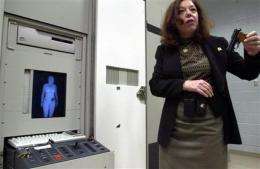
In this June 25, 2003 file photo, Susan Hallowell holds up a side arm that was detected by the "backscatter" machine at the Transportation Security Administration in Egg Harbor Township, N.J. Stifel Nicolaus analyst David Schick said Monday, Dec. 28, 2009, whole-body imagery systems _ rather than standard metal detectors _ could be an effective method of strengthening airport security. (AP Photo/Brian Branch-Price, file)

(AP) -- High-tech security scanners that might have prevented the Christmas Day attempt to blow up a jetliner have been installed in only a small number of airports around the world, in large part because of privacy concerns over the way the machines see through clothing.

The technology is in place at 19 U.S. airports, while European officials have generally limited it to test runs.

Umar Farouk Abdulmutallab, the Nigerian accused of trying to ignite explosives aboard a Northwest Airlines jet as it was coming in for a landing in Detroit, did not go through such a scan where his flight began, at Amsterdam's Schipol airport.

The full-body scanner "could have been helpful in this case, absolutely," said Evert van Zwol, head of the Dutch Pilots Association.

But the technology has raised significant concerns among privacy watchdogs because it can show the body's contours with embarrassing clarity. Those fears have slowed the introduction of the machines.

Jay Stanley, public education director for the American Civil Liberties Union's Technology and Liberty Program, said the machines essentially perform "virtual strip searches that see through your clothing and reveal the size and shape of your body."

Abdulmutallab passed through a routine check at the gate in Amsterdam before boarding, officials said. He is believed to have tucked into his trousers or underwear a small bag holding PETN explosive powder, and possibly a liquid detonator.

Because such items won't set off metal detectors, the U.S. Transportation Security Administration, part of the Department of Homeland Security, has begun installing two types of advanced scanning machines that provide a more detailed picture.

These machines, which cost six figures each, screen without physical contact. They can reveal plastic or chemical explosives and non-metallic weapons.

Such scanners "provide the best protection for the widest range of threats," said Joe Reiss, vice president of marketing for American Science & Engineering Inc. The company makes machines for prisons, military agencies, foreign customs patrols and other customers but does not have a contract with TSA.

TSA has deployed 40 "millimeter wave" machines, which use radio waves to produce a three-dimensional image based on energy reflected back from the body.

Six of those machines, which are made by L-3 Communications Holdings Inc., are being used for what TSA calls "primary screenings" at six U.S. airports: Albuquerque, N.M.; Las Vegas; Miami; San Francisco; Salt Lake City; and Tulsa, Okla.

This means passengers go through the scans instead of a metal detector, although they can elect to receive a pat-down search from a security officer instead.

The remainder of the machines are being used at 13 U.S. airports for secondary screening of passengers who set off a metal detector: Atlanta; Baltimore/Washington; Denver; Dallas/Fort Worth; Indianapolis; Jacksonville and Tampa, Fla.; Los Angeles; Phoenix; Raleigh-Durham, N.C.; Richmond, Va.; Ronald Reagan Washington National; and Detroit. Travelers can opt for a pat-down instead in those instances as well.

The agency also has announced plans to buy150 "backscatter" machines, which use low-level X-rays to create a two-dimensional image of the body, from Rapiscan Systems, a unit of OSI Systems Inc. Those machines, which cost $190,000 each, are being deployed in U.S. airports now.

"The machine gives a very accurate and very precise image of things on the body that are not the body," said Peter Kant, executive vice president of global government affairs for Rapiscan.

Last June, however, because of privacy concerns, the House voted 310-118 to prohibit the use of whole-body imaging for primary screening. The measure, still pending in the Senate, would limit the use of the devices to secondary screening.

"As a society, we're going to have to figure out the balance between personal privacy and the need to secure an aircraft," said Rep. Jason Chaffetz, R-Utah, who sponsored the measure. "And there is no easy answer."

Executives at the companies that make the machines insist there are ways to strike that balance.

Kant said the technology has evolved enough to produce body images that look like chalk outlines. In addition, privacy filters can blur faces, noted Colin McSeveny, communications manager for Smiths Detection, a British company that makes millimeter wave machines that are being tested in Europe and the U.S.

For its part, TSA said it safeguards privacy by ensuring that all full-body images are viewed in a walled-off location not visible to the public. In addition, the security officer assisting the passenger cannot view the image and the officer who views the image never sees the passenger. Also, the machines cannot store, print or transmit any images they produce.

After all, McSeveny said, "all they are looking for is something that shouldn't be there."

Because of the privacy questions, the European Union Parliament voted in October 2008 for more study before authorizing the machines' full deployment in European airports.

Amsterdam's airport has been running a test project with full-body scanners for three years, mainly for a few European flights. One machine being tested there for the past five weeks, made by L-3, is designed to enhance passengers' privacy by having software, rather than a human, analyze the image generated by the scanner. If the software detects an anomaly - something strapped to a leg, for instance - it alerts a human screener to look at the person's leg directly.

"So nobody sees any images," said Ron Louwerse, the airport's chief of security. "The results are very, very good. I'm very confident about it."

In May, TSA abandoned "puffer machines" made by General Electric Co. and Smiths Detection, which blew air onto passengers to dislodge trace amounts of explosives. The government said the machines cost too much to maintain and regularly broke down when exposed to dirt or humidity. There are still 18 puffer machines deployed at U.S. airports.

©2009 The Associated Press. All rights reserved. This material may not be published, broadcast, rewritten or redistributed.

Filter


Move the slider to adjust rank threshold, so that you can hide some of the comments.


Display comments: newest first

NeilFarbstein
Dec 28, 2009

Rank: 5 / 5 (1)
Use them! Our lives are more important than embarrassments.
Caliban
Dec 29, 2009

Rank: 1 / 5 (1)
Exactly, Neil- who cares if a Senator, CEO, or just a garden-variety fetishist is wearing tit-clamps, ladie's underwear, or some other bit of funsy? None of those things-to my knowledge- are explosives/weapons. On the other hand, it would make it far more difficult to smuggle currency, jewels, drugs and the like. Which is the much more likely cause of these concerns over "privacy".
Muchtobedesired
Dec 29, 2009

Rank: not rated yet
Bomber Had No Passport....Helped To Board Plane By "Sharp-Dressed Man"...In Black???

December 27, 2009

A passenger who boarded Northwest Airlines Flight 253 in Amsterdam with attempted plane bomber Umar Farouk Abdul Mutallab says the would-be terrorist had no passport and was aided by a sharp-dressed man who claimed Mutallab was a Sudanese refugee, just one of a plethora of startling inconsistencies surrounding an incident that has led to ramped up security and increased levels of harassment in airports.
http://www.dailyp...e/119717
bentrider1957
Dec 29, 2009

Rank: not rated yet
The images provided my millimeter detection is hardly anything "erotic" or "exciting". Who really cares if someone sees your naughty bits on a screen that looks like Terminator?
Muchtobedesired
Dec 29, 2009

Rank: not rated yet
THE SHARP-DRESSED MAN

Kurt Haskell and his wife, who were witnesses on board Northwest Airlines Flight 253 saw; Umar Farouk Abdulmutallab receiving assistance from a well-dressed wealthy-looking Indian man, at the boarding gate in Amsterdam. Haskell told CNN that the accused bomber appeared strikingly ‘poor’ next to the well-dressed man. According to Haskell, that man (Sharp-Dressed) did the talking for him, explaining to the flight personnel at the gate, that Abdulmutallab needed to board without a passport, claiming that he was a Sudanese refugee.

CNN Airs Witness Testimony that 'Well Dressed' Indian accomplice helped Abdulmutallab board without passport and that man on plane filmed entire flight and bombing attempt.
http://www.youtub...K7FFDukQ
Muchtobedesired
Dec 30, 2009

Rank: not rated yet
Was Detroit Jet “TERRORIST ATTACK” staged?

The recent failed attack on a US passenger jet traveling from Amsterdam to Detroit was a set-up provocation, controlled by US intelligence...author and journalist Webster Tarpley, stated to RT.

“[The terrorist’s] father, a rich Nigerian banker, went to the US embassy in Nigeria, on November 19 and said; ‘my son is in Yemen in a terrorist camp, do something about this.’ Nevertheless, the son is allowed to buy a ticket in Ghana, paying cash, $2,800 for a one-way ticket” Tarpley said.
http://rt.com/Pol...t-terror -act-fake.html#
Muchtobedesired
Dec 30, 2009

Rank: not rated yet
Wow!
This has got to be the best investigative work since the CIA, FBI or which ever alphabet gang it was, that found the PASSPORT laying in the rubble; belonging to a HIJACKERS that flew a PLANE into Silverstein's TWIN-TOWERS.

Imagine that...I counted six different photographs that were made available, and used during this NEWS segment on this so-called Detroit Jet bomber. But there is no evidence yet of the "SHARP-DRESSED MAN...IN BLACK???
http://www.youtub...F8Q2gtx4

Dutch probe claims of Nigerian bomber accomplice.

"At this moment we have no information on whether there was another guy," the military police spokesman said. "We are checking all clues and information we get."

The spokesman added that the military police and the counter-terrorism agency NCTb were reviewing CCTV video and other evidence to see if the accomplice story bears out.
http://au.news.ya...49/dutch -probe-claims-of-nigerian-bomber-accomplice/$
Muchtobedesired
Jan 14, 2010

Rank: not rated yet
Old Study - Airport Security Measures - Full Body Scanners - “unzips double-stranded DNA, creating bubbles in the double strand that could significantly interfere with processes such as gene expression and DNA replication”.

How Terahertz Waves Tear Apart DNA - Friday, October 30, 2009.

A new model of the way the THz waves interact with DNA explains how the damage is done and why evidence has been so hard to gather.
The Link: http://www.techno...v/24331/
Rank 5 /5 (1 vote)
Related Stories
Relevant PhysicsForums posts
  • Empirical data regarding shower heads and water
    created3 hours ago
  • feed hold button on CNC lathe
    created23 hours ago
  • RFAC in Fortran
    createdFeb 09, 2012
  • dynamics 2/32
    createdFeb 08, 2012
  • dynamics
    createdFeb 08, 2012
  • Vibration Absorbtion Problem
    createdFeb 08, 2012
  • More from Physics Forums - General Engineering

More news stories

US video game sales fall 34 percent in January

(AP) -- U.S. retail sales of video game hardware, software and accessories fell 34 percent in January from a year earlier to $751 million due to the lack of new game titles, according to market researcher NPD Group.

Technology / Business

created 16 minutes ago | popularity not rated yet | comments 0

Soraa LED light may dim 50-watt halogen rivals

(PhysOrg.com) -- Soraa, a Fremont, California company founded in 2008, this week launched its first product, a light that uses LEDS (light emitting diodes). The "Soraa LED MR16 lamp" is the "perfect" replacement ...

Technology / Semiconductors

created 23 hours ago | popularity 4.3 / 5 (18) | comments 18 | with audio podcast report

Samsung can continue selling Galaxy tabs in Germany: court

South Korea's Samsung Electronics can continue to sell its Galaxy Tab 10.1N tablet computer in Germany, a German court ruled Thursday, rejecting a bid by arch-rival Apple to have them banned.

Technology / Business

created 21 hours ago | popularity 4 / 5 (4) | comments 3

Digital photos could put kids at risk

A study published in the International Journal of Electronic Security and Digital Forensics this month suggests that parents and carers could be putting children at risk if they upload digital photos that are automatically "geota ...

Technology / Internet

created 17 hours ago | popularity 5 / 5 (1) | comments 3

Google launches Chrome browser for Android smartphones

With more and more people connecting to the Internet through a phone or a tablet instead of a PC, Google Inc. is bringing its fast-growing browser, Chrome, to the newest Android-powered mobile devices.

Technology / Software

created 20 hours ago | popularity 5 / 5 (5) | comments 0


Japan scientist makes 'Avatar' robot

A Japanese-developed robot that mimics the movements of its human controller is bringing the Hollywood blockbuster "Avatar" one step closer to reality.

Fighting crimes against biodiversity: How to catch a killer weed

Invasive species which have the potential to destroy biodiversity and influence global change could be tracked and controlled in the same way as wanted criminals, according to new research from Queen Mary, University of London.

Metastatic breast cancer hitches a free ride from the immune system

Inflammatory breast cancer (IBC) is the most lethal form of breast cancer . It spreads easily through the lymphatic and blood vessels, forming metastasis which can lead to multi-organ failure. New research published in BioMed ...

A novel method for simultaneously measuring blood pressure and arterial stiffness

Arterial stiffness due to is a major contributor to cardiovascular disease but is very difficult to measure. It also can influence blood pressure readings since these rely on the time taken for arteries to return to normal ...

India's global pharmacy role threatened by EU pact

(AP) -- Efforts by India and the European Union to strengthen trade are threatening India's ability to deliver lifesaving medicines to the world's poorest, analysts say as the two sides push through protracted ...

Study finds that red blood cell transfusion decreases fatigue in women with acute postpartum anemia

In a study to be presented today at the Society for Maternal-Fetal Medicine's annual meeting, The Pregnancy Meeting ™, in Dallas, Texas, researchers will report findings that show that in women with acute postpartum ...