After foiled US plane attack, scanners revisited
December 29, 2009 by Stephane Jourdain and Daphne Benoit
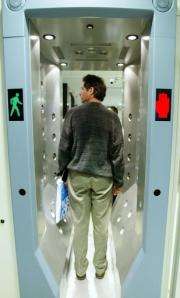
A man passes through a high-tech explosive-detection machine at John F. Kennedy airport in New York

Enlarge

File photo shows a man standing in a high-tech explosive-detection machine at John F. Kennedy International Airport in New York. As US lawmakers demand to know how a would-be attacker smuggled explosives aboard a plane on Christmas Day, the use of body scanners at airport security points is likely to be revisited.

As US lawmakers demand to know how a would-be attacker smuggled explosives aboard a plane on Christmas Day, the use of body scanners at airport security points is likely to be revisited.

The machines are considered effective and have been tested at numerous international airports, but they are also controversial because they scan beneath clothing to detect items that may be hidden from ordinary view.

But security experts believe that the scanners could have detected the explosives that Umar Farouk Abdulmutallab was hiding as he boarded a Northwest Airlines plane in Amsterdam last week.

Abdulmutallab attempted to bring down the Airbus 330 by combining a flammable liquid he was carrying in a syringe with an explosive powder known as pentaerythritol or PETN that was sewn into his underwear.

The metal detectors that passengers ordinarily step through as their luggage is being x-rayed would not have detected either component, experts said.

In the wake of the failed attack, British Interior Minister Alan Johnson said Monday he would consider installing full body scanners at British airports "as quickly as possible."

In the United States, the scanners are already used at 19 airports and a handful of courthouses and prisons, according to the Transportation Security Administration.

The machines look like small booths and use radio frequencies to scan underneath clothing and produce a of the individual's body. Related article: Obama syays 'will not rest' until air terror plotters caught

While the scanner does not produce an image of the naked body, it has caused consternation among privacy advocates because it does faithfully reproduce individual curves hidden beneath clothing, from the shape of a breast to a roll of fat.

The device has been tested in numerous European airports but its use was halted after the European Union expressed concerns and protested a plan to install the scanners at airports throughout the EU.

EU representative Martine Roure praised the mothballing of the project, saying it would have been "disproportionate to submit all passengers to this type of check in the name of the fight against terrorism."

But Thursday's attack, which was prevented by passengers and crew who overwhelmed Abdulmutallab, could prompt lawmakers worldwide to change their minds about the body scanners. Related article: Airports step up security after failed attack

Successful and failed terror attacks targeting airplanes have already led to significant changes to the way people fly.

After the September 11, 2001 attacks, pilots began locking the cockpit door behind them to prevent hijackers from accessing the flight controls.

In the wake of Richard Reid's failed December 2001 attempt to detonate explosives in his shoes, passengers now routinely submit their footwear to inspection before boarding a plane.

And after authorities uncovered a plot in 2006 to blow up airliners with explosives in liquid containers, new regulations were imposed limiting the amount of fluid each traveller could bring aboard a flight.

Bruce Hoffman, a terrorism expert at Georgetown University, told AFP that traditional security measures simply would not be able to detect the sort of explosive Abdulmutallab was carrying.

"There is no other way, except for a body scan, to detect it," he said.

Even the secondary screening measures sometimes used at airports would have failed, he added.

"If it (the explosive PETN) was sealed extremely tight in plastic, dogs wouldn't have picked it up."

Douglas Laird, a former security director for Northwest Airlines, agreed, noting it was virtually impossible to know what was concealed beneath clothing without the scanners.

But some are more skeptical about the efficacy of the machines, including Jimmie Carol Oxley, the co-director of the Center of Excellence in Explosive Detection, Mitigation, Response and Characterization at the University of Rhode Island.

"Anything is hard to detect if you're not looking for it," he pointed out, noting that airport security already has machines that can detect PETN.

"If you go through the and they ever pull you over for your carry-on and they swab your carry-on, they can pick up that, those machines detect it."

The machines also come with another problem: they cost around a million dollars, 20 times more than a standard X-ray machines, according to Laird.

(c) 2009 AFP

3.8 /5 (6 votes)  

Filter


Move the slider to adjust rank threshold, so that you can hide some of the comments.


Display comments: newest first

Mr_Frontier
Dec 30, 2009

Rank: 5 / 5 (1)
Perhaps the next step is to smuggle something in a roll of fat, then maybe we could come up with a weight loss machine at airports, potentially saving tons of jet fuel, as well. Chop chop, Dept. of D.
VOR
Dec 30, 2009

Rank: not rated yet
Classic example of a dramatically asymmetrical response. Dynamite for a roach problem. Im not saying something doesnt needs to be done, but this is just opportunistic marketing of the scanners. And there is the undeniable fact that no matter what we do, there will always be a way to get materials on board. The question is, just how rediculously expensive, invasive, and inconvenient shall we make flying simply to reduce, not eliminate that chance. Further, the chance of violence on board is already much less than accidental causes of loss. As consistently ethnic as terriorts seem to be, we should instead simply intensify scrutiny of
passengers of those origins, requiring special pre-screened passes for them.
MorituriMax
Dec 30, 2009

Rank: not rated yet
How many people are now going to go to jail because they simply HAD to use the restroom on the plane just before it touched down? And how many terrorists are going to set off the explosives they successfuly ALREADY have on the plane 1 hour and 1 minute before they land so they can go into the bathroom to use it?
Claudius
Dec 31, 2009

Rank: 1 / 5 (1)
US lawmakers demand to know how a would-be attacker smuggled explosives aboard a plane on Christmas Day


If they don't know, they should look for the "well-dressed man" who was witnessed escorting the "attacker" past security and onto the plane without a passport.

It is amazing that we are expected to swallow the story the mainstream media is promoting about this obvious setup. Just another contrived excuse to go to war and further restrict our liberties.

Having visited the Soviet Union in the early 1980's, I can say that the level of paranoid security and fear is now greater here in the U.S. than it was in that dictatorship. To think that now we are more oppressive than the Soviet Union was in its heyday is terrifying.
pres68y
Dec 31, 2009

Rank: 1 / 5 (1)
I got an idea!
Lets stop bombing their country and murdering their people?
Their meager efforts are all they have to retaliate with.
Of course, the Mossad/CIA might not be able to take over their countries then... tsk-tsk!
Rank 3.8 /5 (6 votes)
Related Stories
Relevant PhysicsForums posts
  • Empirical data regarding shower heads and water
    created2 hours ago
  • feed hold button on CNC lathe
    created21 hours ago
  • Mechanics of Solids ( Final exam question) please help!
    created23 hours ago
  • RFAC in Fortran
    createdFeb 09, 2012
  • dynamics 2/32
    createdFeb 08, 2012
  • dynamics
    createdFeb 08, 2012
  • More from Physics Forums - General Engineering

More news stories

Soraa LED light may dim 50-watt halogen rivals

(PhysOrg.com) -- Soraa, a Fremont, California company founded in 2008, this week launched its first product, a light that uses LEDS (light emitting diodes). The "Soraa LED MR16 lamp" is the "perfect" replacement ...

Technology / Semiconductors

created 22 hours ago | popularity 4.3 / 5 (17) | comments 18 | with audio podcast report

Samsung can continue selling Galaxy tabs in Germany: court

South Korea's Samsung Electronics can continue to sell its Galaxy Tab 10.1N tablet computer in Germany, a German court ruled Thursday, rejecting a bid by arch-rival Apple to have them banned.

Technology / Business

created 20 hours ago | popularity 3.7 / 5 (3) | comments 3

Digital photos could put kids at risk

A study published in the International Journal of Electronic Security and Digital Forensics this month suggests that parents and carers could be putting children at risk if they upload digital photos that are automatically "geota ...

Technology / Internet

created 16 hours ago | popularity 5 / 5 (1) | comments 3

Google launches Chrome browser for Android smartphones

With more and more people connecting to the Internet through a phone or a tablet instead of a PC, Google Inc. is bringing its fast-growing browser, Chrome, to the newest Android-powered mobile devices.

Technology / Software

created 18 hours ago | popularity 5 / 5 (4) | comments 0

Model analyzes shape-memory alloys for use in earthquake-resistant structures

Recent earthquake damage has exposed the vulnerability of existing structures to strong ground movement. At the Georgia Institute of Technology, researchers are analyzing shape-memory alloys for their potential ...

Technology / Engineering

created 16 hours ago | popularity 5 / 5 (1) | comments 0 | with audio podcast


'Dark plasmons' transmit energy

Microscopic channels of gold nanoparticles have the ability to transmit electromagnetic energy that starts as light and propagates via "dark plasmons," according to researchers at Rice University.

FDA-approved drug rapidly clears amyloid from the brain, reverses Alzheimer's symptoms in mice

Neuroscientists at Case Western Reserve University School of Medicine have made a dramatic breakthrough in their efforts to find a cure for Alzheimer's disease. The researchers' findings, published in the journal Science, show t ...

Hydrogen from acidic water: Researchers develop potential low cost alternative to platinum for splitting water

A technique for creating a new molecule that structurally and chemically replicates the active part of the widely used industrial catalyst molybdenite has been developed by researchers with the Lawrence Berkeley ...

Ultraviolet protection molecule in plants yields its secrets

Lying around in the sun all day is hazardous not just for humans but also for plants, which have no means of escape. Ultraviolet (UV) radiation from the sun can damage proteins and DNA inside cells, leading ...

Anyone can learn to be more inventive, cognitive researcher says

There will always be a wild and unpredictable quality to creativity and invention, says Anthony McCaffrey, a cognitive psychology researcher at the University of Massachusetts Amherst, because an "Aha moment" is rare and ...

Engineers find inspiration for new materials in Piranha-proof armor

(PhysOrg.com) -- It’s a matchup worthy of a late-night cable movie: put a school of starving piranha and a 300-pound fish together, and who comes out the winner?