New Horizons Crosses a Threshold: Closer to Pluto than Earth
December 30, 2009
(PhysOrg.com) -- The new year approaches with New Horizons zooming past another milestone: the NASA spacecraft is now closer to target planet Pluto than its home planet, Earth.
“This is the first of several milestones over the next 10 months that mark the halfway points in our journey to the solar system’s frontier, where Pluto lies. We on the mission team know we will have a long way to go, but are proud to have brought the spacecraft to this important mile marker in our journey across the entirety of our solar system,” says New Horizons Principal Investigator Alan Stern, of the Southwest Research Institute.
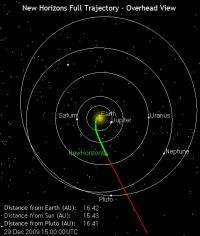
Nearly four years after lifting off from Cape Canaveral Air Force Station, Fla., on Jan. 19, 2006, the speedy probe is now approximately 1.527 billion miles (2.463 billion kilometers) from Earth - and 1.526 billion miles (nearly 2.462 billion kilometers) from the Pluto system. The spacecraft is just a little past halfway between the orbits of giant planets Saturn and Uranus, getting closer to Pluto at the rate of about 750,000 miles (1.2 million kilometers) per day. But closest approach to Pluto is still just over 5½ years away, on July 14, 2015.
New Horizons continues operating normally in hibernation , collecting interplanetary dust impact data as it flies on. The operations team at the Johns Hopkins University Applied Physics Lab in Laurel, Md., plans to wake the craft on Jan. 5 for 10 days of light maintenance and tracking activities; a longer and far more intensive wakeup is planned for next summer.
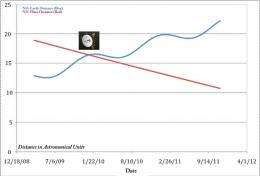
This chart shows the distance of New Horizons to both Earth and Pluto. The “wiggle” in the blue line is due to Earth’s changing position around the Sun.
Meet Me HalfwayWhen will the New Horizons spacecraft be halfway to Pluto? There’s more than one answer to that question:
• On Feb. 25, 2010, it will have covered half the heliocentric distance to Pluto from its launch at Earth.
• On April 20, 2010, it will be half as far from the Sun as Pluto will be at the time of the encounter on July 14, 2015.
• On Oct. 17, 2010, it will have traveled half the flight time to reach Pluto.
-
NASA to send spececraft to Pluto
Jan 16, 2006 |
not rated yet |
0
-
New Horizons Spacecraft Gets Boost From Jupiter for Pluto Encounter
Feb 28, 2007 |
not rated yet |
0
-
Spacecraft to Pluto Prepares for Jupiter Encounter
Jan 18, 2007 |
not rated yet |
0
-
New Horizons Gets First Glimpse of Pluto
Nov 30, 2006 |
not rated yet |
0
-
Pluto-Bound CU Instrument Renamed For Girl Who Named Ninth Planet In 1930
Jun 30, 2006 |
not rated yet |
0
-
Engineers build first sub-10-nm carbon nanotube transistor
Feb 01, 2012 |
4.9 / 5 (31) |
30
-
Something old, something new: Evolution and the structural divergence of duplicate genes
Jan 31, 2012 |
4.6 / 5 (7) |
1
-
The hidden nanoworld of ice crystals: Revealing the dynamic behavior of quasi-liquid layers
Jan 30, 2012 |
5 / 5 (3) |
1
-
Stock market network reveals investor clustering
Jan 27, 2012 |
3.9 / 5 (23) |
8
-
Of microchemistry and molecules: Electronic microfluidic device synthesizes biocompatible probes
Jan 26, 2012 |
5 / 5 (1) |
0
-
Titan's lack of impact craters
Feb 09, 2012
-
Real pictures of black hole eating a star?
Feb 08, 2012
-
Hypothetical way to travel faster than light, but not technically exceed lightspeed
Feb 06, 2012
-
How do scientists monitor the Sun's activity?
Feb 05, 2012
-
Search patterns in observational studies
Feb 05, 2012
-
Derivation of Pogson's law
Feb 03, 2012
- More from Physics Forums - General Astronomy
More news stories
NASA sees wide-eyed cyclone Jasmine
Cyclone Jasmine's eye has opened wider on NASA satellite imagery, as it moves through the Southern Pacific Ocean.
Space & Earth / Earth Sciences
50 minutes ago |
not rated yet |
0
NASA sees Giovanna reach cyclone strength, threaten Madagascar
Tropical Storm 12S built up steam and became a cyclone on February 10, 2012 as NASA's Terra satellite passed overhead. Residents of east-central Madagascar should prepare for this cyclone to make landfall ...
Space & Earth / Earth Sciences
49 minutes ago |
not rated yet |
0
Humans may have helped the decline of African rainforests 3000 years ago
(PhysOrg.com) -- Large areas of rainforests in Central Africa mysteriously disappeared over three thousand years ago, to be replaced by savannas. The prevailing theory has been that the cause was a change ...
Could Venus be shifting gear?
(PhysOrg.com) -- ESAs Venus Express spacecraft has discovered that our cloud-covered neighbour spins a little slower than previously measured. Peering through the dense atmosphere in the infrared, the ...
Space & Earth / Space Exploration
8 hours ago |
5 / 5 (7) |
7
|
Clam fields found at deep, low-temperature Mariana vents
(PhysOrg.com) -- Scientists have marveled at the unusual life forms thriving at high temperature hydrothermal vents of the deep ocean.
Space & Earth / Earth Sciences
9 hours ago |
not rated yet |
0
|
Google users warned of threat to smartphone wallets
Users of Google smartphone wallets were being warned on Friday that there is a way to crack pass codes intended to thwart thieves from going on illicit shopping sprees.
CIA website offline, Anonymous takes credit
The website of the Central Intelligence Agency was unresponsive on Friday after the hacker group Anonymous claimed to have knocked it offline.
Complex wiring of the nervous system may rely on a just a handful of genes and proteins
Researchers at the Salk Institute have discovered a startling feature of early brain development that helps to explain how complex neuron wiring patterns are programmed using just a handful of critical genes. ...
Putting the squeeze on planets outside our solar system
(PhysOrg.com) -- Using high-powered lasers, scientists at Lawrence Livermore National Laboratory and collaborators discovered that molten magnesium silicate undergoes a phase change in the liquid state, abruptly ...
The power of estrogen -- male snakes attract other males
A new study has shown that boosting the estrogen levels of male garter snakes causes them to secrete the same pheromones that females use to attract suitors, and turned the males into just about the sexiest ...
New error-correcting codes guarantee the fastest possible rate of data transmission
Error-correcting codes are one of the triumphs of the digital age. Theyre a way of encoding information so that it can be transmitted across a communication channel such as an optical fiber o ...

Dec 30, 2009
Rank: not rated yet
Dec 30, 2009
Rank: 1 / 5 (1)
Dec 30, 2009
Rank: not rated yet
Jan 05, 2010
Rank: not rated yet
Target planet? Quit living in the past