Suzaku Finds 'Fossil' Fireballs from Supernovae
December 30, 2009 by Francis Reddy
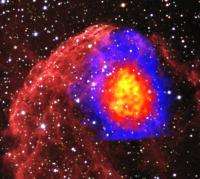
In a supernova remnant known as the Jellyfish Nebula, Suzaku detected X-rays from fully ionized silicon and sulfur -- an imprint of higher-temperature conditions immediately following the star's explosion. The nebula is about 65 light-years across. Credit: JAXA/NASA/Suzaku
(PhysOrg.com) -- Studies of two supernova remnants using the Japan-U.S. Suzaku observatory have revealed never-before-seen embers of the high-temperature fireballs that immediately followed the explosions. Even after thousands of years, gas within these stellar wrecks retain the imprint of temperatures 10,000 times hotter than the sun's surface.
"This is the first evidence of a new type of supernova remnant -- one that was heated right after the explosion," said Hiroya Yamaguchi at the Institute of Physical and Chemical Research in Japan.
A supernova remnant usually cools quickly due to rapid expansion following the explosion. Then, as it sweeps up tenuous interstellar gas over thousands of years, the remnant gradually heats up again.
Capitalizing on the sensitivity of the Suzaku satellite, a team led by Yamaguchi and Midori Ozawa, a graduate student at Kyoto University, detected unusual features in the X-ray spectrum of IC 443, better known to amateur astronomers as the Jellyfish Nebula.
The remnant, which lies some 5,000 light-years away in the constellation Gemini, formed about 4,000 years ago. The X-ray emission forms a roughly circular patch in the northern part of the visible nebulosity.
Suzaku's X-ray Imaging Spectrometers (XISs) separate X-rays by energy in much the same way as a prism separates light into a rainbow of colors. This allows astronomers to tease out the types of processes responsible for the radiation.
Some of the X-ray emission in the Jellyfish Nebula arises as fast-moving free electrons sweep near the nuclei of atoms. Their mutual attraction deflects the electrons, which then emit X-rays as they change course. The electrons have energies corresponding to a temperature of about 12 million degrees Fahrenheit (7 million degrees Celsius).
Several bumps in the Suzaku spectrum were more puzzling. "These structures indicate the presence of a large amount of silicon and sulfur atoms from which all electrons have been stripped away," Yamaguchi said. These "naked" nuclei produce X-rays as they recapture their lost electrons.
But removing all electrons from a silicon atom requires temperatures higher than about 30 million degrees F (17 million C); hotter still for sulfur atoms. "These ions cannot form in the present-day remnant," Yamaguchi explained. "Instead, we're seeing ions created by the enormous temperatures that immediately followed the supernova."
The team suggests that the supernova occurred in a relatively dense environment, perhaps in a cocoon of the star's own making. As a massive star ages, it sheds material in the form of an outflow called a stellar wind and creates a cocoon of gas and dust. When the star explodes, the blast wave traverses the dense cocoon and heats it to temperatures as high as 100 million degrees F (55 million C), or 10,000 times hotter than the sun's surface.
Eventually, the shock wave breaks out into true interstellar space, where the gas density can be as low as a single atom per cubic centimeter -- about the volume of a sugar cube. Once in this low-density environment, the young supernova remnant rapidly expands.
The expansion cools the electrons, but it also thins the remnant's gas so much that collisions between particles become rare events. Because an atom may take thousands of years to recapture an electron, the Jellyfish Nebula's hottest ions remain even today, the astronomers reported in the Nov. 1 issue of The Astrophysical Journal.
"Suzaku sees the Jellyfish's hot heart," Ozawa said.
The team has already identified another fossil fireball in the supernova remnant known as W49B, which lies 35,000 light-years away in the constellation Aquila. In the Nov. 20 edition of The Astrophysical Journal, Ozawa, Yamaguchi and colleagues report X-ray emission from iron atoms that are almost completely stripped of electrons. Forming these ions requires temperatures in excess of 55 million degrees F (30 million C)-- nearly twice the observed temperature of the remnant's electrons.
Launched on July 10, 2005, Suzaku was developed at the Japanese Institute of Space and Astronautical Science (ISAS), which is part of the Japan Aerospace Exploration Agency (JAXA), in collaboration with NASA and other Japanese and U.S. institutions.
-
The case of the neutron star with a wayward wake
Jun 01, 2006 |
not rated yet |
0
-
Suzaku snaps first complete X-ray view of a galaxy cluster
May 28, 2009 |
not rated yet |
0
-
A Super-Efficient Particle Accelerator
Jul 01, 2009 |
not rated yet |
0
-
Supernova Remnants Dance in the LMC
Jan 10, 2008 |
not rated yet |
0
-
Supernova remnant menagerie
Jun 07, 2005 |
not rated yet |
0
-
Engineers build first sub-10-nm carbon nanotube transistor
Feb 01, 2012 |
4.9 / 5 (31) |
30
-
Something old, something new: Evolution and the structural divergence of duplicate genes
Jan 31, 2012 |
4.6 / 5 (7) |
1
-
The hidden nanoworld of ice crystals: Revealing the dynamic behavior of quasi-liquid layers
Jan 30, 2012 |
5 / 5 (3) |
1
-
Stock market network reveals investor clustering
Jan 27, 2012 |
3.9 / 5 (23) |
8
-
Of microchemistry and molecules: Electronic microfluidic device synthesizes biocompatible probes
Jan 26, 2012 |
5 / 5 (1) |
0
-
Scale of the Universe
10 hours ago
-
Titan's lack of impact craters
Feb 09, 2012
-
Real pictures of black hole eating a star?
Feb 08, 2012
-
Hypothetical way to travel faster than light, but not technically exceed lightspeed
Feb 06, 2012
-
How do scientists monitor the Sun's activity?
Feb 05, 2012
-
Search patterns in observational studies
Feb 05, 2012
- More from Physics Forums - General Astronomy
More news stories
Humans may have helped the decline of African rainforests 3000 years ago
(PhysOrg.com) -- Large areas of rainforests in Central Africa mysteriously disappeared over three thousand years ago, to be replaced by savannas. The prevailing theory has been that the cause was a change ...
Could Venus be shifting gear?
(PhysOrg.com) -- ESAs Venus Express spacecraft has discovered that our cloud-covered neighbour spins a little slower than previously measured. Peering through the dense atmosphere in the infrared, the ...
Space & Earth / Space Exploration
17 hours ago |
5 / 5 (7) |
7
|
NASA budget will axe Mars deal with Europe: scientists
US President Barack Obama's budget proposal to be submitted next week for 2013 will cut NASA's budget by 20 percent and eliminate a major partnership with Europe on Mars exploration, scientists said Thursday.
Space & Earth / Space Exploration
20 hours ago |
5 / 5 (2) |
18
Two new moons for Jupiter
Advances in technology have lead to the discovery of new planets outside of our Solar System, and now even new moons in our own backyard.
Space & Earth / Space Exploration
17 hours ago |
4 / 5 (1) |
7
Mars Science Laboratory computer issue resolved
(PhysOrg.com) -- Engineers have found the root cause of a computer reset that occurred two months ago on NASA's Mars Science Laboratory and have determined how to correct it.
Space & Earth / Space Exploration
18 hours ago |
4.7 / 5 (6) |
3
|
Anonymous knocks CIA website offline (Update)
The website of the Central Intelligence Agency was inaccessible on Friday after the hacker group Anonymous claimed to have knocked it offline.
Google users warned of threat to smartphone wallets
Users of Google smartphone wallets were being warned on Friday that there is a way to crack pass codes intended to thwart thieves from going on illicit shopping sprees.
New error-correcting codes guarantee the fastest possible rate of data transmission
Error-correcting codes are one of the triumphs of the digital age. Theyre a way of encoding information so that it can be transmitted across a communication channel such as an optical fiber o ...
New power source discovered
(PhysOrg.com) -- Researchers at the Massachusetts Institute of Technology (MIT) and RMIT University have made a breakthrough in energy storage and power generation.
Small modular reactor design could be a 'SUPERSTAR'
(PhysOrg.com) -- Though most of today's nuclear reactors are cooled by water, we've long known that there are alternatives; in fact, the world's first nuclear-powered electricity in 1951 came from a reactor ...
The power of estrogen -- male snakes attract other males
A new study has shown that boosting the estrogen levels of male garter snakes causes them to secrete the same pheromones that females use to attract suitors, and turned the males into just about the sexiest ...
Dec 30, 2009
Rank: 2.5 / 5 (2)
Dec 30, 2009
Rank: 5 / 5 (1)
Right!
From NASA: "Light from the explosion first reached planet Earth over 30,000 years ago"
Dec 30, 2009
Rank: 1 / 5 (2)
Dec 30, 2009
Rank: 5 / 5 (1)
The "junk" is probably the remnants of the outer layers of the star that were cast off during the giant phase of the stars life. (the article suggests this as well)