Solar showdown in Calif. tortoises' desert home
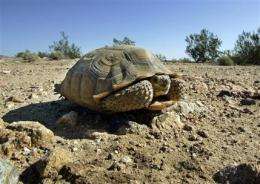
(AP) -- On a strip of California's Mojave Desert, two dozen rare tortoises could stand in the way of a sprawling solar-energy complex in a case that highlights mounting tensions between wilderness conservation and the nation's quest for cleaner power.
Oakland, Calif.-based BrightSource Energy has been pushing for more than two years for permission to erect 400,000 mirrors on the site to gather the sun's energy. It could become the first project of its kind on U.S. Bureau of Land Management property, leaving a footprint for others to follow on vast stretches of public land across the West.
The construction would come with a cost: Government scientists have concluded that more than 6 square miles of habitat for the federally threatened desert tortoise would be permanently lost.
The Sierra Club and other environmentalists want the complex relocated to preserve what they call a near-pristine home for rare plants and wildlife, including the protected tortoise, the Western burrowing owl and bighorn sheep.
"It's actually a good project. It's just located in the wrong place," said Ileene Anderson of the Center for Biological Diversity, a Tucson, Ariz.-based environmental group.
The dispute is likely to echo for years as more companies seek to develop solar, wind and geothermal plants on land treasured by environmentalists who also support the growth of alternative energy. In an area of stark beauty, the question will be what is worth preserving and at what cost as California pushes to generate one-third of its electricity from renewable sources by 2020.
The Bureau of Land Management has received more than 150 applications for large-scale solar projects on 1.8 million acres of federal land in California, Nevada, Arizona, New Mexico, Colorado and Utah. In California alone, such projects could claim an area the size of Rhode Island, transforming the state into the world's largest solar farm.
BrightSource Energy wants permission to construct three solar power plants on the site that together would generate enough power each year for 142,000 homes, potentially generating billions of dollars of revenue over time.
The sun's power is used to heat water and make steam, which in turn drives turbines to create electricity. Built in phases, the project would include seven, 459-foot metal towers, a natural gas pipeline, water tanks, steam turbine generators, boilers and buildings for administration and maintenance. Each plant would be surrounded by 8-foot high steel fencing.
The site has virtually unbroken sunshine most of the year, and is near transmission lines that can carry the power to consumers.
In November, federal and state biologists reviewing the plan proposed that the company catch and move the tortoises and preserve them elsewhere on 12,000 acres, a proposal that could cost BrightSource an estimated $25 million.
John Kessler, a project manager for the California Energy Commission, said there is disagreement with BrightSource over what the company would pay for long-term maintenance for the land that would be purchased, and the company also believes the cost of buying it should be less.
The company declined to comment directly on those issues.
It will likely be months before state and federal regulators considering the plan make a decision on the tortoises' fate.
BrightSource President John Woolard warned in government filings released last month that heavy-handed regulation could kill the proposal. He did not mention the tortoises directly but referred to "unbounded and extreme" requirements being placed on the company.
At a time when the White House is pushing for the rapid development of green power, Woolard predicted the outcome in the California desert would reverberate widely.
The large-scale solar industry "is in its infancy, with great promise to compete with conventional energy," Woolard wrote. "Overburdening this fledgling industry will cause it to be stillborn, ending that promise before it has truly begun."
The Sierra Club wants regulators to move the site closer to Interstate 15, the busy freeway connecting Los Angeles and Las Vegas, to avoid what it says will be a virtual death sentence for the tortoises. Estimates of the population have varied, but government scientists say at least 25 would need to be captured and moved.
The group argues that the reptiles are the "most genetically distinct" of all of California's desert tortoises and point to a 2007 U.S. Fish and Wildlife Service report that found the tortoise population is dropping in parts of a four-state region that includes California.
"The project must not contribute to additional loss of habitat," the Sierra Club said in government filings.
Roy Averill-Murray, the Fish and Wildlife Service's desert tortoise recovery coordinator, said there are insufficient data to make judgments about the population on the BrightSource site.
Tortoise "populations across the board have declined, but we don't have the same kind of information for this particular patch of ground," Averill-Murray said.
In a statement, BrightSource spokesman Keely Wachs did not address proposals to move all or part of the complex, pledging that the company "will continue to work with the environmental community to ensure that we establish a good example for projects that follow."
In government filings, the company depicts the site near the Nevada line as far from untouched: It has been used for livestock grazing, has been crisscrossed by off-roaders and the boundary of a golf club is a half-mile away.
Except for the tortoise, no other federal or state threatened or endangered animal or plant is on the site, the company said. In 1994 the federal government designated 6.4 million acres as "critical habitat" for the tortoise in California, Nevada, Arizona, and Utah, but the BrightSource site was not included "and is by no means in an area critical to the survival of this species," the company concluded.
The complicated review is being watched closely.
"At this point, there are zero solar-energy projects on public land," said Monique Hanis of the Solar Energy Industries Association, a trade group. "We are looking for ways to expand the market and reduce barriers ... and get more of these projects moving."
©2009 The Associated Press. All rights reserved. This material may not be published, broadcast, rewritten or redistributed.


