Spectacular Mars images reveal evidence of ancient lakes (w/ Video)
January 4, 2010
Spectacular Mars images reveal evidence of ancient lakes (w/ Video)

Enlarge

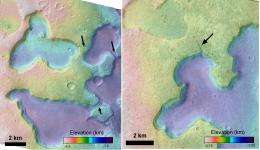
These images show topographic data for depressions interpreted as ancient lakes. Topography data illustrate that channels connect depressions of different depths suggesting lakes drained from shallower to deeper depressions. Main depression in right hand image is ~40 metres deep. Main depression at top left in left image is ~100 metres deep.

Spectacular satellite images suggest that Mars was warm enough to sustain lakes three billion years ago, a period that was previously thought to be too cold and arid to sustain water on the surface, according to research published today in the journal Geology.

The research, by a team from Imperial College London and University College London (UCL), suggests that during the Hesperian Epoch, approximately 3 billion years ago, Mars had lakes made of melted ice, each around 20km wide, along parts of the equator.

Earlier research had suggested that Mars had a warm and wet early history but that between 4 billion and 3.8 billion years ago, before the Hesperian Epoch, the planet lost most of its atmosphere and became cold and dry. In the new study, the researchers analysed detailed images from NASA's , which is currently circling the red planet, and concluded that there were later episodes where Mars experienced warm and wet periods.

This video is not supported by your browser at this time.

3D virtual reality video of Ares Vallis, which is a giant gorge that runs 2000 km across the equator of Mars. The lakes and their interconnecting channels can be seen a third of the way through the video.

The researchers say that there may have been increased , meteorite impacts or shifts in Mars' orbit during this period to warm Mars' atmosphere enough to melt the ice. This would have created gases that thickened the atmosphere for a temporary period, trapping more sunlight and making it warm enough for liquid water to be sustained.

Lead author of the study, Dr Nicholas Warner, from the Department of Earth Science and Engineering at Imperial College London, says:

"Most of the research on Mars has focussed on its early history and the recent past. Scientists had largely overlooked the Hesperian Epoch as it was thought that Mars was then a frozen wasteland. Excitingly, our study now shows that this middle period in Mars' history was much more dynamic than we previously thought."

The researchers used the images from the Mars Reconnaissance Orbiter to analyse several flat-floored depressions located above Ares Vallis, which is a giant gorge that runs 2,000 km across the equator of Mars. Scientists have previously been unable to explain how these depressions formed, but believed that the depressions may have been created by a process known as sublimation, where ice changes directly from its solid state into a gas without becoming liquid water. The loss of ice would have created cavities between the soil particles, which would have caused the ground to collapse into a depression.

In the new study, the researchers analysed the depressions and discovered a series of small sinuous channels that connected them together. The researchers say these channels could only be formed by running water, and not by ice turning directly into gas.
Spectacular Mars images reveal evidence of ancient lakes (w/ Video)
Enlarge

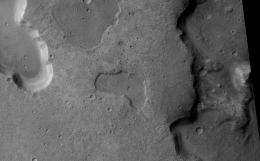
NASA Context Camera image of depressions interpreted as ancient lake basins. Note channel connecting depressions in bottom right providing clear evidence of liquid exchange between depressions. Depression in centre is ~4 km wide.

The scientists were able to lend further weight to their conclusions by comparing the Mars images to images of thermokarst landscapes that are found on Earth today, in places such as Siberia and Alaska. Thermokarst landscapes are areas where permafrost is melting, creating lakes that are interconnected by the same type of drainage channels found on Mars.

The team believe the melting ice would have created lakes and that a rise in water levels may have caused some of the lakes to burst their banks, which enabled water to carve a pathway through the frozen ground from the higher lakes and drain into the lower lying lakes, creating permanent channels between them.

Professor Jan-Peter Muller, Mullard Space Science Laboratory, Department of Space Climate Physics at University College London, was responsible for mapping the 3D shape of the surface of Mars. He adds:

"We can now model the 3D shape of Mars' surface down to sub-metre resolution, at least as good as any commercial satellite orbiting the Earth. This allows us to test our hypotheses in a much more rigorous manner than ever before."

The researchers determined the age of the lakes by counting crater impacts, a method originally developed by scientists to determine the age of geological features on the moon. More craters around a geological feature indicate that an area is older than a region with fewer meteorite impacts. In the study, the scientists counted more than 35,000 crater impacts in the region around the lakes, and determined that the lakes formed approximately three billion years ago. The scientists are unsure how long the warm and wet periods lasted during the Hesperian epoch or how long the lakes sustained in them.

Spectacular Mars images reveal evidence of ancient lakes (w/ Video)
Enlarge

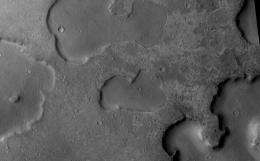
NASA Context Camera image of depressions interpreted as ancient lake basins. Note channel connecting depressions in bottom right providing clear evidence of liquid exchange between depressions. Depression in centre is ~3 km wide.

The researchers say their study may have implications for astrobiologists who are looking for evidence of life on Mars. The team say these lake beds indicate regions on the planet where it could have been warm and wet, potentially creating habitats that may have once been suitable for microbial life. The team say these areas may be good targets for future robotic missions.

The next step will see the team extend their survey to other areas along the equator of so that they can ascertain how widespread these lakes were during the Hesperian Epoch. The team will focus their surveys on a region at the mouth of Ares Vallis called Chryse Planitia, where preliminary surveys of satellite images have suggested that this area may have also supported lakes.

The study was a collaboration between the Department of Earth Science and Engineering at Imperial College London and Space Physics at UCL. The project was funded by the Science and Technology Facilities Council, the Royal Society and the Leverhulme Trust.

More information: "Hesperian equatorial thermokarst lakes in Ares Vallis as evidence for transient warm conditions on Mars", Geology, JANUARY 2010, vol. 38, p. 71-74.

Provided by Imperial College London (news : web)

Filter


Move the slider to adjust rank threshold, so that you can hide some of the comments.


Display comments: newest first

deatopmg
Jan 04, 2010

Rank: not rated yet
WHat is carefully avoided is any mention of the possibility of liquid water TODAY, given these facts:
The ground temp. can reach as high as 20 deg. C,
The atmosphere is saturated or nearly saturated w/ water so there is only slow evaporative cooling if any liquid is present.
The reported atmospheric pressure is less than 10 mm Hg or less than 1.3 percent of the Earths - at that low pressure the atmosphere behaves as an excellent insulator like the vacuum in a thermos bottle.

SO, during summer at the lower latitudes and especially in the deeper regions standing liquid water, whether containing dissolved salts or not, is extremely likely.
Birthmark
Jan 04, 2010

Rank: not rated yet
This article is great news, this helps the chances of life that could have existed on Mars. However, how can all the water just disappear? What could have changed the planet so dramatically, a comet?
Shootist
Jan 04, 2010

Rank: not rated yet
@deatopmg. Yeah one would thing we'd would have been all over Hellas; highest air pressure on Mars.
bluehigh
Jan 05, 2010

Rank: not rated yet
more likely standing slushy salty corrosive ionised ... MUD.
deatopmg
Jan 05, 2010

Rank: not rated yet
more likely standing slushy salty corrosive ionised ... MUD.

That is exactly what NASA would like us to believe, but it is just as likely that some of the standing water has relatively low salt concentration, especially if some of the reported snow reaches the ground.
Rank 5 /5 (18 votes)
Relevant PhysicsForums posts
  • Titan's lack of impact craters
    createdFeb 09, 2012
  • Real pictures of black hole eating a star?
    createdFeb 08, 2012
  • Hypothetical way to travel faster than light, but not technically exceed lightspeed
    createdFeb 06, 2012
  • How do scientists monitor the Sun's activity?
    createdFeb 05, 2012
  • Search patterns in observational studies
    createdFeb 05, 2012
  • Derivation of Pogson's law
    createdFeb 03, 2012
  • More from Physics Forums - General Astronomy

More news stories

Could Venus be shifting gear?

(PhysOrg.com) -- ESA’s Venus Express spacecraft has discovered that our cloud-covered neighbour spins a little slower than previously measured. Peering through the dense atmosphere in the infrared, the ...

Space & Earth / Space Exploration

created 2 hours ago | popularity 5 / 5 (3) | comments 4 | with audio podcast

Clam fields found at deep, low-temperature Mariana vents

(PhysOrg.com) -- Scientists have marveled at the unusual life forms thriving at high temperature hydrothermal vents of the deep ocean.

Space & Earth / Earth Sciences

created 3 hours ago | popularity not rated yet | comments 0 | with audio podcast

Mars Science Laboratory computer issue resolved

(PhysOrg.com) -- Engineers have found the root cause of a computer reset that occurred two months ago on NASA's Mars Science Laboratory and have determined how to correct it.

Space & Earth / Space Exploration

created 3 hours ago | popularity 5 / 5 (4) | comments 2 | with audio podcast

Humans may have helped the decline of African rainforests 3000 years ago

(PhysOrg.com) -- Large areas of rainforests in Central Africa mysteriously disappeared over three thousand years ago, to be replaced by savannas. The prevailing theory has been that the cause was a change ...

Space & Earth / Environment

created 6 hours ago | popularity 5 / 5 (3) | comments 5 | with audio podcast report

Two new moons for Jupiter

Advances in technology have lead to the discovery of new planets outside of our Solar System, and now even new moons in our own backyard.

Space & Earth / Space Exploration

created 2 hours ago | popularity not rated yet | comments 2


Zuckerberg's focus drives Facebook's ascent

When Mark Zuckerberg showed up to rent Judy Fusco's Los Altos, Calif., house in the fall of 2004, soon after he'd arrived in Silicon Valley, the landlord was immediately struck by his confidence.

Antidepressants and pregnancy: Women must consider the impact of drugs on baby, and of depression on baby, themselves

Upon learning they are pregnant, most women dutifully nix the alcohol, sushi and caffeine. But what about antidepressants?

Both maternal and paternal age linked to autism

Older maternal and paternal age are jointly associated with having a child with autism, according to a recently published study led by researchers at The University of Texas Health Science Center at Houston (UTHealth).

Curry spice component may help slow prostate tumor growth

Curcumin, an active component of the Indian curry spice turmeric, may help slow down tumor growth in castration-resistant prostate cancer patients on androgen deprivation therapy (ADT), a study from researchers ...

The power of estrogen -- male snakes attract other males

A new study has shown that boosting the estrogen levels of male garter snakes causes them to secrete the same pheromones that females use to attract suitors, and turned the males into just about the sexiest ...

Netflix light on flicks as viewers soak up TV shows

Like most fresh faces that arrive in Hollywood, Netflix wanted to be a movie star. But now it's learning what many in Tinseltown have known for decades: Movies are sexy, but the real money is in television.