Argonne streaming visualization sends images across the world (w/ Video)
January 4, 2010
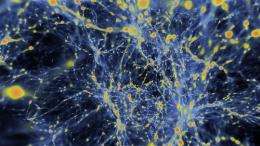
This visualization of the Universe as it condenses around fluctuations in the density of dark and ordinary matter is a result from a collaboration between Argonne National Lab and the San Diego Supercomputer Center.
(PhysOrg.com) -- Modeling the evolution of the universe is no mean feat, not only because of the complex mathematics involved, but also because of the sheer amount of data that is generated from a working model of -- well, the universe.
Dealing with data, however, is the specialty of a group of scientists at the U.S. Department of Energy's (DOE) Argonne National Laboratory. To more easily share and analyze the mountains of data from today's scientific challenges, they are developing software that enables researchers to interact with their results in real-time from across the country.
The rise of supercomputers has given a powerful tool to scientists, who use these machines to model complex questions. As the compute power of such resources increases, so does the complexity of the questions that can be asked—and the size of the data sets that are generated.
This video is not supported by your browser at this time.
“Finding the resources and software capable of rendering volumes of data at such large scales can be a challenge,” said Mark Hereld, visualization and analysis lead for Argonne’s Leadership Computing Facility (ALCF). Fortunately, the ALCF is home to Eureka, one of the world’s largest graphics supercomputers, which features 200 high-end graphics processing units. Eureka enables software such as vl3, a volume rendering toolkit developed at Argonne and the University of Chicago, that leverages graphics hardware to visualize such data sets in real time.Networking advances make it feasible to move large amounts of data from the location where it was computed to specialized visualization resources where it can be rendered into images. However, the scientists who need to analyze this data often live and work far from both supercomputing and rendering clusters. It is vital that the renderings be brought to the scientist.
To see the subtle details in the data and make full use of the visualizations, high-quality images are also required. New vl3 enhancements allow researchers to stream hi-res images created on graphics clusters to a remote cluster driving a high-resolution tiled display.
To illustrate the importance—and feasibility—of visualization at a distance, scientists from several organizations, including institutions from both the National Science Foundation’s TeraGrid project and from DOE, teamed up to create a live demonstration using vl3. Images were streamed live at 10 gigabits per second from Eureka in ALCF over DOE's ESnet, a high-speed network with dedicated bandwidth for moving large datasets worldwide, to an OptiPortal tiled display in the San Diego Supercomputer Center's booth at this year’s annual Supercomputing Conference (SC09).
"As a team, we were able to link institutions across the country and leverage high performance computing, visualization resources, high speed networks and advanced displays in real-time,” said Joe Insley, principal software developer at Argonne. “But what was really wonderful was seeing the scientists get excited about the possibilities that this will enable.”
The next step will be to add controls already present in the local version of the software to the wide-area version, giving the scientist even more power to investigate his or her data.
The simulation was done as part of a 2009 TeraGrid resource allocation entitled “Projects in Astrophysical and Cosmological Structure Formation”, designed to simulate the cosmic structures of the early universe by calculating the gravitational clumping of intergalactic gas and dark matter. The model uses a computational grid made up of 40003 cells, contained 64 billion dark matter particles and took over four million CPU hours to complete.
The project used resources from the National Institute for Computational Sciences, a joint project of the University of Tennessee and Oak Ridge National Laboratory. The visualization of the results was also enabled in part by the TeraGrid visualization team at the University of Chicago.
More information: More information about the project, including links to the animation, is available at http://press.mcs.a … argate-sc09/
-
Leading-edge data analytics and visualization enable breakthrough science
Apr 10, 2009 |
not rated yet |
0
-
Seeking efficiency, scientists run visualizations directly on supercomputers
Jul 30, 2009 |
not rated yet |
0
-
New technology enables high-speed data transfer
Jun 18, 2009 |
not rated yet |
0
-
Argonne's supercomputer named world’s fastest for open science, third overall
Jun 18, 2008 |
not rated yet |
0
-
New grant to enhance world's largest open computing network
Aug 31, 2009 |
not rated yet |
0
-
Engineers build first sub-10-nm carbon nanotube transistor
Feb 01, 2012 |
4.9 / 5 (30) |
30
-
Something old, something new: Evolution and the structural divergence of duplicate genes
Jan 31, 2012 |
4.6 / 5 (7) |
1
-
The hidden nanoworld of ice crystals: Revealing the dynamic behavior of quasi-liquid layers
Jan 30, 2012 |
5 / 5 (3) |
1
-
Stock market network reveals investor clustering
Jan 27, 2012 |
3.9 / 5 (23) |
8
-
Of microchemistry and molecules: Electronic microfluidic device synthesizes biocompatible probes
Jan 26, 2012 |
5 / 5 (1) |
0
-
Synergistic relations between computer science and technology.
Feb 06, 2012
-
how do iphone gloves work?
Feb 05, 2012
-
iPhone battery over time
Jan 30, 2012
-
Best alternate Tablet to an iPad for writing math or physics equations?
Jan 26, 2012
-
Sending SMS to a website
Jan 20, 2012
-
Need help with my technical fest!
Jan 19, 2012
- More from Physics Forums - Computing & Technology
More news stories
Soraa LED light may dim 50-watt halogen rivals
(PhysOrg.com) -- Soraa, a Fremont, California company founded in 2008, this week launched its first product, a light that uses LEDS (light emitting diodes). The "Soraa LED MR16 lamp" is the "perfect" replacement ...
Samsung can continue selling Galaxy tabs in Germany: court
South Korea's Samsung Electronics can continue to sell its Galaxy Tab 10.1N tablet computer in Germany, a German court ruled Thursday, rejecting a bid by arch-rival Apple to have them banned.
18 hours ago |
3.7 / 5 (3) |
3
First Google hire leaving for online academy
The first person hired by Google's founders is leaving the Internet giant to devote himself to an innovative online education website called Khan Academy.
8 hours ago |
5 / 5 (1) |
0
Google launches Chrome browser for Android smartphones
With more and more people connecting to the Internet through a phone or a tablet instead of a PC, Google Inc. is bringing its fast-growing browser, Chrome, to the newest Android-powered mobile devices.
17 hours ago |
5 / 5 (4) |
0
Model analyzes shape-memory alloys for use in earthquake-resistant structures
Recent earthquake damage has exposed the vulnerability of existing structures to strong ground movement. At the Georgia Institute of Technology, researchers are analyzing shape-memory alloys for their potential ...
15 hours ago |
5 / 5 (1) |
0
|
'Dark plasmons' transmit energy
Microscopic channels of gold nanoparticles have the ability to transmit electromagnetic energy that starts as light and propagates via "dark plasmons," according to researchers at Rice University.
FDA-approved drug rapidly clears amyloid from the brain, reverses Alzheimer's symptoms in mice
Neuroscientists at Case Western Reserve University School of Medicine have made a dramatic breakthrough in their efforts to find a cure for Alzheimer's disease. The researchers' findings, published in the journal Science, show t ...
Hydrogen from acidic water: Researchers develop potential low cost alternative to platinum for splitting water
A technique for creating a new molecule that structurally and chemically replicates the active part of the widely used industrial catalyst molybdenite has been developed by researchers with the Lawrence Berkeley ...
Ultraviolet protection molecule in plants yields its secrets
Lying around in the sun all day is hazardous not just for humans but also for plants, which have no means of escape. Ultraviolet (UV) radiation from the sun can damage proteins and DNA inside cells, leading ...
Anyone can learn to be more inventive, cognitive researcher says
There will always be a wild and unpredictable quality to creativity and invention, says Anthony McCaffrey, a cognitive psychology researcher at the University of Massachusetts Amherst, because an "Aha moment" is rare and ...
Flexible paper robots
(PhysOrg.com) -- These inexpensive robots can stretch, bend and twist under control, and lift objects up to 120 times their own weight. Being soft, they can apply gentle and even pressure, and adapt to varied ...
Jan 04, 2010
Rank: not rated yet
Just gotta say, I love you science.