Electric car Think to be assembled in US in 2011: report
January 5, 2010
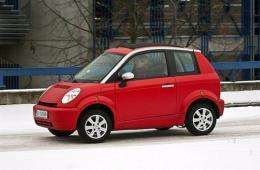
An electric car made by Norwegian compagny Think is pictured on the road in Oslo in 2008. Think, an electric car maker based in Norway, will assemble its vehicles in the United States next year and hopes to roll out more than 20,000 units a year, the Wall Street Journal said on Tuesday, quoting the group's chief executive.
Think, an electric car maker based in Norway, will assemble its vehicles in the United States next year and hopes to roll out more than 20,000 units a year, the Wall Street Journal said on Tuesday, quoting the group's chief executive.
"Nothing has been finalised yet but a decision is expected today," a Think spokesman, James Andrew, told AFP.
Think, which will receive local and state incentives, is expected to invest 43.5 million dollars (30.1 million euros) to modernise an assembly plant in Indiana, the Wall Street Journal said in an article to be published on Tuesday.
Several US states had been in competition for the investment.
The newspaper reported that the project was to be officially announced in Indiana on Tuesday.
The plant would have an assembly capacity of more than 20,000 cars a year, but production would be "in the low thousands" in 2011, chief executive Richard Canny said.
The Think City, a small plastic vehicle that seats two adults and two children, is expected to sell for around 30,000 dollars, after a tax rebate of some 7,500 dollars, the Wall Street Journal said.
After teetering on the brink of bankruptcy, Think was saved in August by a group of investors, including Ener1 of the US, the owner of Enerdel which supplies batteries for the Think cars.
Enerdel is the largest shareholder in the carmaker, holding 31 percent.
In northern Europe, production of Think cars was transferred last year from Oslo to a plant in the Finnish town of Uusikaupunki, where the Finnish group Valmet Automotive already assembles models for German sportscar maker Porsche.
The Think City has a maximum speed of 100 kilometres (68 miles) an hour and a range of 180 kilometres (110 miles).
(c) 2010 AFP
-
Finnish firms announce electric car plans
Aug 06, 2009 |
not rated yet |
0
-
Proton goes Dutch in electric car tie-up
Mar 31, 2009 |
not rated yet |
0
-
Orders streaming in for new Tesla electric sedans
Apr 02, 2009 |
not rated yet |
0
-
Tesla to unveil electric 5-seat sedan next week
Mar 19, 2009 |
not rated yet |
0
-
Hybrid automaker Fisker to buy shuttered GM plant
Oct 27, 2009 |
not rated yet |
0
-
Engineers build first sub-10-nm carbon nanotube transistor
Feb 01, 2012 |
4.9 / 5 (31) |
30
-
Something old, something new: Evolution and the structural divergence of duplicate genes
Jan 31, 2012 |
4.6 / 5 (7) |
1
-
The hidden nanoworld of ice crystals: Revealing the dynamic behavior of quasi-liquid layers
Jan 30, 2012 |
5 / 5 (3) |
1
-
Stock market network reveals investor clustering
Jan 27, 2012 |
3.9 / 5 (23) |
8
-
Of microchemistry and molecules: Electronic microfluidic device synthesizes biocompatible probes
Jan 26, 2012 |
5 / 5 (1) |
0
-
Calling function with no input argument
13 hours ago
-
Force free body diagram problem on gym equipment
14 hours ago
-
Empirical data regarding shower heads and water
22 hours ago
-
feed hold button on CNC lathe
Feb 09, 2012
-
RFAC in Fortran
Feb 09, 2012
-
dynamics 2/32
Feb 08, 2012
- More from Physics Forums - General Engineering
More news stories
Google users warned of threat to smartphone wallets
Users of Google smartphone wallets were being warned on Friday that there is a way to crack pass codes intended to thwart thieves from going on illicit shopping sprees.
7 hours ago |
5 / 5 (2) |
0
Anonymous knocks CIA website offline (Update)
The website of the Central Intelligence Agency was inaccessible on Friday after the hacker group Anonymous claimed to have knocked it offline.
8 hours ago |
5 / 5 (9) |
13
New error-correcting codes guarantee the fastest possible rate of data transmission
Error-correcting codes are one of the triumphs of the digital age. Theyre a way of encoding information so that it can be transmitted across a communication channel such as an optical fiber o ...
Technology / Computer Sciences
17 hours ago |
4.9 / 5 (8) |
6
|
New power source discovered
(PhysOrg.com) -- Researchers at the Massachusetts Institute of Technology (MIT) and RMIT University have made a breakthrough in energy storage and power generation.
Technology / Energy & Green Tech
16 hours ago |
4.8 / 5 (26) |
8
|
Small modular reactor design could be a 'SUPERSTAR'
(PhysOrg.com) -- Though most of today's nuclear reactors are cooled by water, we've long known that there are alternatives; in fact, the world's first nuclear-powered electricity in 1951 came from a reactor ...
Technology / Energy & Green Tech
16 hours ago |
4.3 / 5 (12) |
22
|
Humans may have helped the decline of African rainforests 3000 years ago
(PhysOrg.com) -- Large areas of rainforests in Central Africa mysteriously disappeared over three thousand years ago, to be replaced by savannas. The prevailing theory has been that the cause was a change ...
Complex wiring of the nervous system may rely on a just a handful of genes and proteins
Researchers at the Salk Institute have discovered a startling feature of early brain development that helps to explain how complex neuron wiring patterns are programmed using just a handful of critical genes. ...
The power of estrogen -- male snakes attract other males
A new study has shown that boosting the estrogen levels of male garter snakes causes them to secrete the same pheromones that females use to attract suitors, and turned the males into just about the sexiest ...
Putting the squeeze on planets outside our solar system
(PhysOrg.com) -- Using high-powered lasers, scientists at Lawrence Livermore National Laboratory and collaborators discovered that molten magnesium silicate undergoes a phase change in the liquid state, abruptly ...
Could Venus be shifting gear?
(PhysOrg.com) -- ESAs Venus Express spacecraft has discovered that our cloud-covered neighbour spins a little slower than previously measured. Peering through the dense atmosphere in the infrared, the ...
Fool's gold may prove an unlikely alternative to overexploited catalytic materials
Catalytic materials, which lower the energy barriers for chemical reactions, are used in everything from the commercial production of chemicals to catalytic converters in car engines. However, with current catalytic materials ...
Jan 05, 2010
Rank: not rated yet
Jan 05, 2010
Rank: not rated yet
Jan 05, 2010
Rank: 1 / 5 (1)
1. need a price tag of less than 20k in order to get ANY market penetration.
2. need quick-charge capability(say, 15 minutes or less) to make it practical for use other than strictly commuter, in which case public transit would still be cheaper/greener.
3. plastic ends up being less green, and less(as perceived) safe- which translates into fewer sales.
Anyone care to add to the list?
Jan 05, 2010
Rank: not rated yet
Cars like the upcoming Volt would offer the best of both worlds.No gas would be used on commutes of less than 40 miles,while extended range would be possible thanks to the onboard recharging engine.
I read somewhere that public transit is NOT necessarily greener,especially on certain routes at off peak hours.Buses have to be packed to maximize their green potential.
Jan 06, 2010
Rank: not rated yet
Currently requires Fossil fuel fired electricity which releases more toxins than gasoline.(CO2 is not a toxin).
Safety regulations for electric cars are more lax than those for ICE vehicles.
Vehicle is overly small limiting market penetration.
Owning company has folded and been bought twice now, losing almost all consumer confidence.
Jan 06, 2010
Rank: not rated yet
Jan 06, 2010
Rank: not rated yet
ASSUMING AN EV CAN GET 50 MILES PER CHARGE, CHARGE TIMES ARE THE MOST IMPORTANT SPEc.
EV's are bound to fail in anything but niche hypergreen marketing ploys(directed at wealthy people) , until charge times are lowered to under 5 minutes to get 50 miles of charge. because they are too inconvenient to use for most people.
what budget conscious consumer is going to buy a car that they cannot use for multiple purposes on a monments notice because the car acan only be driven to and from work on a rigid schedule proscribed by the highly constrained chargin times required for the vehicles to operate. it's like buying a car and only being able to use it half the time you own it.
think faster charge. and think about selling the diesel hybrid tata nano in the u.s. when it comes out. that car is a gas sipping anorexic. amazing efficiency for a 5k package. but of course, government motors and ford financinigans will bankrupt themselves fighting the competition.
Jan 10, 2010
Rank: not rated yet
Jan 14, 2010
Rank: not rated yet
When people have been operating vehicles that normally go 300+ miles per fill, there is going to be a lot of adaptation and backlash to anything but that number, especially without a way for a quick charge. Pure electric does not hold nearly enough value yet against chemical. I'll be patient though.
Jan 15, 2010
Rank: not rated yet
The average person commutes over 20 miles to their job and then another 20 back home and that's excluding the people who need to use their personal car for work and drive far more than 50 miles at a time.