'Ferropaper' is new technology for small motors, robots
January 5, 2010
'Ferropaper' is new technology for small motors, robots

Enlarge

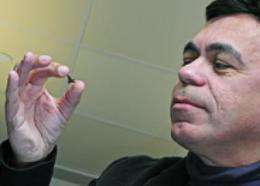
Purdue researchers have created a magnetic "ferropaper" that might be used to make low-cost "micromotors" for surgical instruments, tiny tweezers to study cells and miniature speakers. Babak Ziaie, a professor of electrical and computer engineering and biomedical engineering, holds a miniature birdlike shape made from the material. The wings move slowly, but the structure is not capable of flight. Credit: Purdue University photo/Andrew Hancock

(PhysOrg.com) -- Researchers at Purdue University have created a magnetic "ferropaper" that might be used to make low-cost "micromotors" for surgical instruments, tiny tweezers to study cells and miniature speakers.

The material is made by impregnating ordinary paper - even newsprint - with a mixture of and "magnetic " of . The nanoparticle-laden paper can then be moved using a magnetic field.

"Paper is a porous matrix, so you can load a lot of this material into it," said Babak Ziaie, a professor of electrical and computer engineering and biomedical engineering.

The new technique represents a low-cost way to make small stereo speakers, miniature robots or motors for a variety of potential applications, including tweezers to manipulate cells and flexible fingers for minimally .

"Because paper is very soft it won't damage cells or tissue," Ziaie said. "It is very inexpensive to make. You put a droplet on a piece of paper, and that is your actuator, or motor."

Once saturated with this "ferrofluid" mixture, the paper is coated with a biocompatible plastic film, which makes it water resistant, prevents the fluid from evaporating and improves mechanical properties such as strength, stiffness and elasticity.

Findings will be detailed in a research paper being presented during the 23rd IEEE International Conference on Micro Electro Mechanical Systems on Jan. 24-28 in Hong Kong. The paper was written by Ziaie, electrical engineering doctoral student Pinghung Wei and physics doctoral student Zhenwen Ding.

Because the technique is inexpensive and doesn't require specialized laboratory facilities, it could be used in community colleges and high schools to teach about micro robots and other engineering and scientific principles, Ziaie said.

The , which are commercially available, have a diameter of about 10 , or billionths of a meter, which is roughly 1/10,000th the width of a human hair. Ferro is short for ferrous, or related to iron.

"You wouldn't have to use nanoparticles, but they are easier and cheaper to manufacture than larger-size particles," Ziaie said. "They are commercially available at very low cost."

The researchers used an instrument called a field-emission scanning electron microscope to study how well the nanoparticle mixture impregnates certain types of paper.

"All types of paper can be used, but newspaper and soft tissue are especially suitable because they have good porosity," Ziaie said.

The researchers fashioned the material into a small cantilever, a structure resembling a diving board that can be moved or caused to vibrate by applying a magnetic field.

"Cantilever actuators are very common, but usually they are made from silicon, which is expensive and requires special cleanroom facilities to manufacture," Ziaie said. "So using the ferropaper could be a very inexpensive, simple alternative. This is like 100 times cheaper than the silicon devices now available."

The researchers also have experimented with other shapes and structures resembling Origami to study more complicated movements.

More information: IEEE 23rd International Conference on Micro Electro Mechanical Systems: http://www.ieee-ra … ms-2010.html

Provided by Purdue University (news : web)

3.9 /5 (12 votes)  

Rank 3.9 /5 (12 votes)
Relevant PhysicsForums posts
  • polymer nanocomposites
    created11 hours ago
  • Corrosion Tests on Magnesium
    createdFeb 09, 2012
  • polyethylene copper nanocomposite
    createdFeb 09, 2012
  • Output of xrd analysis
    createdFeb 08, 2012
  • Transport phenomena problem based on problems 18.B11 and 19B.6 from Bird, stewart, lw
    createdFeb 06, 2012
  • Help with material selection - Car Piston
    createdFeb 05, 2012
  • More from Physics Forums - Materials & Chemical Engineering

More news stories

What lies beneath: Mapping hidden nanostructures

The ability to diagnose and predict the properties of materials is vital, particularly in the expanding field of nanotechnology. Electron and atom-probe microscopy can categorize atoms in thin sheets of material, ...

Nanotechnology / Nanophysics

created 3 hours ago | popularity 5 / 5 (1) | comments 1

'Dark plasmons' transmit energy

Microscopic channels of gold nanoparticles have the ability to transmit electromagnetic energy that starts as light and propagates via "dark plasmons," according to researchers at Rice University.

Nanotechnology / Nanophysics

created 20 hours ago | popularity 5 / 5 (6) | comments 1 | with audio podcast

New kind of solar cell could capture significantly more energy than current cells

New solar cells could increase the maximum efficiency of solar panels by over 25%, according to scientists from the University of Cambridge.

Nanotechnology / Nanophysics

created Feb 08, 2012 | popularity 4.5 / 5 (12) | comments 14 | with audio podcast

Nanoshell whispering galleries improve thin solar panels

Visitors to Statuary Hall in the U.S. Capitol Building may have experienced a curious acoustic feature that allows a person to whisper softly at one side of the cavernous, half-domed room and for another on ...

Nanotechnology / Nanomaterials

created Feb 07, 2012 | popularity 4.3 / 5 (6) | comments 6 | with audio podcast

Nanotube therapy takes aim at breast cancer stem cells

Wake Forest Baptist Medical Center researchers have again proven that injecting multiwalled carbon nanotubes (MWCNTs) into tumors and heating them with a quick, 30-second laser treatment can kill them.

Nanotechnology / Bio & Medicine

created Feb 09, 2012 | popularity 5 / 5 (1) | comments 0 | with audio podcast


Hovering not hard if you're top-heavy, researchers find

Top-heavy structures are more likely to maintain their balance while hovering in the air than are those that bear a lower center of gravity, researchers at New York University's Courant Institute of Mathematical Sciences ...

Grass to gas: Researchers' genome map speeds biofuel development

Researchers at the University of Georgia have taken a major step in the ongoing effort to find sources of cleaner, renewable energy by mapping the genomes of two originator cells of Miscanthus x giganteus, a large perenn ...

Drug halts organ damage in inflammatory genetic disorder

A new study shows that Kineret (anakinra), a medication approved for the treatment of rheumatoid arthritis, is effective in stopping the progression of organ damage in people with neonatal-onset multisystem inflammatory disease ...

Cochlear implants may be safe, effective for organ transplant patients

Cochlear implants may be a safe, effective option for some organ transplant patients who've lost their hearing as an unfortunate consequence of their transplant-related drug regime, researchers report.

Researchers develop new method for creating tissue engineering scaffolds

Researchers at Northwestern University have developed a new method for creating scaffolds for tissue engineering applications, providing an alternative that is more flexible and less time-intensive than current technology.

Molecular profiling reveals differences between primary and recurrent ovarian cancers

There is a need to analyze tumor specimens at the time of ovarian cancer recurrence, according to a new study published in Molecular Cancer Therapeutics. Researchers used a diagnostic technology called molecular profiling to examine ...