Quantum simulation of a relativistic particle
January 6, 2010
Quantum simulation of a relativistic particle

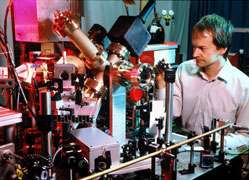
Christian Roos in the lab (Photo: Lackner)

(PhysOrg.com) -- Researchers of the Institute for Quantum Optics and Quantum Information (IQOQI) in Innsbruck, Austria used a calcium ion to simulate a relativistic quantum particle, demonstrating a phenomenon that has not been directly observable so far: the Zitterbewegung. They have published their findings in the current issue of the journal Nature.

In the 1920s was already established and in 1928 the British physicist showed that this theory can be merged with postulated by Albert Einstein. Dirac’s work made applicable to relativistic particles, which move at a speed that is comparable to the speed of light.

The Dirac equation forms the basis for groundbreaking new insights, e.g. it provides a natural description of the electron spin and predicts that each particle also has its antiparticle (anti matter).

In 1930, as a result of the analysis of the Dirac equation, the Austrian Nobel laureate Erwin Schrödinger first postulated the existence of a so called Zitterbewegung (quivering motion), a kind of fluctuation of the motion of a relativistic particle. “According to the Dirac equation such a particle does not move in a linear fashion in a vacuum but ‘jitters’ in all three dimensions,“ Christian Roos from the Institute for and (IQOQI) of the Austrian Academy of Sciences (ÖAW) explains. “It is not clear whether this Zitterbewegung can be observed in real systems in nature.“

Quantum simulation of a particle

Physical phenomena are often described by equations, which may be too complicated to solve. In this case, researchers use computer simulations to answer open questions. However, even for small quantum systems, classical computers have not enough power to manage the processing of the data; thus, scientists, such as Richard Feynman, proposed to simulate these phenomena in other quantum systems experimentally. The preconditions for doing this - detailed knowledge about the physics of these systems and an excellent control over the technology and set-up - have been set by the research group headed by Rainer Blatt by conducting experiments with quantum computers over the last few years; they are now able to carry out quantum simulations experimentally.

“The challenges with these experiments are to recreate the equations in the quantum system well, to have a high level of control over the various parameters and to measure the results,“ Christian Roos says. The experimental physicists of the IQOQI trapped and cooled a and in this well-defined state, a laser coupled the state of the particle and the state of the relativistic particle to be simulated. “Our quantum system was now set to behave like a free relativistic quantum particle that follows the laws of the Dirac equation,“ Rene Gerritsma explains, a Dutch Postdoc working at the IQOQI and first author of the work published in Nature. Measurements revealed the features of the simulated particle. “Thereby, we were able to demonstrate Zitterbewegung in the experimental simulation and we were also able to determine the probability of the distribution of a particle,“ Gerritsma says. In this very small quantum system the physicist simulated the Dirac equation only in one spatial dimension. ”This simulation was a proof-of-principle experiment,“ Roos says, “which, in principle, can also be applied to three-dimensional dynamics if the technological set-up is adjusted accordingly.“

Simulation of antiparticles

Due to the extremely high level of control over the physical regime of the simulated particle, the scientists were able to modify the mass of the object and to simulate antiparticles. “In the end, our approach was very simple but you have to come up with the idea first,“ says Christian Roos, whose team of scientists was inspired by a theoretical proposal of a Spanish group of researchers. The work was supported by the Austrian Science Funds (FWF) and the European Commission.

More information: Quantum simulation of the Dirac equation. Gerritsma R, Kirchmair G, Zähringer F, Solano E, Blatt R, Roos CF. Nature January 7, 2010.

Provided by Austrian Academy of Sciences

4.9 /5 (22 votes)  

Filter


Move the slider to adjust rank threshold, so that you can hide some of the comments.


Display comments: newest first

flaredone
Jan 10, 2010

Rank: not rated yet
It is not clear whether this Zitterbewegung can be observed in real systems in nature

Why not? Neutrino oscillation is an effect of the same category.
frajo
Jan 10, 2010

Rank: 1 / 5 (1)
It is not clear whether this Zitterbewegung can be observed in real systems in nature

Why not? Neutrino oscillation is an effect of the same category.
But only if we assume that the three spatial dimensions and lepton flavors are of the same category.
Rank 4.9 /5 (22 votes)
Related Stories
Relevant PhysicsForums posts
  • Oscilloscope triggering function on aperiodic signals...
    created1 hour ago
  • How can pulleys or levers multiply forces?
    created7 hours ago
  • why higher resistance means more heat produced in a circuit
    created10 hours ago
  • Pascals principle
    created14 hours ago
  • Need help finding origin of an equation
    created14 hours ago
  • Aligning a laser with a single-mode fibre
    created20 hours ago
  • More from Physics Forums - Classical Physics

More news stories

Quantum physicist explains $100K offer for proof scaled-up quantum computing is impossible

(PhysOrg.com) -- MIT researcher Scott Aaronson has certainly riled the physics community with his offer this past Friday, of $100,000 to anyone who can prove that scaled-up quantum computing is impossible. ...

Physics / Quantum Physics

created 7 hours ago | popularity 4.5 / 5 (8) | comments 12 | with audio podcast weblog

Physicists build highly efficient 'no-waste' laser

A team of University of California, San Diego researchers has built the smallest room-temperature nanolaser to date, as well as an even more startling device: a highly efficient, "thresholdless" laser that ...

Physics / General Physics

created 2 hours ago | popularity 5 / 5 (9) | comments 1 | with audio podcast

Transparent iron? For the first time, an experiment shows that atomic nuclei can become transparent

At the high-brilliance synchrotron light source PETRA III, a team of DESY scientists headed by Dr. Ralf Röhlsberger has succeeded in making atomic nuclei transparent with the help of X-ray light. At the ...

Physics / General Physics

created 2 hours ago | popularity 5 / 5 (3) | comments 1 | with audio podcast

Flipping a light switch in the cell: Quantum dots used for targeted neural activation

By harnessing quantum dots—tiny light-emitting semiconductor particles a few billionths of a meter across—researchers at the University of Washington (UW) have developed a new and vastly more targeted ...

Physics / Optics & Photonics

created 4 hours ago | popularity 5 / 5 (2) | comments 0 | with audio podcast

Unusual 'collapsing' iron superconductor sets record for its class

(PhysOrg.com) -- A team from the National Institute of Standards and Technology and the University of Maryland has found an iron-based superconductor that operates at the highest known temperature for a material ...

Physics / Superconductivity

created 7 hours ago | popularity 4 / 5 (2) | comments 1 | with audio podcast


Amasia: As next supercontinent forms, Arctic Ocean, Caribbean will vanish first

(PhysOrg.com) -- Geologists at Yale University have proposed a new theory to describe the formation of supercontinents, the epic process by which Earth’s major continental blocks combine into a single ...

New images capture 'stealth merger' of dwarf galaxies

New images of a nearby dwarf galaxy have revealed a dense stream of stars in its outer regions, the remains of an even smaller companion galaxy in the process of merging with its host. The host galaxy, known ...

Chandra finds Milky Way's black hole grazing on asteroids

(PhysOrg.com) -- The giant black hole at the center of the Milky Way may be vaporizing and devouring asteroids, which could explain the frequent flares observed, according to astronomers using data from NASA's ...

Windows 8 preview set for February 29

Microsoft on Wednesday revealed plans to unveil a test version of its latest Windows computer operating software later this month.

In scientific coup, Russians reach Antarctic lake

After more than two decades of drilling in Antarctica, Russian scientists have reached a gigantic freshwater lake hidden under miles of ice for some 20 million years - a pristine body of water that may hold ...

European Internet campaigners battle ACTA

A controversial international accord billed as a way to beat online piracy has sparked a fightback led by Internet users in ex-communist countries who say the region's past underlines the need to defend freedom.