Scientists reveal Milky Way's magnetic attraction
January 6, 2010
Scientists reveal Milky Way's magnetic attraction

Enlarge

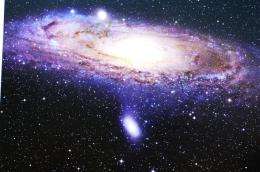
New research shows the Milky Way's magnetic field is far stronger than previously realised. Photo courtesy Stockvault

(PhysOrg.com) -- An international research project involving the University of Adelaide has revealed that the magnetic field in the centre of the Milky Way is at least 10 times stronger than the rest of the Galaxy.

The evidence is significant because it gives astronomers a lower limit on the , an important factor in calculating a whole range of astronomical data.

Researchers from the Max-Planck-Institute for Nuclear Physics, the University of Adelaide, Monash University and the United States have published their findings in Nature this week.

Dr Roland Crocker, the lead author, and Dr David Jones both worked on the project while based at Monash University and the University of Adelaide’s School of Chemistry and Physics. The two physicists are now based at the Max-Planck-Institute for in Heidelberg, Germany.

“This research will challenge current thinking among astronomers,” Dr Crocker says. “For the last 30 years there has been considerable uncertainty of the exact value of the magnetic field in the centre of the Milky Way. The strength of this field enters into most calculations in astronomy, since almost all of space is magnetised,” he says.

Dr Jones says the findings will affect diverse fields, from star formation theory to cosmology.

“If our Galactic centre’s magnetic field is stronger than we thought, this raises additional questions of how it got so strong when fields in the are, in contrast, quite weak. We know now that more than 10% of the Galaxy’s magnetic energy is concentrated in less than 0.1% of its volume, right at its centre,” he says.

Dr Jones completed his PhD at Adelaide, studying the Galactic Centre magnetic field under the supervision of Dr Raymond Protheroe, Associate Professor of Physics at the University of Adelaide, and Dr Crocker, a former postdoctoral researcher at the University.

“The just glows in and in gamma-rays produced by collisions of , and is brightest near its centre. Knowing the magnetic field there helps us understand the source of the radio and gamma-rays better,” says Dr Protheroe.

More information: A 50 uG baseline for the Galactic Centre magnetic field; Roland M. Crocker, David Jones, Fulvio Melia, Jurgen Ott, Raymond J. Protheroe, Nature.

Provided by University of Adelaide (news : web)

4.8 /5 (9 votes)  

Filter


Move the slider to adjust rank threshold, so that you can hide some of the comments.


Display comments: newest first

Auxon
Jan 06, 2010

Rank: 2 / 5 (1)
Would this effect the proposition that most matter is dark matter? If the magnetic field can be at least 10x stronger, wouldn't that mean we are overestimating the mass, since we would be attributing magnetic field effects to gravity?
in7x
Jan 06, 2010

Rank: 1 / 5 (2)
duuuuur. What a shocking surprise for those who have steadfastly ignored electromagnetic phenomenon in space.

Not only stellar formation, but galactic formation.

"This research will challenge current thinking among astronomers"

Time to end the myth of the gravitationally driven cosmos.
omatumr
Jan 10, 2010

Rank: 1 / 5 (3)
Quote: “If our Galactic centre’s magnetic field is stronger than we thought, this raises additional questions of how it got so strong when fields in the early universe are, in contrast, quite weak. We know now that more than 10% of the Galaxy’s magnetic energy is concentrated in less than 0.1% of its volume, right at its centre,” he says.

Reply: The problem is a basic misunderstanding of nuclear material. Hydrogen fusion is not the primary source of nuclear energy.

Nuclear material is dissociating - not fusing - in the Sun and the cosmos :

a.) Neutron repulsion causes dense neutron stars to emit neutrons, => n .

b.) The free neutron decays to a hydrogen atom in about 10 minutes, n => H, and the volume increases by a factor of 1,000,000,000,000,000 !

c.) The Sun and others stars release hydrogen to space (solar wind); Each year the Sun discards 50,000 billion metric ton of Hydrogen.

d.) Hydrogen (a neutron decay product) thus fills the cosmos.

Oliver K. Manuel
brant
Jan 11, 2010

Rank: not rated yet
"
Reply: The problem is a basic misunderstanding of nuclear material. Hydrogen fusion is not the primary source of nuclear energy.

Nuclear material is dissociating - not fusing - in the Sun and the cosmos :

a.) Neutron repulsion causes dense neutron stars to emit neutrons, => n .

b.) The free neutron decays to a hydrogen atom in about 10 minutes, n => H, and the volume increases by a factor of 1,000,000,000,000,000 !

c.) The Sun and others stars release hydrogen to space (solar wind); Each year the Sun discards 50,000 billion metric ton of Hydrogen.

d.) Hydrogen (a neutron decay product) thus fills the cosmos.

Oliver K. Manuel
"

So where does the magnetic field come from?
Rank 4.8 /5 (9 votes)
Related Stories
Relevant PhysicsForums posts
  • Scale of the Universe
    created5 hours ago
  • Titan's lack of impact craters
    createdFeb 09, 2012
  • Real pictures of black hole eating a star?
    createdFeb 08, 2012
  • Hypothetical way to travel faster than light, but not technically exceed lightspeed
    createdFeb 06, 2012
  • How do scientists monitor the Sun's activity?
    createdFeb 05, 2012
  • Search patterns in observational studies
    createdFeb 05, 2012
  • More from Physics Forums - General Astronomy

More news stories

Humans may have helped the decline of African rainforests 3000 years ago

(PhysOrg.com) -- Large areas of rainforests in Central Africa mysteriously disappeared over three thousand years ago, to be replaced by savannas. The prevailing theory has been that the cause was a change ...

Space & Earth / Environment

created 17 hours ago | popularity 4.2 / 5 (9) | comments 11 | with audio podcast report

Could Venus be shifting gear?

(PhysOrg.com) -- ESA’s Venus Express spacecraft has discovered that our cloud-covered neighbour spins a little slower than previously measured. Peering through the dense atmosphere in the infrared, the ...

Space & Earth / Space Exploration

created 13 hours ago | popularity 5 / 5 (7) | comments 7 | with audio podcast

NASA sees wide-eyed cyclone Jasmine

Cyclone Jasmine's eye has opened wider on NASA satellite imagery, as it moves through the Southern Pacific Ocean.

Space & Earth / Earth Sciences

created 5 hours ago | popularity 3.5 / 5 (2) | comments 1

NASA budget will axe Mars deal with Europe: scientists

US President Barack Obama's budget proposal to be submitted next week for 2013 will cut NASA's budget by 20 percent and eliminate a major partnership with Europe on Mars exploration, scientists said Thursday.

Space & Earth / Space Exploration

created 16 hours ago | popularity 5 / 5 (2) | comments 18

Mars Science Laboratory computer issue resolved

(PhysOrg.com) -- Engineers have found the root cause of a computer reset that occurred two months ago on NASA's Mars Science Laboratory and have determined how to correct it.

Space & Earth / Space Exploration

created 14 hours ago | popularity 4.7 / 5 (6) | comments 3 | with audio podcast


Google users warned of threat to smartphone wallets

Users of Google smartphone wallets were being warned on Friday that there is a way to crack pass codes intended to thwart thieves from going on illicit shopping sprees.

Anonymous knocks CIA website offline (Update)

The website of the Central Intelligence Agency was inaccessible on Friday after the hacker group Anonymous claimed to have knocked it offline.

Complex wiring of the nervous system may rely on a just a handful of genes and proteins

Researchers at the Salk Institute have discovered a startling feature of early brain development that helps to explain how complex neuron wiring patterns are programmed using just a handful of critical genes. ...

New error-correcting codes guarantee the fastest possible rate of data transmission

Error-correcting codes are one of the triumphs of the digital age. They’re a way of encoding information so that it can be transmitted across a communication channel — such as an optical fiber o ...

The power of estrogen -- male snakes attract other males

A new study has shown that boosting the estrogen levels of male garter snakes causes them to secrete the same pheromones that females use to attract suitors, and turned the males into just about the sexiest ...

New power source discovered

(PhysOrg.com) -- Researchers at the Massachusetts Institute of Technology (MIT) and RMIT University have made a breakthrough in energy storage and power generation.