Galaxy History Revealed in This Colorful Hubble View (w/ Video)
January 6, 2010
Galaxy History Revealed in This Colorful Hubble View

Enlarge

Credit: NASA, ESA, R. Windhorst, S. Cohen, M. Mechtley, and M. Rutkowski (Arizona State University, Tempe), R. O'Connell (University of Virginia), P. McCarthy (Carnegie Observatories), N. Hathi (University of California, Riverside), R. Ryan (University of California, Davis), H. Yan (Ohio State University), and A. Koekemoer (Space Telescope Science Institute)

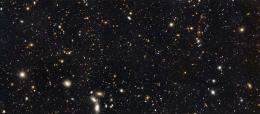
(PhysOrg.com) -- More than 12 billion years of cosmic history are shown in this unprecedented, panoramic, full-color view of thousands of galaxies in various stages of assembly.

This image, taken by NASA's , was made from mosaics taken in September and October 2009 with the newly installed 3 (WFC3) and in 2004 with the Advanced Camera for Surveys (ACS). The view covers a portion of the southern field of a large galaxy census called the Great Observatories Origins Deep Survey (GOODS), a deep-sky study by several observatories to trace the formation and evolution of .

The final image combines a broad range of colors, from the ultraviolet, through visible light, and into the near-infrared. Such a detailed multi-color view of the universe has never before been assembled in such a combination of color, clarity, accuracy, and depth.

This video is not supported by your browser at this time.

Credit: NASA, ESA, and G. Bacon (STScI)

Hubble's sharp resolution and new color versatility, produced by combining data from the two cameras, are allowing astronomers to sort out the various stages of . The image reveals galaxy shapes that appear increasingly chaotic at each earlier epoch, as galaxies grew through accretion, collisions, and mergers. The galaxies range from the mature spirals and ellipticals in the foreground, to smaller, fainter, irregularly shaped galaxies, most of which are farther away, and therefore existed farther back in time. These smaller galaxies are considered the building blocks of the larger galaxies we see today.

Astronomers are using this multi-color panorama to trace many details of galaxy assembly over cosmic time, including the rate in galaxies, the rate of mergers among galaxies, and the abundance of weak .

The image shows a rich tapestry of 7,500 galaxies stretching back through most of the universe's history. The closest galaxies seen in the foreground emitted their observed light about a billion years ago. The farthest galaxies, a few of the very faint red specks, are seen as they appeared more than 13 billion years ago, or roughly 650 million years after the Big Bang. This mosaic spans a slice of space that is equal to about a third of the diameter of the full Moon (10 arcminutes).

The new Hubble view highlights a wide variety of stages in the galaxy assembly process. Ultraviolet light taken by WFC3 shows the blue glow of hot, young stars in galaxies teeming with star birth. The orange light reveals the final buildup of massive galaxies about 8 billion to 10 billion years ago. The near-infrared light displays the red glow of very distant galaxies — in a few cases as far as 12 billion to 13 billion light-years away — whose light has been stretched, like a toy Slinky, from ultraviolet light to longer-wavelength infrared light due to the expansion of the universe.
Galaxy History Revealed in This Colorful Hubble View
Enlarge

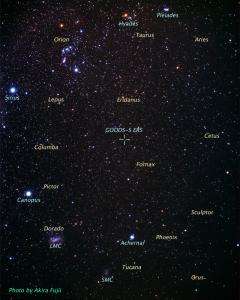
Location of GOODS-S/ERS in the Sky

In this ambitious use of Hubble's observing time, astronomers used 96 Hubble orbits to make the ACS optical observations of this slice of the GOODS field and 104 orbits to make the WFC3 ultraviolet and near-infrared exposures. WFC3 peered deeper into the universe in this study than comparable near-infrared observations from ground-based telescopes. This set of unique new Hubble observations reveals galaxies to about 27th magnitude in brightness over a factor of 10 in wavelength. That's over 250 million times fainter than the unaided eye can see in visual light from a dark ground-based site.

Provided by ESA/Hubble Information Centre (news : web)

4.2 /5 (6 votes)  

Rank 4.2 /5 (6 votes)
Relevant PhysicsForums posts
  • Scale of the Universe
    created7 hours ago
  • Titan's lack of impact craters
    createdFeb 09, 2012
  • Real pictures of black hole eating a star?
    createdFeb 08, 2012
  • Hypothetical way to travel faster than light, but not technically exceed lightspeed
    createdFeb 06, 2012
  • How do scientists monitor the Sun's activity?
    createdFeb 05, 2012
  • Search patterns in observational studies
    createdFeb 05, 2012
  • More from Physics Forums - General Astronomy

More news stories

Humans may have helped the decline of African rainforests 3000 years ago

(PhysOrg.com) -- Large areas of rainforests in Central Africa mysteriously disappeared over three thousand years ago, to be replaced by savannas. The prevailing theory has been that the cause was a change ...

Space & Earth / Environment

created 18 hours ago | popularity 4.2 / 5 (10) | comments 12 | with audio podcast report

Could Venus be shifting gear?

(PhysOrg.com) -- ESA’s Venus Express spacecraft has discovered that our cloud-covered neighbour spins a little slower than previously measured. Peering through the dense atmosphere in the infrared, the ...

Space & Earth / Space Exploration

created 14 hours ago | popularity 5 / 5 (7) | comments 7 | with audio podcast

NASA budget will axe Mars deal with Europe: scientists

US President Barack Obama's budget proposal to be submitted next week for 2013 will cut NASA's budget by 20 percent and eliminate a major partnership with Europe on Mars exploration, scientists said Thursday.

Space & Earth / Space Exploration

created 17 hours ago | popularity 5 / 5 (2) | comments 18

Mars Science Laboratory computer issue resolved

(PhysOrg.com) -- Engineers have found the root cause of a computer reset that occurred two months ago on NASA's Mars Science Laboratory and have determined how to correct it.

Space & Earth / Space Exploration

created 15 hours ago | popularity 4.7 / 5 (6) | comments 3 | with audio podcast

Two new moons for Jupiter

Advances in technology have lead to the discovery of new planets outside of our Solar System, and now even new moons in our own backyard.

Space & Earth / Space Exploration

created 14 hours ago | popularity 4 / 5 (1) | comments 7


Anonymous knocks CIA website offline (Update)

The website of the Central Intelligence Agency was inaccessible on Friday after the hacker group Anonymous claimed to have knocked it offline.

Google users warned of threat to smartphone wallets

Users of Google smartphone wallets were being warned on Friday that there is a way to crack pass codes intended to thwart thieves from going on illicit shopping sprees.

New error-correcting codes guarantee the fastest possible rate of data transmission

Error-correcting codes are one of the triumphs of the digital age. They’re a way of encoding information so that it can be transmitted across a communication channel — such as an optical fiber o ...

Complex wiring of the nervous system may rely on a just a handful of genes and proteins

Researchers at the Salk Institute have discovered a startling feature of early brain development that helps to explain how complex neuron wiring patterns are programmed using just a handful of critical genes. ...

The power of estrogen -- male snakes attract other males

A new study has shown that boosting the estrogen levels of male garter snakes causes them to secrete the same pheromones that females use to attract suitors, and turned the males into just about the sexiest ...

New power source discovered

(PhysOrg.com) -- Researchers at the Massachusetts Institute of Technology (MIT) and RMIT University have made a breakthrough in energy storage and power generation.