Nanodragsters hit the street: Scientists roll agile hot rod out of micro-garage (Update)
January 6, 2010
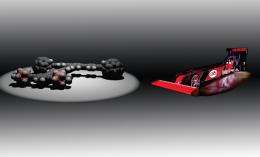
The new "nanodragster" (left) may lead to molecular machines for manufacturing computer circuits and other electronic components. Credit: American Chemical Society
(PhysOrg.com) -- Chemists are getting better at building nanomachines, but Rice researchers continue to race ahead of the pack.
The latest work in a series of molecular machines that began with 2005's nanocar has produced what Rice University scientists James Tour and Kevin Kelly call a nanodragster for its characteristic hot-rod shape, with small wheels on a short axle in the front and large wheels on a long axle in the back.
Their research, reported in the American Chemical Society journal Organic Letters, is another step toward functional nanomachines that can be custom-built and set to work in microelectronics and other applications. Guillaume Vives, a postdoctoral research associate in Tour's lab, and JungHo Kang, a graduate student in the Department of Electrical and Computer Engineering, co-authored the paper.
What those wheels are made of matters most. Early nanocars rolled on simple carbon 60 molecules, aka buckyballs. But they were a drag, literally, as they would only turn on a gold surface in high heat, about 200 degrees Celsius.
Tour, Rice's T.T. and W.F. Chao Chair in Chemistry and a professor of mechanical engineering and materials science and of computer science, and his team found in previous research that wheels made of p-carborane, a cluster of carbon and boron atoms, operate at much lower temperatures. But they're more difficult to image with a scanning tunneling microscope because of their much weaker interaction with metallic surfaces.
The key to making nanodragsters, Tour said, was putting p-carborane wheels in the front and buckyballs in the back, getting the advantages of both. The front wheels roll easier, while the buckyballs grip the gold roadway well enough to be imaged by Kelly, an associate professor in the Department of Electrical and Computer Engineering at Rice. And the vehicle operates at a much lower temperature than previous nanovehicles.
"The trick to making these nanocars was to attach the smaller wheels first, then deactivate their reactive ends through carbon group attachments that we called 'scythes,' much like blades on the centers of classical chariot wheels," Tour said. "Then we could affix the larger C60 wheels to the rear axle."
The tiny hot rod, 1/25,000th the width of a human hair, has a chassis that rotates freely and allows the car to turn when one front wheel or the other is lifted, a behavior not seen in previous nanocars. Much to the researchers' amusement, in several of the images the nanodragsters appear to be "popping wheelies" with both front wheels raised off the surface, just like real dragsters at the start of a race.
Imaging at different temperatures to better understand the energy barriers associated with moving nanovehicles is not discussed in this paper, but the researchers are undertaking such work both on the original gold surfaces and on glass and other substrates. Obtaining greater control of their motion is also the subject of ongoing research.
More information: "Molecular Machinery: Synthesis of a 'Nanodragster'", http://pubs.acs.or … 21/ol902312m
-
Turning an axel mounted molecular wheel
Jan 23, 2007 |
not rated yet |
0
-
Nanocar inventor named Top Nanotech Innovator
Sep 21, 2006 |
not rated yet |
0
-
Molecular machines drive plasmonic nanoswitches
Feb 11, 2009 |
not rated yet |
0
-
Toward 'invisible electronics' and transparent displays
Feb 05, 2009 |
not rated yet |
0
-
Rice University rolls out new nanocars (Videos)
Feb 02, 2009 |
not rated yet |
0
-
Engineers build first sub-10-nm carbon nanotube transistor
Feb 01, 2012 |
4.9 / 5 (29) |
30
-
Something old, something new: Evolution and the structural divergence of duplicate genes
Jan 31, 2012 |
4.6 / 5 (7) |
1
-
The hidden nanoworld of ice crystals: Revealing the dynamic behavior of quasi-liquid layers
Jan 30, 2012 |
5 / 5 (3) |
1
-
Stock market network reveals investor clustering
Jan 27, 2012 |
4 / 5 (22) |
8
-
Of microchemistry and molecules: Electronic microfluidic device synthesizes biocompatible probes
Jan 26, 2012 |
5 / 5 (1) |
0
-
Output of xrd analysis
13 hours ago
-
Transport phenomena problem based on problems 18.B11 and 19B.6 from Bird, stewart, lw
Feb 06, 2012
-
Help with material selection - Car Piston
Feb 05, 2012
-
Name of the steel alloy?!!?
Feb 02, 2012
-
Heating and Annealing Temp/Times of PMMA and Polypropylene and
Feb 01, 2012
-
information about photocorrosin
Jan 30, 2012
- More from Physics Forums - Materials & Chemical Engineering
More news stories
New kind of solar cell could capture significantly more energy than current cells
New solar cells could increase the maximum efficiency of solar panels by over 25%, according to scientists from the University of Cambridge.
5 hours ago |
4.8 / 5 (5) |
9
|
Revealing how a battery material works
Since its discovery 15 years ago, lithium iron phosphate (LiFePO4) has become one of the most promising materials for rechargeable batteries because of its stability, durability, safety and ability to deliver ...
Nanotechnology / Nanomaterials
10 hours ago |
5 / 5 (4) |
0
|
Will bubble-powered microrockets zoom through the human stomach?
Scientists have developed a new kind of tiny motor which they term a "microrocket" that can propel itself through acidic environments, such as the human stomach, without any external energy source, ...
Nanotechnology / Nanomaterials
4 hours ago |
not rated yet |
0
'Shish kebab' structure provides improved form of 'buckypaper'
Scientists are reporting development of a new form of buckypaper, which eliminates a major drawback of these sheets of carbon nanotubes -- 50,000 times thinner than a human hair, 10 times lighter than steel, ...
Nanotechnology / Nanomaterials
3 hours ago |
not rated yet |
0
|
Nanoshell whispering galleries improve thin solar panels
Visitors to Statuary Hall in the U.S. Capitol Building may have experienced a curious acoustic feature that allows a person to whisper softly at one side of the cavernous, half-domed room and for another on ...
Nanotechnology / Nanomaterials
Feb 07, 2012 |
4.2 / 5 (5) |
6
|
New images capture 'stealth merger' of dwarf galaxies
New images of a nearby dwarf galaxy have revealed a dense stream of stars in its outer regions, the remains of an even smaller companion galaxy in the process of merging with its host. The host galaxy, known ...
Chandra finds Milky Way's black hole grazing on asteroids
(PhysOrg.com) -- The giant black hole at the center of the Milky Way may be vaporizing and devouring asteroids, which could explain the frequent flares observed, according to astronomers using data from NASA's ...
Windows 8 preview set for February 29
Microsoft on Wednesday revealed plans to unveil a test version of its latest Windows computer operating software later this month.
In scientific coup, Russians reach Antarctic lake
After more than two decades of drilling in Antarctica, Russian scientists have reached a gigantic freshwater lake hidden under miles of ice for some 20 million years - a pristine body of water that may hold ...
European Internet campaigners battle ACTA
A controversial international accord billed as a way to beat online piracy has sparked a fightback led by Internet users in ex-communist countries who say the region's past underlines the need to defend freedom.
Phelps using hyperbaric chamber to aid recovery
(AP) -- Michael Phelps is the latest athlete to use a hyperbaric chamber to aid his recovery from training.