Astronomers unveil images of 12-billion-year-old space nursery
January 6, 2010
Astronomers unveil images of 12-billion-year-old space nursery

Enlarge

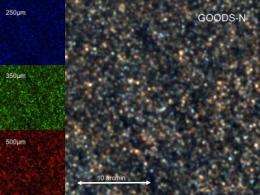
The SPIRE camera has three arrays operating at different wavelengths and the image from each of these is rendered in red, blue or green. Then the three images are combined to form a single false color image. Credit: Gaelen Marsden, University of British Columbia

A University of British Columbia astronomer has produced the most detailed images of deep space from 12 billion years ago, using data from the European Space Agency's Herschel Space Observatory.

Recently presented at the first International Herschel Science Meeting in Madrid, Spain, the images by UBC post-doctoral fellow Gaelen Marsden reveal tens of thousands of newly-discovered galaxies at the early stages of formation - just one billion years after the Big Bang, when the Universe was a thriving nursery of newly-formed stars.

"These images allow us to see 10 times more galaxies than ever before and with stunning clarity," says Marsden, who has spent the past few years working on similar but lower-resolution images from previously collected data.

"It is incredibly rewarding to see the high sensitivity and resolution that the new Herschel data have enabled. They allow us to take a close look at the stars during early and vital stages of formation, and could change the way we study formation in the future."

Herschel is the largest and most expensive ever built. It is equipped with three infrared cameras: SPIRE, PACS and HIFI. Herschel was successfully launched on May 14, 2009 aboard an Ariane-5 rocket from Europe's spaceport in French Guiana, for a two-month trip to its observation point, some 1.5 million kilometres above Earth.

Data collected by Herschel are being analysed by the programme's biggest research project, the Herschel Multi-tiered Extragalactic Survey (HerMES). The project consists of more than 100 astronomers from six countries, including UBC Astronomy Professors Mark Halpern and Douglas Scott and post-doctoral fellows Ed Chapin, Gaelen Marsden, Elisabetta Valiante and Don Wiebe.

The HerMES project aims to produce a map of the Universe as it was as far back as 12 billion years ago and is expected to discover hundreds of thousands of new galaxies at early stages of their formation. The first results from the HerMES survey come from the SPIRE camera, in which Canadians are involved through the support of the Canadian Space Agency (CSA).

The SPIRE is capable of peering into the coldest dust clouds to see the most distant sites of star formation. Its three filters allow for a colour composite image to be made, where the colour indicates the temperature of the region. This allows astronomers to learn about the physical conditions in some of the most distant sites of star formation and untangle the mysteries of how the first stars formed.

"Seeing such stunning images after just 14 hours of observations gives us high expectations for the full length observations over much larger regions of the Universe," says Seb Oliver, a U.K. lead in the project. "This will give us a much clearer idea of how star formation has progressed throughout the history of the Universe."

This survey was preceded by the successful BLAST project, the Antarctic balloon experiment that inspired a full-length documentary "BLAST! The Movie." BLAST used a replica of the SPIRE camera and provided a glimpse of what was to come.

"While BLAST provided exciting results, the ability to go into space for an extended period of time allows for much more ambitious surveys of the distant Universe," says UBC's Douglas Scott, part of the CSA-funded UBC BLAST team. "The Herschel telescope has the biggest mirror to be launched into space, and this provides images which are less blurred than those collected by BLAST."

A major goal of the Herschel mission is to discover how galaxies were formed and how they evolved to give rise to present-day galaxies like our own Milky Way Galaxy. Professors Halpern and Scott of UBC's Department of Physics & Astronomy are experts in understanding galaxy formation through using far-infrared, millimetre wavelength and microwave radiation and will actively participate in the HerMES project as it produces more results.

"We chose to feature these images first because they show what we believe is the most important result in the initial science release of this satellite - and the key to the early star formation history of the Universe," says Halpern.

Background

The Universe is estimated at 13.7 billion years old. Light observed from these images took 12 billion years to reach us at 300,000 kilometres per second.

SPIRE is one of three instruments on the Herschel . The SPIRE camera operates across three wavelength bands centred on 0.25, 0.35 and 0.5 mm. SPIRE is a UK-led instrument, with an instrument consortium consisting of institutions in many countries, including the University of Lethbridge in Canada, and with a science team involving researchers at Lethbridge, and the Universities of British Columbia, Calgary, McMaster, Toronto and Victoria.

Herschel Multi-tiered Extragalactic Survey (HerMES) is the largest of Herschel's Key Programmes, with 900 hours of observation currently allocated, and is carried out by the SPIRE High-redshift Specialist Astronomy Group. HerMES will map large regions of the sky using cameras that are sensitive to infrared radiation, and is expected to discover over 100,000 galaxies. The light from most of these galaxies will have taken more than 10 billion years to reach us, which means we would see them as they were three or four billion years after the Big Bang. Since the cameras are detecting infrared radiation they see star formation that is hidden from conventional telescopes. It is expected that the SPIRE cameras will catch many of the galaxies at the moment they are forming most of their stars.

Provided by University of British Columbia (news : web)

4.6 /5 (15 votes)  

Filter


Move the slider to adjust rank threshold, so that you can hide some of the comments.


Display comments: newest first

SincerelyTwo
Jan 06, 2010

Rank: 5 / 5 (1)
I asked this question on another story, but it's actually far more relevant to ask here;

Would it be possible for us to see the big bang explosion?

Just how far back is it possible for us to see? I imagine the light from the explosion of the big bang is in the distance somewhere, right? Everything flew ahead of the explosion at faster than the speed of light, according to random things I've read around the net. That's how it's possible for us to create images like this... or?
antialias_physorg
Jan 06, 2010

Rank: 5 / 5 (3)
Would it be possible for us to see the big bang explosion?


No, because shortly after the big bang temperatures were too high. Atoms had not fromed yet and the then existent plasma state absorbed electromagnetic radiation of all types (effectively rendering this state opaque).

Unless we find another way of looking at the universe (i.e. not by catching photons) it is unlikely we will be able to 'see' the big bang itself.
Donutz
Jan 06, 2010

Rank: 5 / 5 (1)
Unless we find another way of looking at the universe (i.e. not by catching photons) it is unlikely we will be able to 'see' the big bang itself.

Read 'The Light of Other Days' by Steven Baxter and Arthur C Clarke for one 'possible' way. That's my favorite book of all time.

GaryB
Jan 07, 2010

Rank: not rated yet
All we would see is some grad student switching on simulation machine.
Donutz
Jan 07, 2010

Rank: not rated yet
All we would see is some grad student switching on simulation machine.


Bwaaa hahah!
vmircea
Jan 09, 2010

Rank: not rated yet
How old are this galaxy discoverd by the Herschel telescope? If they are 12 bilion years than they shood be very young without heavy elements... if they discover heavy elements such as iron than the universe is much older and biger perhaps infinit.
RubberBaron
Jan 09, 2010

Rank: 5 / 5 (2)
We can see back to close to the Big Bang if ever gravitational wave telescopes take off.
Zenmaster
Jan 10, 2010

Rank: 1 / 5 (1)
We merely assume these objects are young, in order to fit a system of theory based on pure invention.
bluehigh
Jan 11, 2010

Rank: not rated yet
Hopefully in a few years with a further set of images, be able to detect relative motion. Then extrapolate the positions of where they are NOW. As the light from these objects in current locations will not reach us for another 12 billion years we will be completely unable to detect them NOW. However, we prove that information can travel much faster than light across huge distances and immense time - we could know where they are NOW.
Rank 4.6 /5 (15 votes)
Related Stories
Relevant PhysicsForums posts
  • Scale of the Universe
    created8 hours ago
  • Titan's lack of impact craters
    createdFeb 09, 2012
  • Real pictures of black hole eating a star?
    createdFeb 08, 2012
  • Hypothetical way to travel faster than light, but not technically exceed lightspeed
    createdFeb 06, 2012
  • How do scientists monitor the Sun's activity?
    createdFeb 05, 2012
  • Search patterns in observational studies
    createdFeb 05, 2012
  • More from Physics Forums - General Astronomy

More news stories

Humans may have helped the decline of African rainforests 3000 years ago

(PhysOrg.com) -- Large areas of rainforests in Central Africa mysteriously disappeared over three thousand years ago, to be replaced by savannas. The prevailing theory has been that the cause was a change ...

Space & Earth / Environment

created 18 hours ago | popularity 4.3 / 5 (11) | comments 12 | with audio podcast report

Could Venus be shifting gear?

(PhysOrg.com) -- ESA’s Venus Express spacecraft has discovered that our cloud-covered neighbour spins a little slower than previously measured. Peering through the dense atmosphere in the infrared, the ...

Space & Earth / Space Exploration

created 14 hours ago | popularity 5 / 5 (7) | comments 7 | with audio podcast

NASA budget will axe Mars deal with Europe: scientists

US President Barack Obama's budget proposal to be submitted next week for 2013 will cut NASA's budget by 20 percent and eliminate a major partnership with Europe on Mars exploration, scientists said Thursday.

Space & Earth / Space Exploration

created 17 hours ago | popularity 5 / 5 (2) | comments 18

Mars Science Laboratory computer issue resolved

(PhysOrg.com) -- Engineers have found the root cause of a computer reset that occurred two months ago on NASA's Mars Science Laboratory and have determined how to correct it.

Space & Earth / Space Exploration

created 15 hours ago | popularity 4.7 / 5 (6) | comments 3 | with audio podcast

NASA sees wide-eyed cyclone Jasmine

Cyclone Jasmine's eye has opened wider on NASA satellite imagery, as it moves through the Southern Pacific Ocean.

Space & Earth / Earth Sciences

created 6 hours ago | popularity 3.5 / 5 (2) | comments 1


Google users warned of threat to smartphone wallets

Users of Google smartphone wallets were being warned on Friday that there is a way to crack pass codes intended to thwart thieves from going on illicit shopping sprees.

Anonymous knocks CIA website offline (Update)

The website of the Central Intelligence Agency was inaccessible on Friday after the hacker group Anonymous claimed to have knocked it offline.

New error-correcting codes guarantee the fastest possible rate of data transmission

Error-correcting codes are one of the triumphs of the digital age. They’re a way of encoding information so that it can be transmitted across a communication channel — such as an optical fiber o ...

Complex wiring of the nervous system may rely on a just a handful of genes and proteins

Researchers at the Salk Institute have discovered a startling feature of early brain development that helps to explain how complex neuron wiring patterns are programmed using just a handful of critical genes. ...

New power source discovered

(PhysOrg.com) -- Researchers at the Massachusetts Institute of Technology (MIT) and RMIT University have made a breakthrough in energy storage and power generation.

The power of estrogen -- male snakes attract other males

A new study has shown that boosting the estrogen levels of male garter snakes causes them to secrete the same pheromones that females use to attract suitors, and turned the males into just about the sexiest ...