Neuroengineers silence brain cells with multiple colors of light
January 6, 2010
Neuroengineers silence brain cells with multiple colors of light

Enlarge

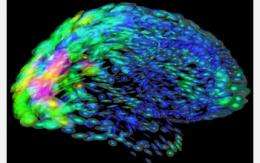
Neuroscientists at the Massachusetts Institute of Technology in Cambridge, Mass., recently developed a way to turn off abnormally active brain cells using multiple colors of light. This research could prove useful for managing disorders including chronic pain, epilepsy, brain injury and Parkinson's disease. The brain mapping in this image represents collaboration between neuroscientists and experts in math, statistics, computer science, bioinformatics, imaging and nanotechnology. Credit: Arthur Toga, Laboratory of Neuro Imaging, Department of Neurology, UCLA School of Medicine

(PhysOrg.com) -- Neuroscientists at MIT have developed a powerful new class of tools to reversibly shut down brain activity using different colors of light. When targeted to specific neurons, these tools could potentially lead to new treatments for the abnormal brain activity associated with disorders such as chronic pain, epilepsy, brain injury, and Parkinson's disease.

The tools work on the principle that such disorders might be best treated by silencing, rather than stimulating, . These "super silencers" exert exquisite control over the timing of the shutdown of overactive neural circuits - an effect that's impossible with existing drugs or other conventional therapies.

"Silencing different sets of neurons with different colors of light allows us to understand how they work together to implement brain functions," explains Ed Boyden, senior author of the study, to be published in the Jan. 7 issue of Nature. "Using these new tools, we can look at two neural pathways and study how they compute together. These tools will help us understand how to control neural circuits, leading to new understandings and treatments for - some of the biggest unmet medical needs in the world." Boyden is the Benesse Career Development Professor in the MIT Media Lab and an associate member of the McGovern Institute for Brain Research at MIT.

Boyden's super silencers are developed from two genes found in different natural organisms such as bacteria and fungi. These genes, called Arch and Mac, encode for light-activated proteins that help the organisms make energy. When neurons are engineered to express Arch and Mac, researchers can inhibit their activity by shining light on them. Light activates the proteins, which lowers the voltage in the neurons and safely and effectively prevents them from firing. In this way, light can bathe the entire brain and selectively affect only those neurons sensitized to specific colors of light. Neurons engineered to express Arch are specifically silenced by yellow light, while those expressing Mac are silenced by blue light.

"In this way the brain can be programmed with different colors of light to identify and possibly correct the corrupted neural computations that lead to disease," explains co-author Brian Chow, postdoctoral associate in Boyden's lab.

In 2005, Boyden, in collaboration with investigators at Stanford University and the Max Planck Institute, introduced the first such "optogenetic" technique, so called because it combines the use of optics with gene delivery. The 2005 tool, now widely used, involves a light-activated ion channel, ChR2, which allows light to selectively turn on neurons in the brain.

Two years later, Boyden demonstrated that halorhodopsin, another light-sensitive protein, could inhibit the activity of neurons when illuminated. "But the genomic diversity of the world suggested that more powerful tools were out there waiting to be discovered," Boyden says. His group accordingly screened a diverse set of microbial light-sensitive proteins, and found the new multicolor silencers. The newly discovered tools are much better than the old. Arch-expressing neurons were switched off with greater precision and recovered faster than halorhodopsin-expressing neurons, allowing researchers to manipulate different neurons with different colors of light.
Neuroengineers silence brain cells with multiple colors of light
Enlarge

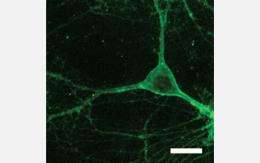
To test whether neurons could be turned off using specific proteins, MIT researchers inserted "Arch" and "Mac" genes into viruses. The viruses then inserted their genetic cargo into mouse neurons. Optical fibers attached to lasers flashed light onto the neurons, and electrodes measured the resulting neural activity. Here, a mouse neuron takes on the characteristics of an Arch gene. Credit: Image courtesy Brian Chow, Xue Han, and Ed Boyden

"Multicolor silencing dramatically increases the complexity with which you can study neural circuits," says co-author Xue Han, postdoctoral researcher in Boyden's lab. "We will use these tools to parse out the neural mechanisms of cognition."

MIT researchers loaded the Arch and Mac genes into viruses that inserted their genetic cargo into mouse neurons. Optical fibers attached to lasers flashed light onto the , and electrodes measured the resulting neural activity.

Boyden's team recently demonstrated the efficacy of ChR2 in monkeys with no apparent side effects. Determining whether Arch and Mac are safe and effective in monkeys will be a critical next step toward the potential use of these optical silencing tools in humans. Boyden plans to use these super silencers to examine the neural circuits of cognition and emotion and to find targets in the brain that, when shut down, could relieve pain and treat epilepsy. His group continues to mine the natural world for new and even more powerful tools to manipulate brain cell activity - tools that, he hopes, will empower scientists to explore neural circuits in ways never before possible.

More information: "High-Performance Genetically-Targetable Optical Neural Silencing by Light-Driven Proton Pumps," Chow BY, Han X, Dobry AS, Qian X, Chuong AS, Li M, Henninger MA, Belfort GM, Lin Y, Monahan PE, Boyden ES. Nature Jan 7 2010.

Provided by Massachusetts Institute of Technology (news : web)

4.5 /5 (12 votes)  

Filter


Move the slider to adjust rank threshold, so that you can hide some of the comments.


Display comments: newest first

Rohitasch
Jan 06, 2010

Rank: not rated yet
How is it determined as to where the genes corresponding to a particular colour end up?
GrahamRounce
Jan 09, 2010

Rank: not rated yet
Sounds silly but... how do they get the light inside the brain?
Rank 4.5 /5 (12 votes)
Relevant PhysicsForums posts
  • Is Everyday Technology Killing Us?
    createdFeb 08, 2012
  • Exercise and weight loss
    createdFeb 08, 2012
  • Why do we have head aches? Our brains can't feel anything.
    createdFeb 07, 2012
  • "The end of diseases" by David Agus, interview from Daily Show with Jon Stewart
    createdFeb 04, 2012
  • Oncolytic adenovirus
    createdFeb 04, 2012
  • Nutrition label stuffs and diets
    createdFeb 02, 2012
  • More from Physics Forums - Medical Sciences

More news stories

Complex wiring of the nervous system may rely on a just a handful of genes and proteins

Researchers at the Salk Institute have discovered a startling feature of early brain development that helps to explain how complex neuron wiring patterns are programmed using just a handful of critical genes. ...

Medicine & Health / Research

created 5 hours ago | popularity 4.9 / 5 (8) | comments 0 | with audio podcast

Both maternal and paternal age linked to autism

Older maternal and paternal age are jointly associated with having a child with autism, according to a recently published study led by researchers at The University of Texas Health Science Center at Houston (UTHealth).

Medicine & Health / Psychology & Psychiatry

created 10 hours ago | popularity 4 / 5 (2) | comments 0 | with audio podcast

New understanding of DNA repair could eventually lead to cancer therapy

A research group in the Faculty of Medicine & Dentistry at the University of Alberta is hoping its latest discovery could one day be used to develop new therapies that target certain types of cancers.

Medicine & Health / Cancer

created 9 hours ago | popularity 4.8 / 5 (4) | comments 0 | with audio podcast

Curry spice component may help slow prostate tumor growth

Curcumin, an active component of the Indian curry spice turmeric, may help slow down tumor growth in castration-resistant prostate cancer patients on androgen deprivation therapy (ADT), a study from researchers ...

Medicine & Health / Cancer

created 11 hours ago | popularity 4.5 / 5 (6) | comments 0 | with audio podcast

Human cognitive performance suffers following natural disasters, researchers find

Not surprisingly, victims of a natural disaster can experience stress and anxiety, but a new study indicates that it might also cause them to make more errors - some serious - in their daily lives. In their upcoming Human Fa ...

Medicine & Health / Psychology & Psychiatry

created 7 hours ago | popularity 4 / 5 (1) | comments 0


Google users warned of threat to smartphone wallets

Users of Google smartphone wallets were being warned on Friday that there is a way to crack pass codes intended to thwart thieves from going on illicit shopping sprees.

Anonymous knocks CIA website offline (Update)

The website of the Central Intelligence Agency was inaccessible on Friday after the hacker group Anonymous claimed to have knocked it offline.

New error-correcting codes guarantee the fastest possible rate of data transmission

Error-correcting codes are one of the triumphs of the digital age. They’re a way of encoding information so that it can be transmitted across a communication channel — such as an optical fiber o ...

The power of estrogen -- male snakes attract other males

A new study has shown that boosting the estrogen levels of male garter snakes causes them to secrete the same pheromones that females use to attract suitors, and turned the males into just about the sexiest ...

Putting the squeeze on planets outside our solar system

(PhysOrg.com) -- Using high-powered lasers, scientists at Lawrence Livermore National Laboratory and collaborators discovered that molten magnesium silicate undergoes a phase change in the liquid state, abruptly ...

Humans may have helped the decline of African rainforests 3000 years ago

(PhysOrg.com) -- Large areas of rainforests in Central Africa mysteriously disappeared over three thousand years ago, to be replaced by savannas. The prevailing theory has been that the cause was a change ...